Archive for the ‘Uncategorized’ Category
Tokyo: Industrial Landscape Tourism
“Factory infatuation” maybe a thing?
Yesterday’s post drew a comparison between liminal spaces and the work that happens in a good conversation: how we help each other explore a topic, which often opens a route to a conclusion and even action.
Along the way I confessed that I am drawn to those more industrial parts of the city. Artist Michael Banning said that particular bent is starting to look like a thing people do. At least in Tokyo. He pointed me toward this:
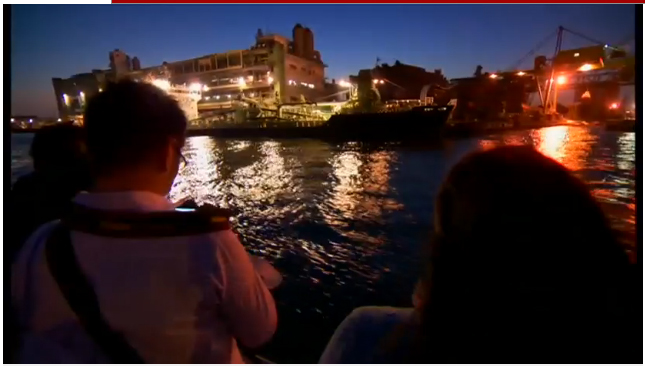
Click to play.
###
Via BBC World News
Let’s Get Liminal: How to be a Co–Laborer/Co-Thinker/Co-Contributor
Show up to explore the space between
My friend helps researchers at his Midwestern university organize their thoughts for publication. He also helps them apply for grants to fund their research—a function many universities are increasingly focused on.
To do this work, my friend has found ways to walk alongside new professors as they form their research interests. By staying beside them over time (years, even), he is able to help identify places where the work can go forward and also begin to locate potential funding sources. That’s when the hard work begins of explaining the research to a funding committee.

Approaches to Minneapolis
This space between—where the research shows particular promise but is still unformed—this is where a conversation can bear fruit. Maybe even the goal itself is starting to take shape, along with possible routes to that desired end. Sometimes it is the conversations surrounding the goal and routes to the goal that open it for exploration.
Michael Banning is an observer and painter of liminal spaces—those spaces and places that we typically don’t even see:
I am interested in the liminal spaces found at the edges of the inner city. Amid the trucks, weeds and railroad tracks of those often post-industrial surroundings, one can find compelling views of the distant skyline as well as a sense of peace and quiet uncommon in the urban experience.
–“Parking Lot near Train Tracks,” by Michael Banning, label from James J. Hill House Gallery
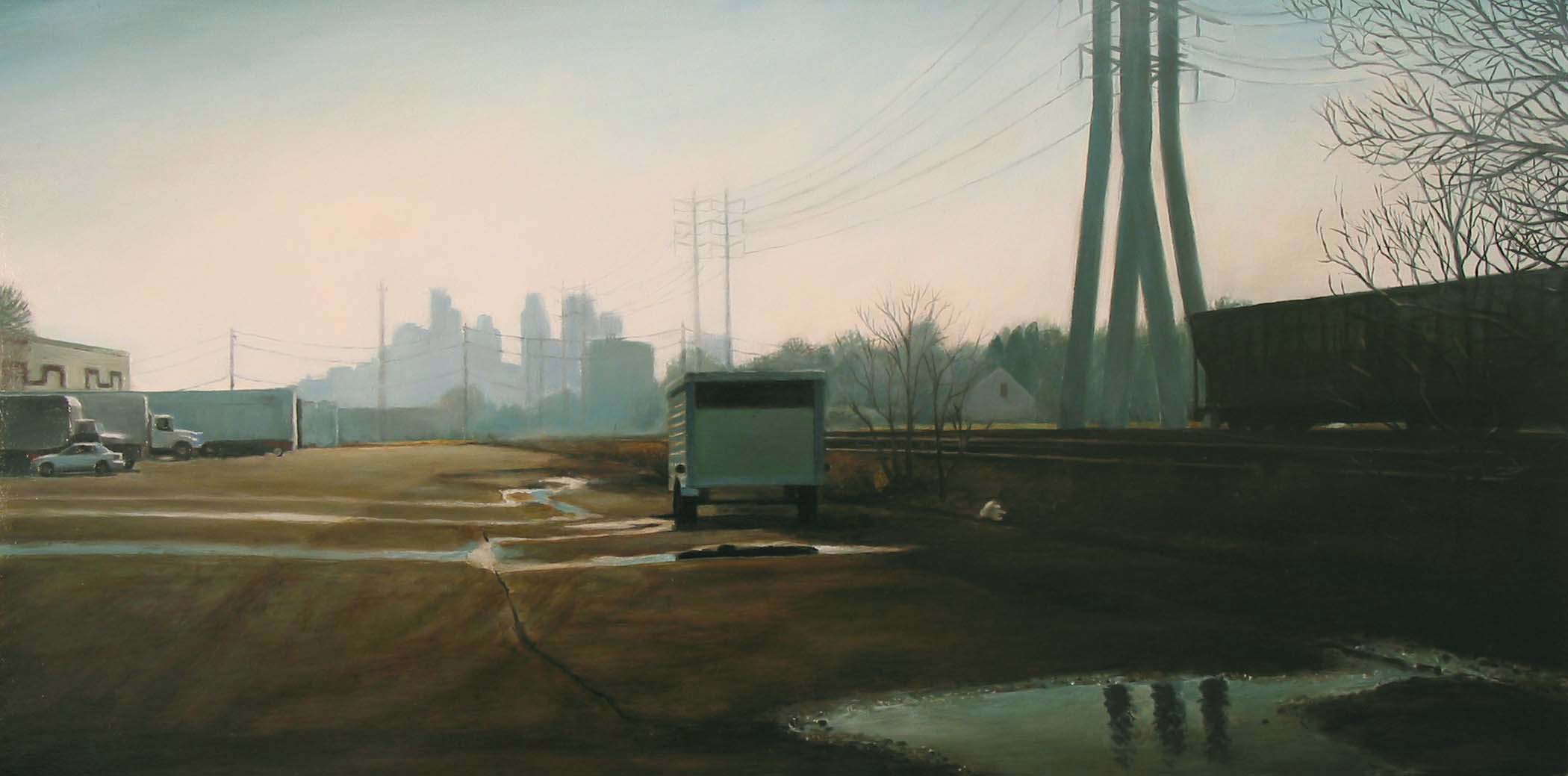
Parking Lot near Train Tracks (Photo courtesy Michael Banning)
See Michael Banning’s work here.
When we are lucky enough to find ourselves talking about these liminal spaces with each other, we might be collaborating in a particularly effective way. Typically we don’t have a clue when we’ve entered such a verbal space. Years later we might identify a conversation that was a turning point. Perhaps the best we can do is to remain open to entertaining each other’s unformed thoughts.
Who knows what might result?
###
Image credit: Kirk Livingston
Pearls Before Swine: The World According to the Supreme Court
Stephen Pastis helps us wonder aloud.
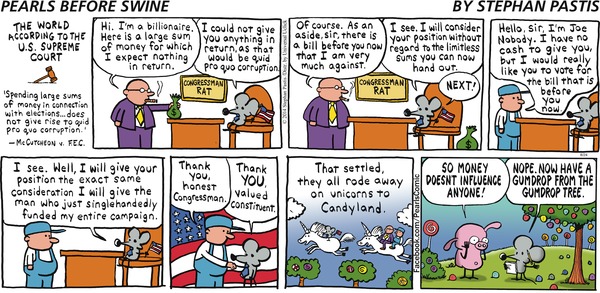
That seems right: “So money doesn’t influence anyone!”
###
How To Talk Like Superman
Please, put the cape away.
Not so much the cartoon character, but think of the raconteur who magnetizes with stories and wit and rhythm. Or think of the person you go to when trying to sort some thorny issue. These are the people you find entertaining or interesting at least partly because they listen to you. And partly because you hear something useful from them.

That’s how to talk like superman: listen closely to what someone is saying and then respond with stories and probing questions that drill down a bit—staying focused on what you heard. To the person you are talking with, you just may be summoning superpowers. That’s because we never know when a casual word may be the linchpin that connects two or three sets of thoughts that set a life in motion.
We all have stories like this: the guy we talked with casually at the end of a club meeting mentioned a guy to talk with at the company we were interested in. We talk with that guy and he mentions someone else in the company…and then you find yourself in the company. Your online application and discussions with HR led nowhere, but a few conversations with the right people and you are in.
David Rock’s Quiet Leadership offers solid pointers about gathering the superpower of helping others learn what they already know. He shows how to help people make connections.
Please use your superpowers for good today.
###
Image credit: Kirk Livingston
Today’s U.S. Mass Shooting: What To Do?
Yesterday it was Seattle Pacific University. Today: a town near you?
What could we possibly do to prevent shootings?
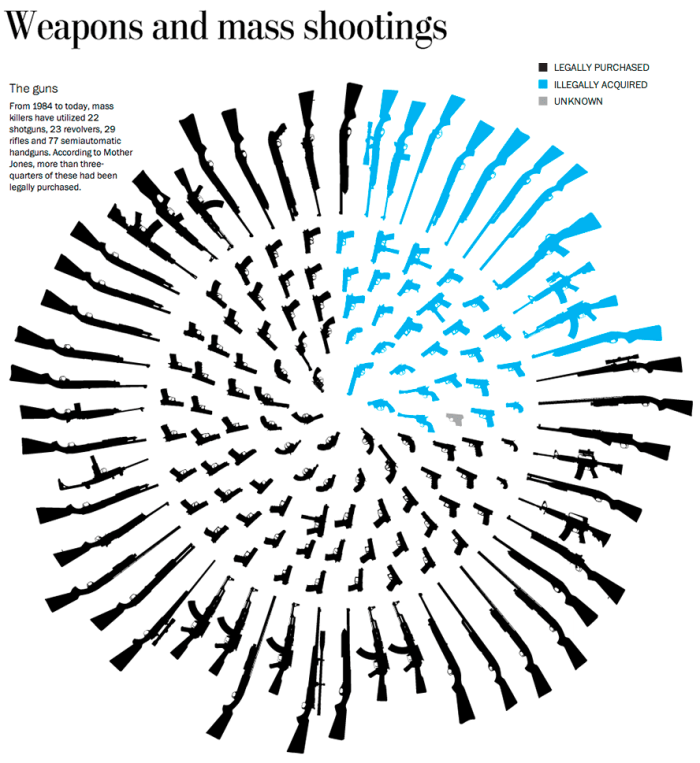
Nothing comes to mind.
There’s just nothing we can do.
What a puzzle.
Postscript: Oh. Wait. What if we made it really difficult to legally get assault weapons? Would 75% of the pie chart above be gone?
###
Best Work Direction Ever: “Avoid giving the impression of diligence…,”
Said the boss to the worker:

Hermann Hesse, The Glass Bead Game (Magister Ludi) (Holt, Rinehart, Winston, 1969) 158.
###
Image Credit: Kirk Livingston
Copywriting Tip #1: Love the Study
As an undergrad studying the general courses before getting into the nuts and bolts of my major, I typically looked for the easiest way to get homework done. I wanted to spend as little time on it as possible. Homework simply was not that interesting.
But in my major, that notion got turned on its head: I wanted to spend as much time as I could gather because the topics were fascinating. Becoming fascinated and digging deeply are prerequisites to making something remarkable to someone else.
Making something remarkable is the work of the copywriter.
We’re at the threshold of another copywriting class so I am bringing back this older post to get at why it is critical we go deeper than first impressions. We all want to take the easiest path, but the easy or obvious solution—the one you developed because you waited too long to start the assignment and it is now due—is not the one you’ll want to show someone else.
“Easy” and “obvious” do not produce remarkable results.Remarkable requires going deep.
###

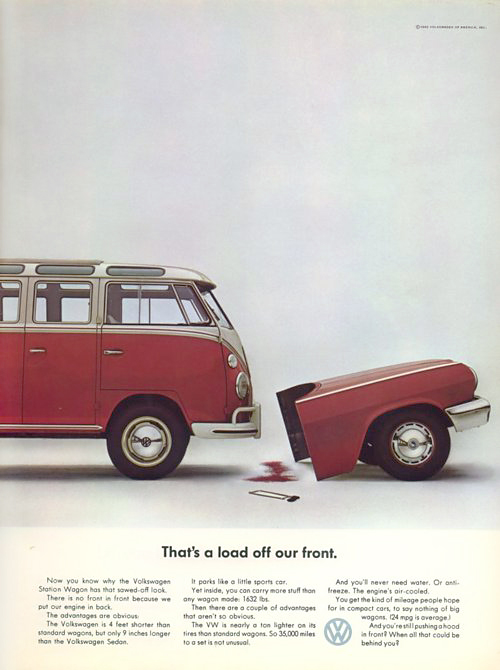 In Freelance Copywriting (Eng3316) we’ve started producing work in earnest and every week (including tomorrow) another student piece moves into their portfolio. All the students have signed up for work they’ve never tried before—ad concepts, radio scripts instructional booklets, and many other forms. All according to where their writing passions are leading them.
One thing I love about copywriting is learning new stuff. Whether it’s asking a doctor questions during brain surgery or watching a silicon wafer get doped and fired or learning about the medicines Lewis and Clark used (forced marches and blood-letting seemed to resolve a lot of their ailments). There is no end to fascination with how the world works. Putting what I learned into words (and images) electrifies the whole task: spooling out my argument and helping show why anyone would care what the patient said while the doctor probed his frontal lobe, or why ramping…
View original post 184 more words
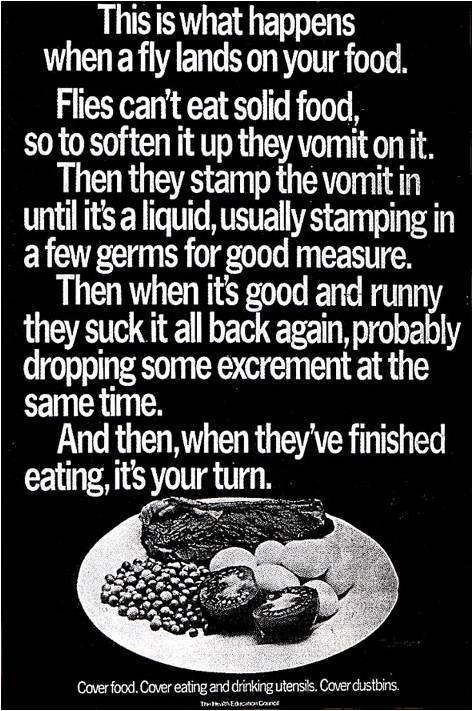
Challenge: Get People To Cover Their Dinner. Tools: 73 words.
Let us revisit the sordid picture of the dining fly.
Is blogging bad for writing?
Thoughtful reflection from bottledworder on how blogging helps develop good writing, and perhaps where it does not.

 Do you want to become a good writer? Keep writing! Practice makes perfect.
Or does it?
Keep writing is usually the advice new writers are given to help them launch a journey onto the uncharted waters of how to write well, a practice that doesn’t usually have any proven rules of success although there’s plenty of advice going around.
I realized that as in every good thing in life, blogging too comes with its own share of pitfalls. Where there is opportunity for improvement in writing, there is also a need for tremendous caution.
Some of the pitfalls might not be that obvious in the first few months when the novelty of producing writing every week obscures many a nuance of habits picked up, where the unsuspecting traveler of the blogosphere might encounter a dangerous writer’s sinkhole.
Writing becomes work. A hobby becomes a job.
 Most experienced bloggers recommend…
View original post 344 more words
Thanks for stopping by in 2013
The entire staff of Conversation is an Engine wishes you an extraordinary 2014.

###
Image Credit: Kirk Livingston

 conversation is an engine