Listentalk Chapter 5 Synopsis: Could Prayer be a Model for Listentalk?
Deep Stuff Happens With This Connection
The Word became flesh and dwelt among them. And while Jesus had a priority of walking and talking with the people, he also had a habit of stealing away for focused bouts of conversation with God. Why pray, since Jesus was/is God? Is there something about the human condition that invites conversation with God? And is there something in prayer that connects us as we live in this human condition? There is talk in prayer—clearly. Experienced praying people say listening comes after the talk. Those who have gone far in prayer say tell of listening coming before talk and even replacing talk.
Prayer is a model of communication because of the intent and listening that motivates and surrounds the practice. Speech-act theory, when combined with this notion of communication with the God of the Universe, suggests insights into the nature of the performatives uttered by the praying person—performatives like no other communication. Prayer becomes an engine behind listening-rhetoric (“pursuing the truth behind our differences”) with the possibility for permanently altering individual lives, states and nations. All because of the connection with the Eternal. And as people pray together, profound, inexplicable connections grow. The result is that a praying people may also be a people profoundly open to the work God is accomplishing in the world—and a people profoundly connected to God and to each other.
###
Listentalk Chapter 3 Synopsis: Building Communities with Words
Words Can Accomplish Stuff Among Us
We spend ourselves in word-formation without giving it a second thought. Producing and delivering words is our daily task. Words are the currency of our social capital, and we cash them in on paper, orally and electronically. And yet even as we spend our words to persuade or motivate someone to action or even command (perhaps depending on the context of hierarchy to provide the whip missing from our voice), we sometimes bank up even more social capital. Words are the giving that keeps giving—sometimes for good. Sometimes for ill.
Our words can be deposits in a community-wide bank as we annotate a context that helps a group self-identify, clarify tasks and purposes and simply move forward. Our words can pinpoint the human condition in a way that names a common problem or promise and so frees others to tackle it. Our words often fly out in camouflage simply because they blend in so well with all the other words flying through the air.
The opportunity to let our words fly is changing on a monumental scale because of technology and because of new attitudes of who, what and how to hear from each other. The opportunity has opened a wide new vista for forming community. But this is no time to hold back. No. It is time to jump in.
###
Listentalk Chapter 1 Synopsis: The Preacher and the Farmer
Conversation can be a scattered affair or it can be strategic.
The street preacher tosses out words that may pull in a passer-by. The street preacher might even aim and deliver those words to his mobile audience, hoping to bring some casual listener to a full stop. The farmer also tosses out seed and hopes for the best. It’s just that the farmer plants systematically, knowing she has given her seed the best environment for growth by choosing the well-drained plot of rich loam and cultivating it before planting.
Is dialogue more like words scattered by the street preacher or like words systematically implanted for growth by the strategic communicator? The moving parts of a conversation are put on display by an overview of philosophers Martin Buber, Emmanuel Levinas, JL Austin and John Searle. Context, content, character and intention all play a role in how our conversations move forward. Finally, observations about what makes for a good conversation, including thoughts on control, disruptions, rhetoric and the place of whimsy/serendipity.
###
“The Shallows: What The Internet Is Doing To Our Brains” by Nicholas Carr
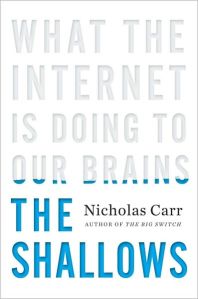 Maybe a Break is in Order
We can do research, entertain ourselves, communicate and think without the Internet, of course. It’s just that the addiction-like rewards of constantly seeing something new—along with the web’s ubiquity (given our groovy gadgets)—keeps pulling us back. Again and again. Carr’s book makes at least that point. One surprise is how plastic even the adult brain is (no one’s brain ever stops growing and adapting it seems). Combine that plasticity with the very old argument that the tools we use, while extending our reach and ability, also subtly limit us (make that “self-limit” because we naturally begin thinking of what we can do in tool terms), and you’ll understand the basis for Carr’s argument. What’s fascinating in the book is the conversations he has with himself and with a variety of authorities and thinkers about how and why we love the clicking life of the finger.
Carr’s much-reviewed book really has started a number of conversations among people who care about books and publishing, as well as among folks just curious about how we think and communicate. Carr builds a strong argument for taking a closer look at our own habits and even to consider taking a break from our 24/7 connections and the mesmerizing screens.
At least that was my reaction: to begin to take intervals of internet silence (small intervals—let’s not get carried away). As far as experiments go, that’s a good one, because if nothing else, the interval is perspective-producing (if uncomfortable). Carr described his own withdrawal from constant connection in a move he made from NYC to Colorado in terms that would put any junkie at ease.
I’m preparing a class on Social Media Marketing and The Shallows, plus Hamlet’s Blackberry A Practical Philosophy for Building a Good Life in the Digital Age by William Powers (which I’m reading and enjoying now) both provide a useful counter to the always-connected expectation. There is something refreshing about an hour or two of focus on a single task.
###
Buy a Book that Helps a Guy Help the Homeless

All profits go to homeless advocate Mark Horvath
I’m a fan of the work of local writer Kevin D. Hendricks. He’s used his writing skills in a number of ways to serve others, from wells to adoption.
Today he’s launching a new book–Open Our Eyes: Seeing the Invisible People of Homelessness–about Mark Horvath and his work in helping the homeless. I am not familiar with Mark Horvath’s work and I’ve not read the book, but I’m going to get a copy. I admire Kevin’s passion for help others and maybe that is a good enough place to start.
###
“Turn Off Your Mind” is One Approach to Faith. It’s Not a Good Approach for the Person of Faith.
In which I post about God, thinking and hypocrisy (my own). Skip if offensive.

and yet it remains
Let me pull back the curtain on faith as I’ve seen it practiced—if only just for my own peace of mind.
[Full Disclosure #1: I am not writing from a generalized “faith” perspective. Instead, I write from the specificity of a follower of Jesus the Christ, who I believe was/is the Trinitarian God and who lived, died and lived. Further, I believe persons must act on their belief, because that’s what Jesus the Christ said. He made the point, which I believe, that the only way to God was through Him (including trying to be good enough which—logically—could not possibly work). Comment/email me to talk more about this.]
“Turn off my mind” has popped up countless times since I was a lad. The phrase has often been offered to me as the reason why people would choose not to believe in God or Jesus the Christ. It went something like, “Look, I’d have to turn off my mind to be a follower of Jesus.” Sometimes the phrase went: “I’d have to turn off my mind to go to church.” The first phrase I disagree with. The second phrase may actually be true.
It’s an Honest Assessment
Maybe you’ve heard or said this phrase or one like it. It’s an honest statement that reflects many things. For instance: a reasonable or scientific person may feel they would have to turn off their mind to embrace faith in Jesus the Christ. Perhaps they think of faith in Jesus the Christ as a kind of voodoo/animism/magic because of the contra-logical behaviors and antics they’ve seen practiced in the name of faith. Maybe the religion they’ve witnessed seems not all that different from the ancients sifting through the bowels of chickens to determine the way forward. I respect people who grapple thusly. Faith in Jesus the Christ is simple—and profoundly not simple—especially with your mind engaged. Wrapping your mind around the actions of an infinite God is way more than just difficult. I would argue faith is a gift, which (happily) is the Apostle Paul’s argument too.
It’s Not (Necessarily) the Leap
It used to be that when my friend said “I don’t want turn off my mind,” I would always hear “I don’t want to make the leap of faith required to believe in this Jesus guy. Who knows, maybe it’s all a fiction. I won’t entrust myself to fiction.”
But my perception has changed over the years as my own doubts and questions about how people have practiced their faith. Now I hear “turn off my mind” and understand there are all sorts of leaps in our lives, and I wonder which leap is calling to shut down the mind.
We make leaps daily, from trust that the bus we’re riding on won’t be blown heavenward by a terrorist with a bomb, to trust that social security will be there when we retire, to faith that the authorities are telling the truth when they say the groundwater is safe despite the chemicals 3M poured in the soil years ago. All of us act on leaps constantly. We act on these leaps because every time we take the bus—so far—we’ve arrived safely at our destination. We act on the leap because we don’t have a choice about social security and we’re putting a little bit aside anyway (besides, no one really retires anymore). We act on faith by drinking tap water, but we’re also reading the reports and we may yet resort to bottled water (though no regulations govern the purity of that water). We make leaps of faith and generally keep observing and considering what’s going on with each leap.
Now I think the “turn off my mind” phrase as applying to my friend’s observations of lives governed by faith. Maybe he sees too many of us exhibiting a herd mentality with some gifted leader we’ve hoisted into a popish position (sometimes against the leader’s will) from which they inevitably fall (no one is perfect, after all) (except that one Guy). My friend feels he must turn off his mind because of the echo chamber talking points that roll off our tongues in response life’s deepest questions. I’ll confess to spending much of my life in mindless following as well. Just doing what I hear the preacher or leaders say. Thinking it’s true (often it was, sometimes it wasn’t). Following the paths everyone else followed—we’re all going the right way. Right?
The fact is it’s just much, much easier to walk the same direction as everyone else. Find a group that’s going in a good direction and jump in. And just stick with it. The problem is that groups need help in continuing to find the way and the leaders don’t always know the right answers. And sometimes leaders may even respond to other interests that become incompatible with the original direction.
Faith Infrastructures are Culturally-Based
It turns out that much of the infrastructure surrounding faith is culturally-based. It’s always been that way. How we are together is not truth in the sense that God said it. Much is invention. People who say “I don’t want to turn off my mind” are not stupid—they see artifice (perhaps even built on something that might be believable) and turn away whether or not they can say why.
[Full Disclosure #2: I take the Bible as the Word of God, which means I read and understand it as a document where the usual rules of interpretation apply. But the words I’m reading carry much greater authority than, say, the New York Times. Further: I believe God helps readers understand His words (which carry mystery and are not always black and white). I see the Bible as a living document that pulls me into constant conversation with the God of the Universe. That’s my leap.]
I’m saying this just to point out that there are many leaps we each take every day. I want to invite you toward the great mystery of knowing God, in any way I can. I also want to avoid turning people away because of my pat answers.
###

 conversation is an engine