
Words Build Stuff Between Us
Words destroy stuff we’ve built
We all know this, don’t we? It’s perfectly obvious.
If words were money (words are definitely not money), we would be aware of our spending to inform or persuade or entertain. And just like people who make a hobby of “going shopping,” spending our word budget every day would be just another normal piece of everyday life for a U.S. citizen (or “consumer,” as business has renamed humans).
And that is actually how words work: We spend them.
With words we buy influence. We give some bit of knowledge or direction to someone else and win something in return. Some bit of psychic collateral. With words we buy context: we proclaim this or that in response to a situation at home or at work. Sometimes those around us agree with our context-setting assessment. Sometimes they don’t. Hint: if you want more people to agree with you, become the boss. Authority has a way of bringing believability with it, whether or not it is earned.
How we spend our words is worth thinking about. For many of us conversation seems instinctual. We say this in response to that. We inform, persuade, entertain with a joke. We do most of this without making conscious choices about our wordly-intentions.
But what if we did think of how we spend our words? What if we invested our words to accomplish some end? What if we invested our words with meaning—which is to say, what if we said things that were pulled from the well of what is important to us? That would make us vulnerable, of course. It would also be a platform for growth. Because when we say what is important, we learn something about ourselves and often a meaningful conversation can follow. The kind of conversation that has a chance of touching us deeply.

If you’ve not read Mistakes Were Made (But Not by Me), now is a good time. Tavris and Aronson have been referred to frequently as the Rolling Stone article on rape at the University of Virginia and news reader Brian Williams were found to have amped up their stories beyond anything resembling truth. Tavris and Aronson talk about cognitive dissonance and how we have such a hard time living with ourselves when our inconsistencies and personal malpractices appear—so we just change the story to coddle our precious psyches. The authors also demonstrate how memory gets built and rebuilt as we change stories:
Memories create our stories, but our stories also create our memories. Once we have a narrative, we shape our memories to fit into it.
–Carol Tavris and Elliot Aronson, Mistakes Were Made (But Not by Me), (Orlando: Harcourt, Inc, 2007) 77
I am advocating for conscious use of words, and for filling those words with stuff that is important to us—scary as that is. I see this as the opposite of small talk. I do, however, acknowledge that small talk is the precursor to big talk.
In my dream world, we use words to constantly build stuff between us rather than destroying relationships by purposely misunderstanding and showing we are better/righter/fitter/stronger/groovier.
###
Image credit: Kirk Livingston
The World Needs You—Ms./Mr. Verbal Processor—Annoying As You Are
Silence can be nice sometimes, too
I know a few people who process life verbally. I’m not naming names, but to be with them is to sit before an open window through which you hear internal debates, sharp intakes of breath in response to a new stimulus, and general narration about turning left or standing up or “I think I’ll eat a jelly bean.”
People process life in all sorts of ways, of course. I don’t know what I think until I write it down. Others might sketch a response to a life event. Others process a life event over the course of a three-hour bicycle ride. James Thurber could hold 1000 words in his head as his eyesight failed, processing and editing in his brain-pan and seeming to spit out a fully-formed essay or story.
And some talk it out: declaring boldly and then backing up to change direction. And then boldly declaring the opposite. They settle on a position over time (often). Sometimes it’s fun to engage in their internal debate. Sometimes it is maddening to witness the ebb and flow.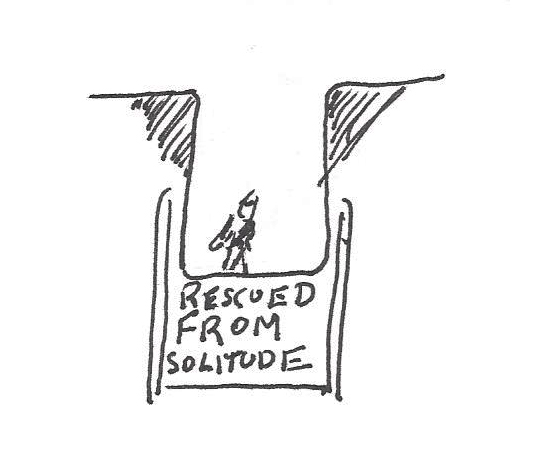
The ways we process life are not mutually exclusive, we might each do all of the above to figure out what is going on. It may take many conversations and many bike rides and many sketches to, say, process a larger than expected tax refund (ha), or a job loss. Or a death.
But the verbal processor plays a unique role among us. They are the ones who quickly spout a response to a question. They tend to be more comfortable in a group, or , perhaps this: for the groups they are comfortable in, they are even more verbal. The things they say become a sort of conversational/processing rudder against which we agree or disagree. But it is something nearly tangible (as tangible as words ever get) we can react to. The verbal processor does everyone a service by putting something out there for the rest of us to respond to. Their initial, fast response is a word that can rescue us from our solitude. Their quick work can help us avoid sitting passively while inside we are furiously yelling to get our heads around some new situation.
Kudos to the verbal processor.
Their out-flowing attempts to sort things pull the rest of us in as well.
###
Dumb sketch: Kirk Livingston
God-Talk and Other BS
Do Communication and Spirituality Connect?
I say “Yes.”
And I say it manifests in the ordinary conversations of everyday life.
Let me prove it: deep down in your brain-pan, where you instantly recoil from people who snap at you; back down there where your inner child says snarky, politically incorrect, frankly obscene, stuff that your adult, outer-self edits and translates to “Hmm. I see….”
Deep down there in the hidden recesses—that’s part of the connection.
Your immediate responses to the stuff of everyday life can tip you off that things are not right—deep down in the soul. Yes—I’m talking about weird stuff. But you have an inner life, right? A place where no one visits but you.

If that inner place is full of doubt, while your outer self—the adult self in tie and loafers, who edits and translates the inner child’s voice so the rest of the world remains unaware what a low-life that kid is—if that outer self proclaims stable faith in God and corporation and the upright institutions (ha ha) that surround us—that’s where the cognitive dissonance starts. That’s the precise locus of hypocrisy.
Mind you: I’m big on doubt. Questions are good. Questioning institutions and the quick answers to life’s hard questions—I’m all for that. Talking unbelief to God makes perfect sense to me (Just read Job, my patron saint of doubt honestly-processed).
It’s the saying one thing while believing another I’m not for. It is that very place where God-talk becomes BS. And I believe most of us have sixth-sense/BS detector that goes off when outer words don’t match inner life—even if we cannot put our finger on exactly why. I am most certainly talking to myself here as well.
We need to process our bouts of cognitive dissonance together to keep our God-talk from becoming BS—rudderless words without the ballast of belief and action a life-lived.
If you don’t have a friend to be honest with, find one.
This is important.
Today is Good Friday—a day when the Christian Church celebrates (is that even the right word?) Jesus’ death. Three days later we celebrate that this dead guy is dead no longer.
I appreciate this time of year for processing doubts together with others. Quite often we come away rejoicing. And somehow more whole.
###
Image credit: Kirk Livingston
By the way: I’ve written ListenTalk: Is Conversation an Act of God? to explore this connection. Pre-order here.
Fie on You, Toilet-Writer
Don’t Be This Writer

At least try your recommendation before declaring so boldly.
###
Colorless Teletubbies & a Punk Soundtrack
What’s not to love?
Thank you, Werner Twertzog
###
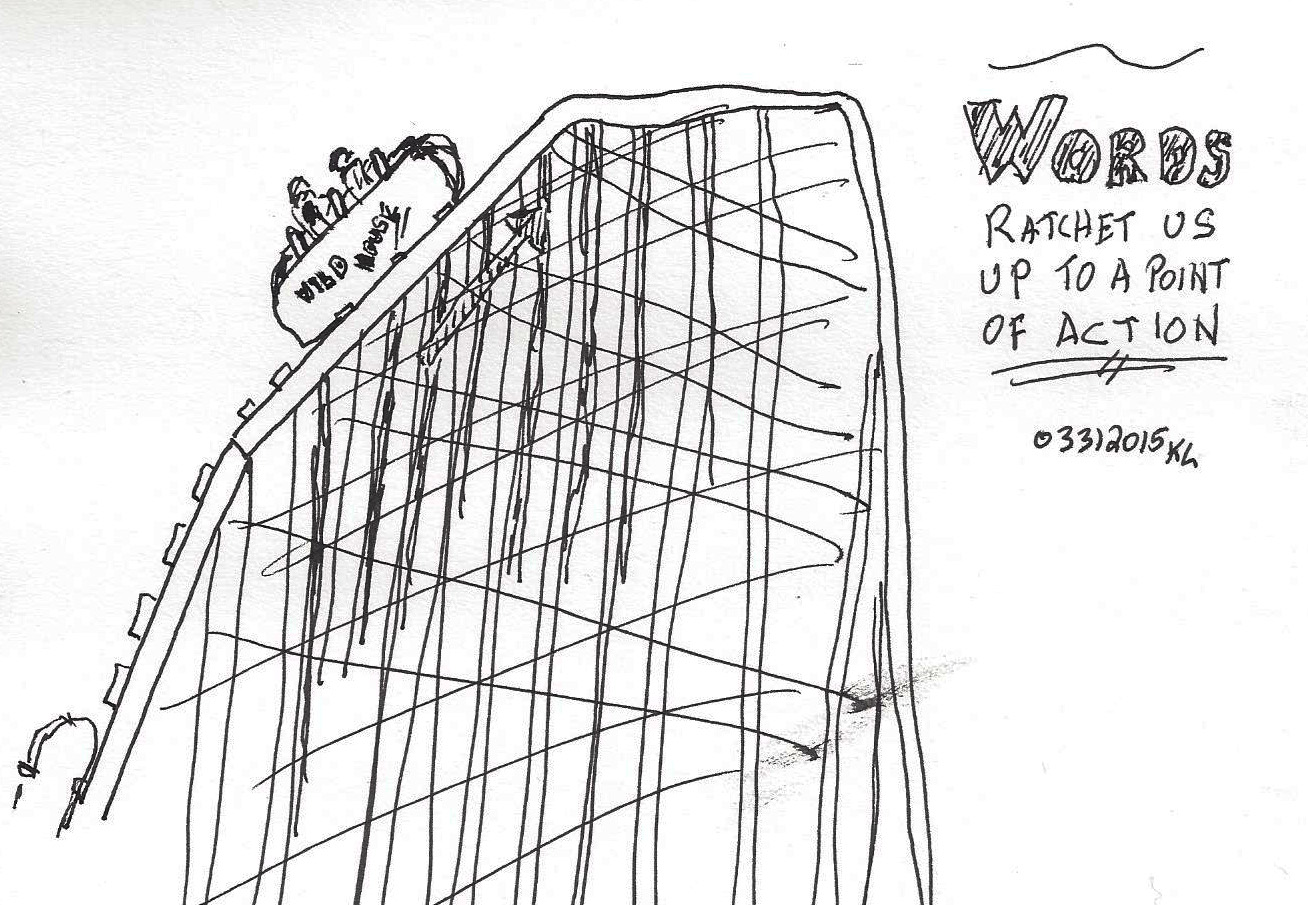
Let’s Talk: Will You Fly This Plane into a Mountain?
Listening-Rhetoric and Public Conversations Gone Private
To the casual news-reader, it’s looking more like the German copilot purposely flew into the side of a mountain. Given that, it’s not hard to imagine last week’s conversations between airline human resource vice-presidents and corporate lawyers:
- How do we screen for lethal depression?
- Let’s get serious about that two-people-in-the-cockpit rule.
- Is there an intention-detector we can employ before anyone—pilots included—steps into an airplane?
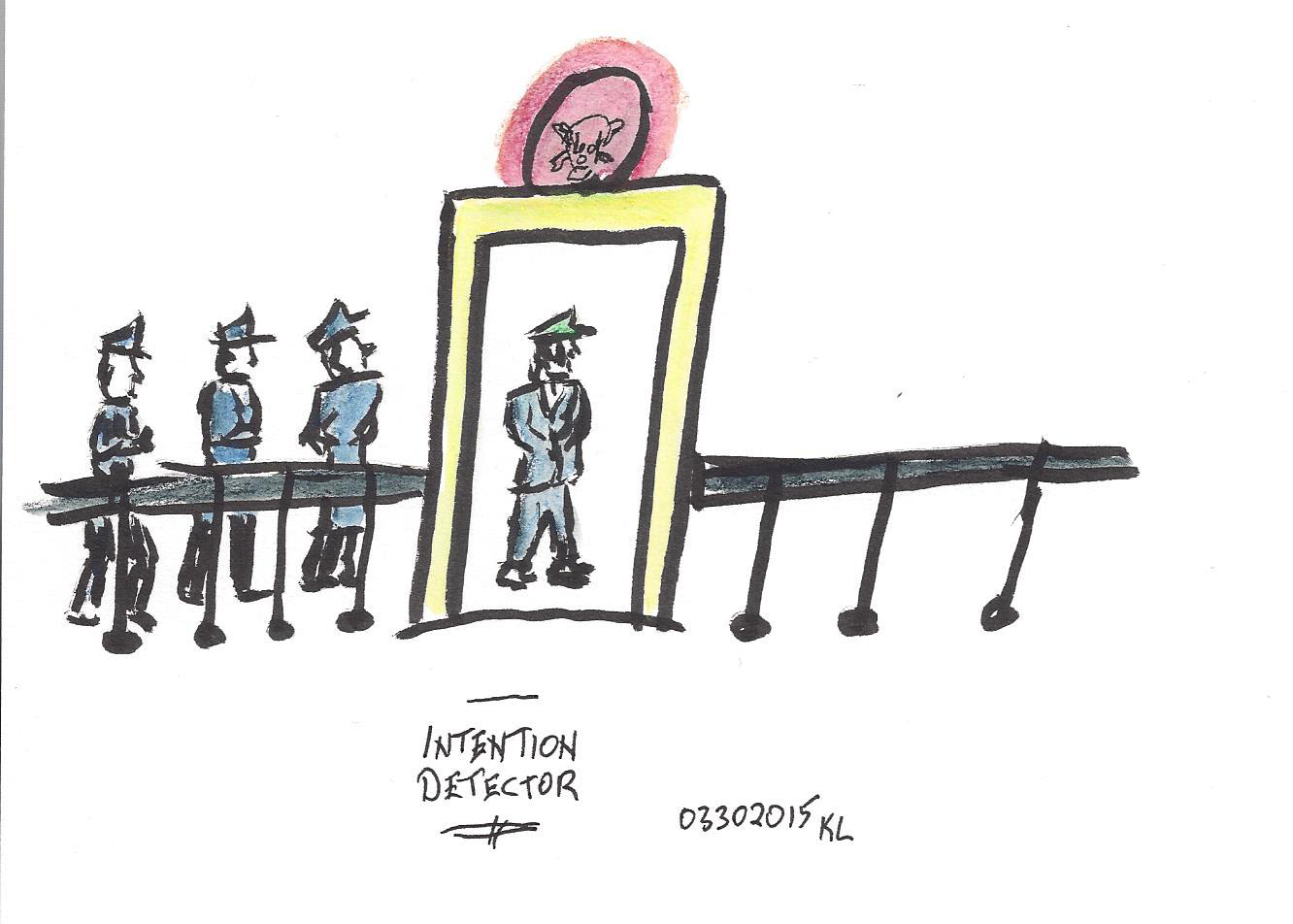
Intentions frame how we talk and how we listen. Wayne Booth posited that sometimes we come into a conversation with the intent to win—to bash our conversation partner into submission with whatever way we can. Sometimes we come with the intent to bargain, and so we are ready with a list of conciliations. Sometimes we come to listen and learn. Booth called that “listening-rhetoric” and recommended it as an antidote for stupidity, partisanship and as a way to “pursue truth behind our differences.”
People will speculate for a long time on the pilot’s intentions and actions—which we will never fully know. But as lawyers and HR talk I hope they will also examine the role of relationship-building conversation as an antidote to isolated suffering. Suffering that may become lethal.
###
Dumb Sketch: Kirk Livingston
What does fresh hope sound like for cynical colleagues? (How to Talk #3)
A credible word spoken boldly
Constant cynicism is a downward spiral that saps energy, like the dome light on all night—little by little wasting energy for no reason. Eventually the car will not start. Have a conversation with a cynic and the world looks a shade or two darker.
Offering fresh hope to a cynical colleague is not about squatting at the other end of the emotional spectrum, babbling like a Pollyanna. That is quickly seen as fanciful.

No.
Fresh hope is a word of the moment that is credible and believable. A word about where we are going or what we are doing that becomes meaningful. If not meaningful right now, meaningful later. Fresh hope has a way of stopping the cynic, if only momentarily. But even the cynic finds herself meditating on a word spoken yesterday or the day before. The cynic happily shoots down the platitude, but his trigger-finger falters at a contextual insight from a conscious person processing a shared experience.
Fresh hope requires a bit of courage. Cynicism and general world-weariness is always in style.
But hope? Not so much.
But what’s the point of conversation if not to speak up boldly about what is important?
###
Dumb sketch: Kirk Livingston

 conversation is an engine