Dave’s Regrettable Dance is…Hilarious
Superbowl commercials are mere hours away.
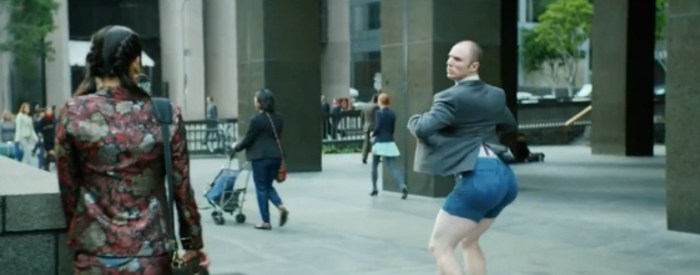
[Click image to play on Creativity site]
I think they are playing a football game too.
###
Via Creativity
English: I still believe in you.
Get in that job-machine, mister.
More dire news for university English departments: from the University of Maryland, English majors are bailing like mad. And faster and faster.

The humanities have been getting a bad rap for, oh, half a dozen decades or so, because they don’t lead directly to a slot in a job machine. And, as the thinking goes, without the job machine you fail at life. Or at least paying for life’s good things (like a huge TV and plenty of Lean Cuisine) (Or rent and clothing).
We’ve certainly seen this coming. We’ve wondered: Why go into college debt just to be a philosophy-talking barista? We’ve lamented the pitiful conditions of adjuncts. Colleges in my area cut budgets and then cut more, from fat to bone. And now wholesale amputation to accommodate the demands of producing souls for job machines.
True: English departments that focus solely on esoterics need to undergo change. I’ll argue that any academic program (or any institution, frankly) that promotes the inward-gaze as the end-all, top-function of the human condition is currently being rudely awakened.
Smart English departments are tuning in to this—just like businesses have been realizing people don’t really care about their product all that much. Even churches are starting to realize there is a world of people living and working just outside their doors—people not interested in joining the club but crazy-interested in the meaning of life. Speaking of churches, we used to call it “evangelism” when we invited others in. Business evangelists understand all too well the benefit of going where people are and adapting their product to current conditions.
But reaching out to the rest of humanity—that’s where the action is.
It’s because we’ll always need to reach out, to communicate something to someone else, that I’m optimistic about English, if not exactly English departments. Rather than an either-or approach (deep-thinking/creative expression or assembly line training), we need both-and: deep-thinking and creative expression that leads to more conscious assembly line work. And perhaps that thinking will help us move beyond assembly lines entirely.
As I prepare my next set of writing classes for college English majors, I am beefing up the entrepreneurial end. Because the way out of a soulless slot in a job machine is to invent your own job machine.
That’s something we should train writers to do. And some of those writers will be English majors.
###
Image credit: Kirk Livingston

We’re All In Construction
We build every day with actions and words
Sometimes our work is purposeful.

Sometimes we build walls with ice.
Sometimes we joke that our habits and actions and speech patterns amount to nothing. But that is false: if nothing else, what we do and say affects us. And there is no telling the power of example and well-placed words in the circles we travel.
Don’t think for a second you are not building.
Something.

###
Image credits: Kirk Livingston
Lift and Separate (Copywriting Tip #12)
An idea is a new combination of old elements
This part comes after.
After the interviews and after reading the transcripts, after absorbing the journal articles and revisiting the notes from discussions with various experts. After taking in as much as you can, there is the sitting-back and ordering of facts and impressions.
Maybe you use an outline. Maybe you use index cards. Maybe you use a mind map or a white-board. Maybe you draw figures or icons on the back of corporate memos. But this is an essential creative exercise: sorting through and lifting up what keeps coming to the top. This creative exercise is about identifying and corralling the really important stuff. The stuff that simply must be transmitted.

Take steps to see more.
A shortcut to this essential phase is a conversation. If a colleague interrupts you with “What’s that project about?” The first three things out of your mouth—those things worth remarking on aloud—those three things need to find their way into the copy. Often they become the main topics.
Sometimes I’ll just start writing to see what I say. Give yourself 10 minutes to answer “What is this about?” and you will come close to producing an outline for the piece.
Or you can write a letter to a smart ten-year-old. Molding an idea into a simplified (but not simplistic) presentation has a clarifying effect.
The point is that your mind needs to find a grapple with myriad facts and figures and impressions and data—to sort minor from major and to begin to find the story that makes sense to you and to your target audience.
I like the wide-open blank page aspect of this exercise. I also like that brand new stuff presents itself during the exercise:
…an idea is nothing more nor less than a new combination of old elements.
–James W. Young, A Technique for Producing Ideas (NY: Thinking Ink Media, 2011)
###
Image credit: Kirk Livingston
For Some, The Past is Still Present
One Wall in North America’s Only Walled City
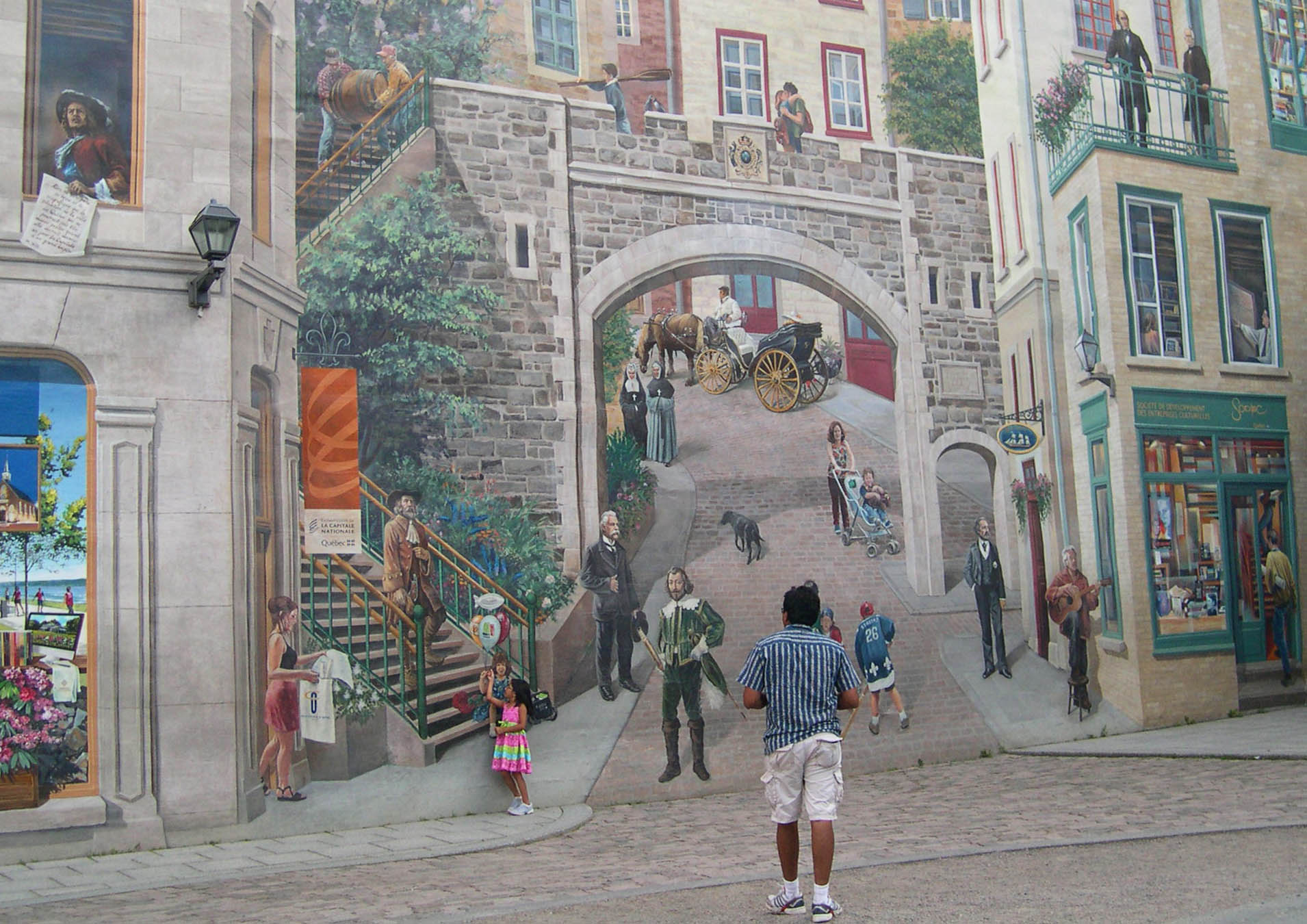
This art wall reminds me of Wendell Berry’s The Memory of Old Jack.
###
Image Credit: Kirk Livingston
“6 things I learned after drawing 319 drawings in 4 months and 13 days”
Especially #6. Buy Why Does #2 Work?
I follow One Drawing Daily in my attempts to produce my own Dumb Sketch Daily. But whether you’ve made it a point to draw or paint or sketch or shoot photos (or write essays or verse or reflections) there are some curious things about developing and sharing daily habits.

Read One Drawing Daily’s whole post (please!) but I’m particularly interested in #6: “Draw whatever you feel like.” Much of art—like much of life—seems to be about absorbing the sensibilities of the taste-makers among us. Critics, media, famous artists. Famous people who are famous for being famous. There is a subtle pressure to like what they like and do what they do. But uniformity is not the great thing about the human condition. One of the great things about the human condition is that we all have a slightly different take on things. I love seeing different people’s perspectives. And developing your own perspective takes time and attention. But out of the habit of time and attention come a point of view.
And #2 still enthralls me: “Share everything you do!” How is it that the simple act of sharing something can have so much impact? It’s true with writing, true with making dumb sketches. It’s true with our ordinary conversations and when we confess some secret to someone else. It’s true with my clients: as they come to understand the power of sharing expertise and passion, all sorts of things start to happen in their business. It’s still shrouded in mystery for me, this sharing thing, but I’m pretty sure it triggers something in us that simultaneously wakes us up and fine-tunes consciousness.
What habits are you building?
###
Image credit: One Drawing Daily
Here’s the Story of a Man Named Quady
Who was living with three alloys of his own
Yesterday I met Quady* for coffee. I was impressed all over again by the executive function of his brain: how he seems to effortlessly order complicated systems and businesses and talented people and even his own life. Quady** told me how he was weaving consulting with business acumen with creativity. I could not help but be impressed with the forward motion the guy exuded.

…and here’s the dumb sketch you ordered.
In fact, it was about ten years ago I met Quady at (yet) another Dunn Brothers on another side of Minneapolis to talk about how he grew the business he was running at that time. He was president of a firm that placed creative people in creative positions and his firm was on fire (that is, busy). At the time he gave me some solid advice which I resisted for years until embracing it fully: make a daily/weekly habit of reaching out to make contact with varieties of people.
And listen to them.
These days Quady is weaving together a consulting life that draws on his outsized executive function and his creativity plus a desire to walk alongside people. He’s a kind of CEO-for-hire and he’s currently working some high-level gigs. It’s the melding of these three threads that seems to open doors for him: the organizing gene plus the creative gene plus the people-smarts gene. Because he understands the moving parts of business, he can give solid, real-world advice to people. He gives the kind of advice that encourages from some deep place: the sort of advice like,
“Look. You’ve got this. It’s a stretch, but you can do it.”
And who doesn’t want to hear that?
###
Dumb sketch: Kirkistan
*Not his real name.
**His real name was Markothy.
What hope looks like.
Maybe something like this.

Minnesota friends–think back–can you recall “Spring”?
###
Image Credit: Kirk Livingston
Write Alone And Send To Collect. (Copywriting Tip #11)
Except for Bill Holm

Bill Holm, by Brian Peterson, Star Tribune
The late poet and writer Bill Holm spent his days teaching at Southwest Minnesota State University. In the context of daily teaching, he was too busy to write his own works. But when class finished for the semester, he wrote his poems and stories and memoirs long-hand on the back of the memos he received at school. Interestingly, he was a gregarious soul who often welcomed people into his house but continued to write at the kitchen table even as he engaged in discussions with visitors.
But for many of us, writing is a solitary activity. Oh, sure: ideas pop in conversation. Careful, committed writers take note of the idea on whatever scrap they have handy. And that scrap becomes useful when the writer is, yet again, sitting before blank screen or page.
Unless you are/were Bill Holm, it is the typical writer’s fate to sit alone.
This is not to say writers must be loners or introverts. Those are not necessary conditions, although they do often fit together.
But creating is only one part of writing. Yes, it seems like the biggest part of writing, doesn’t it? Creating and the aura around creating are certainly the most celebrated bits of writing.
But another part of writing is reading. Specifically, getting read. And that requires publishing, in one form or another. At its essence publishing is getting read by someone else. And for all the (quite true) advice about “just sitting down and writing” and “writing = butt-time-in-chair,” it seems to me there is still a missing piece: the reader at the other end of the writing. Written words need to find and land on their audience.

Here is a place where writers might learn something from copywriters. Copywriters have deadlines. They have people who expect copy at a certain time and quite often that copy is delivered verbally—often read aloud by the copywriter to the client.
Something happens when writing is read aloud to an audience. The text itself tends to shape and reshape and the writer hears it differently because of the people listening. The writer cannot help but see things differently when another person is also hearing the copy.
Many will say that some of their best writing happens during revising. I agree. Especially after having read something aloud to someone else and seen their reaction. It can be thrilling. Or depressing.
Butt-in-chair time is essential for writing. But sending your writing out—scary though it might be—is equally essential to hear how the ideas land and to revise with creativity and gusto and possibly increased motivation.
###
Image credit: Kirk Livingston, Brian Peterson/StarTribune

 conversation is an engine