Northeast Minneapolis Art-A-Whirl
Wandering through the artist’s workspace is at least 50% of the fun

Urban Garden in Mill City

Six floors of art studios in the California Building
The top photo shows how Minneapolis begins to blossom in the spring.
###
Photo credit: Kirk Livingston
The Silence of the Protocols (Miss Manners)
“He then falls silent.”
I have an ongoing disagreement with my husband regarding telephone etiquette.
Yes? Please continue.
When he calls me, I pick up the phone and say “Hello” and he responds with “Hi.”
He then falls silent, expecting me to respond to his “Hi” with a “Hi” of my own.
I feel that, since he called me, and I have greeted him, it is not necessary to then respond to his greeting, as it would be redundant. So I just wait for him to tell me what he called about.
This irks him no end….
–Miss Manners, via The StarTribune, 13 May 2014
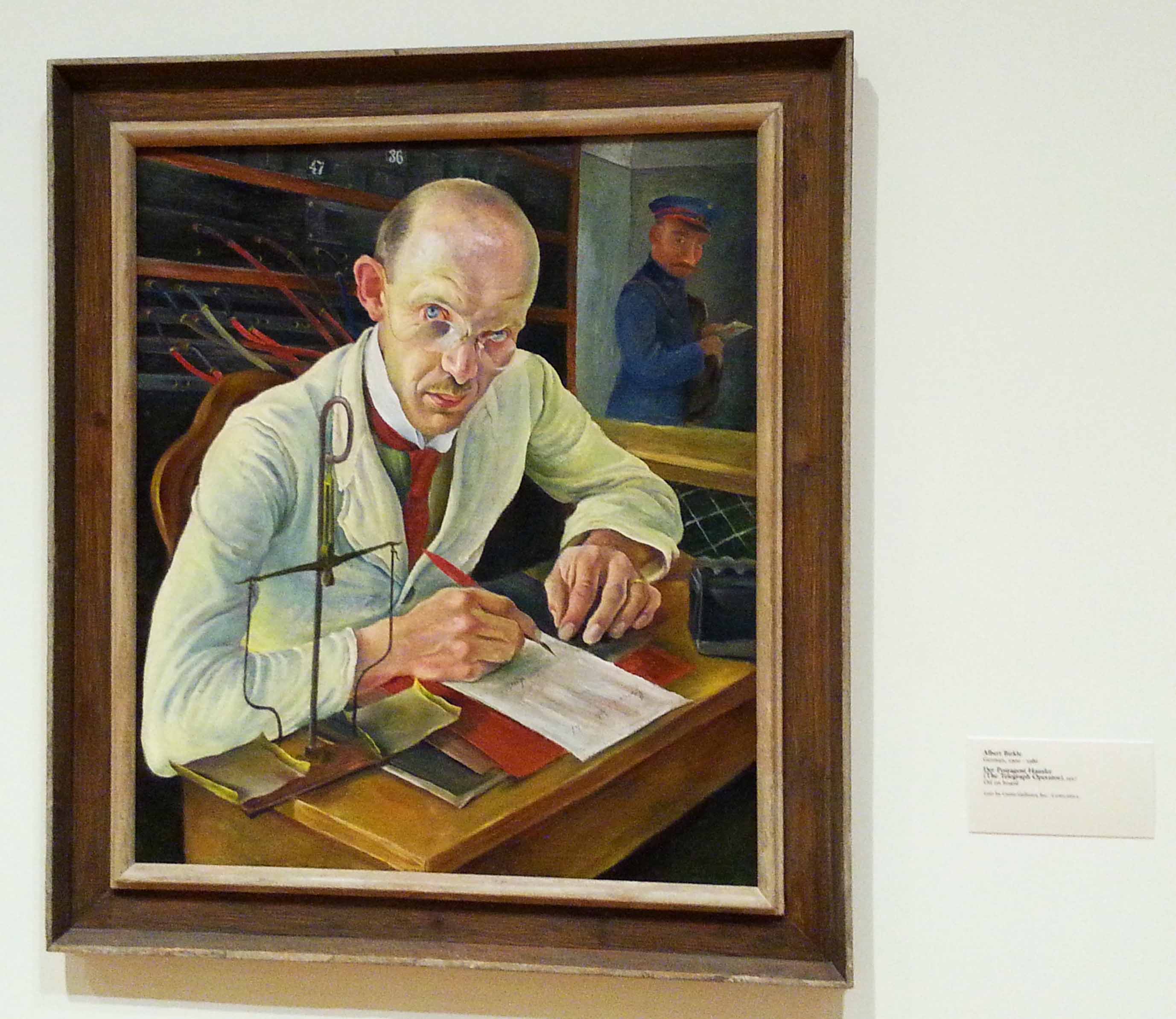
Image Credit: Photo–Kirk Livingston. Albert Birkle: Telegraph Operator, via the Minneapolis Institute of Arts
Writing finds its own audience
Except: Even God had a hard time holding an audience for long
My cousin is a big cheese in the world of women’s studies. She’s published a number of books and teaches some pretty astute, high-level stuff to aspiring Ph.Ds. Once we talked about why anyone would write and what’s the point, after all, since fewer and fewer read. (By the way: I always say this to my classes, that even a paragraph of copy scares many of us. All those words, they’re just, well, so much work.)
My cousin said something to the effect that you’ve got to believe your writing will find its own audience. That is a perceptive statement and I’ve wrestled with it since. I think it is true. I hope it is true. And I know it is false—at least immediately.

Meh. Another Sunset.
Social technologies and search let more of us find our long-lost cousins and brothers and tribesmen—the ones we never knew existed. We find them because they speak our language, possibly with our own words. And we know them because they are passionate about our topics—the stuff we think on constantly. (“You write about garlic butter too? You are my brother!”)
It’s just that it may take a long, long time for that audience to co-locate to your web address or your part of the bookshelf. Of course we hear and read stories of the overnight success folks, who start a blog on Saturday and by Tuesday they are talking with Oprah. But for more of us, we tell our stories and organize our arguments and spin them out into silence. But we must continue on with diligence, continuing to tell the story, as if keeping the porch light on, waiting for that audience to show.
There’s an old story about God giving his words to a guy and telling him to say the words. But know that no one will listen—you’ll be banging your head against a brick wall most of the time. And it’s all going to end badly. But those words will take root. And those words will blossom.
Eventually.
And over time the audience did show up.
And we’re still reading those words today, lo, these thousands of years later.
###
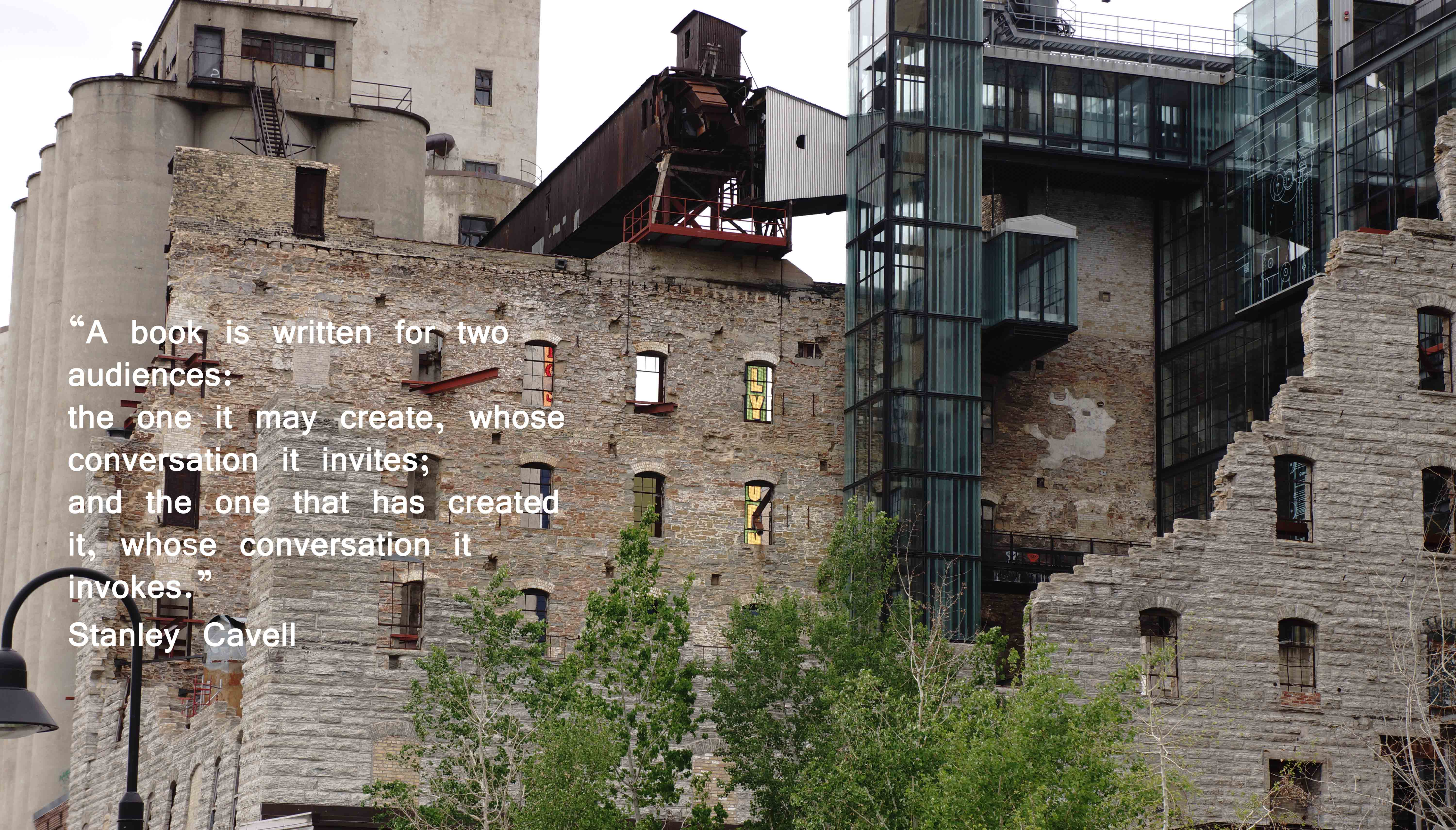
Image credit: Kirk Livingston
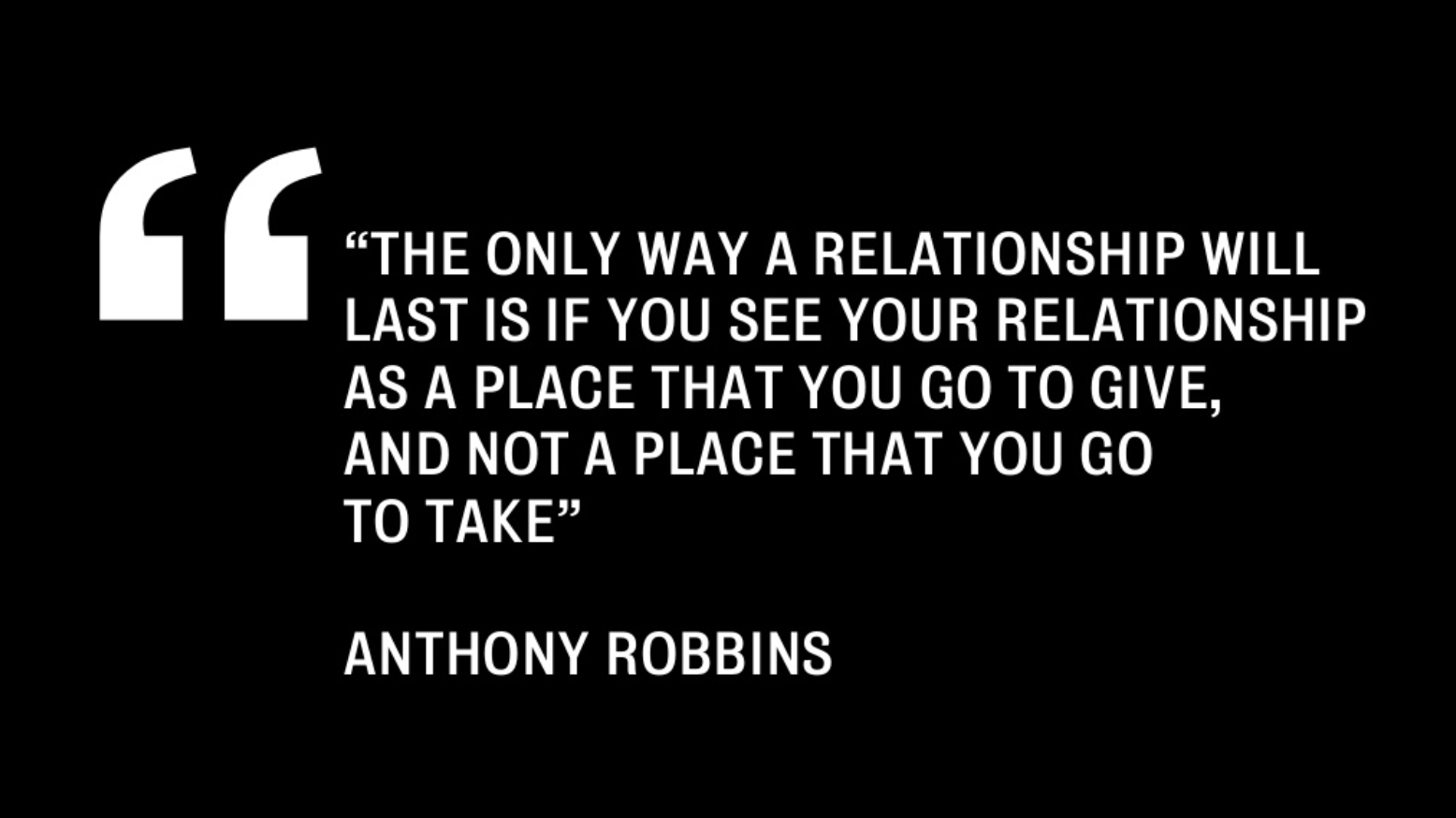
Martin Weigel: Go to give. Don’t go to take.
Even advertising people are human.
In the spirit of “What is remarkable?” I offer Slide #43 from adman Martin Weigel’s excellent Slideshare on how brands fool themselves into thinking they matter in the grand scheme of real life.
They don’t.
Not when it comes to real human interaction.
No sir.
Can a brand serve? Yes. And I will argue that is the profitable space to explore.
I’m not generally an Anthony Robbins fan, but this quote has been stuck in my brainpan since I first reposted these slides. And that is remarkable.
###
Why I Don’t Listen To Christian Music
Short Answer: No One Likes Being Manipulated
On Conversation is an Engine I mostly write about communication and conversation and copywriting and how business interacts because I am fascinated by what happens when people talk. But undergirding this sense of wonder is a faith in God that makes me see much of life in theological hues. The fallout from that theological saturation means I want to approach the work of communication and persuasion from an ethical perspective—as best I can.
Lots of music labeled “Christian” does not do that.
 The college I occasionally teach at has a radio station that spins out Christian music. I stopped listening years ago when I realized my emotions were being manipulated by music that was nearly content-free. It had a veneer of faith, but seemed much more about living a good life and having positive feelings.
Especially positive feelings.
I’m not against positive feelings. Happy is good in my book. Happy makes sense to me. But if happy comes from a sugar-like high that dissipates as quickly as it formed, was it real? And is happy the point of faith in God?
I argue: No.
Happy is good. Joy is better and depending on how you define things, joy lasts longer. And true is best.
And really, what is Christian music? I might argue Tom Waits has a lot more truth to offer than whatever contemporary Christian band is currently famous. The Talking Heads seemed to provide many glimpses of truth—so do many of the folk musicians I listen to. Certainly Mr. Bach and Mr. Mozart and Mr. Telemann and Mr. John Adams and even Philip Glass provide more soaring and more depth and more truth.
Of course, music is a very personal thing and there is no right or wrong. We like what we like and I don’t want to disparage anyone’s choices—really I don’t. But if I sense I’m being manipulated by sentimental lyrics, I move on.
###
Image credit: Kirk Livingston, in response to on the move
12 Years a Slave vs. The Wolf of Wall Street
Two Films filed under “Difficult to Watch”
One film I can’t stop thinking about. The other, I wish I could.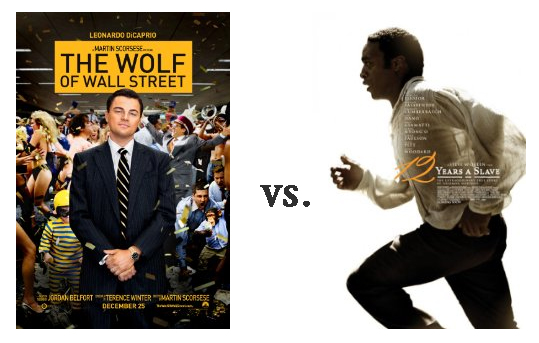
I’ll admit straight up I never finished The Wolf of Wall Street. I tried thrice. But every time I picked up where I left off, it felt like I was shimmying through a hole in an outhouse and dropping into the muck below. The movie has a corrosive effect. It’s a nudie, sex- and Quaalude-filled downward spiral of lies, idiocy and bad behavior borne from naked greed. Evidently a true story and maybe even the movie excesses were not far off from how it actually played out in real life.
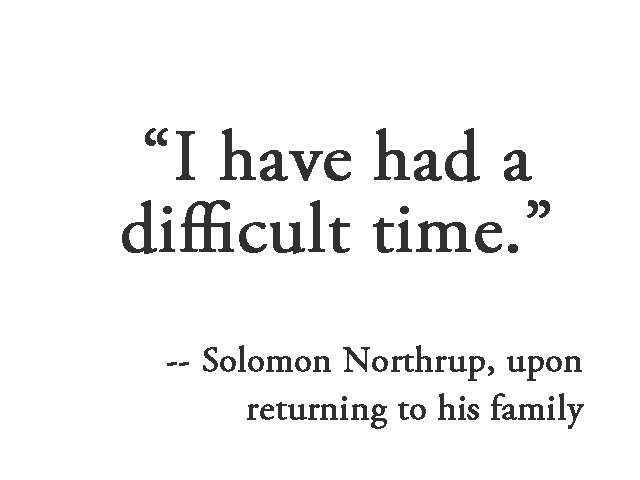 Then there was 12 Years a Slave. Also difficult to watch, but not corrosive. It was difficult because the filmmaker helped me empathize with these intelligent people living in the degrading and inhumane deep South. Their courage was breathtaking and heartbreaking and deeply affecting. Solomon Northrup, played by Chiwetel Ejiofor, is an honorable man stolen into a dishonorable system. In 12 Years a Slave, Steve McQueen brings alive a terrible period of our history. The result is clarifying and worth the discomfort: we need to recover our sense of shame at ill treatment and still—even today—we need to recognize the inherent dignity in being a person.
###
Creative Rebellion and Your DIY Career
Creativity + Freedom = Finding Your Work
We’ve finished our last session of freelance copywriting at the University of Northwestern—St.Paul. And now, after all the boring, blathery lecture stuff and all the portfolio additions and all the clever advertising we’ve seen, the bottom line is freelancing is a business of making it up as you go.

Just like no one can teach you to write (though teachers offer suggestions and direction, writing remains something one learns on one’s own), no one can teach you to rebel or to cultivate a disruptive presence in your work. Writing your way into and through creative rebellion is the beginning point to locating a solution to a problem that connects with an audience.
Freelance copywriting has by no means cornered the market on these qualities of creative rebellion. But those freelancers invited back provide value by looking at things deeply and differently. These are the folks who have organized their lives around creative rebellion and get antsy when asked to follow a party line.
Let there be more of this tribe.
###
Image credit: Kirk Livingston

 conversation is an engine