Humble Inquiry: To Lead is to Listen
Help Team Members Find Their Roles
The important lesson here is that teams almost always work better when the higher status person in the group exhibits some humility by active listening, this acknowledges that the others are crucial to good outcomes and creates psychological space for them to develop identities and roles in the group that feel equitable and fair.
…someone is still in charge, but if the group has a chance to evolve, the members can find their niches that both facilitate the accomplishment of the task and satisfy their own personal needs. Status and rank do not become equal, but teammates are comfortable with the appropriate amount of status commensurate with their roles.
Helping: How to Offer, Give, and Receive Help by Edgar H. Schein (San Francisco: Berrett-Koehler, 2009) 108
###
Image credit: Allison V. Smith via MPD
Pinterest Knows Me!
Pinterest has a wonderful plan for my life.
I’m new to Pinterest. I really have no clue to what it is about, but one team from my Social Media Class focused on Pinterest—so I’m right there! So far I’ve search for (pinned?) exactly two things: an attic fan and a pair of boots.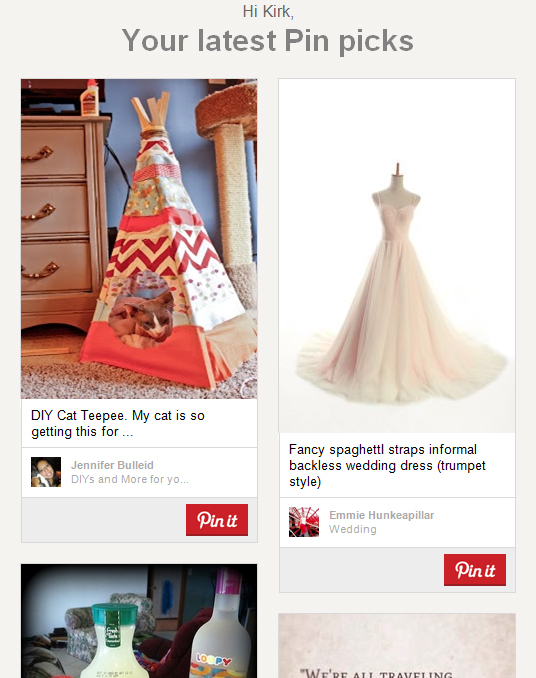
Yesterday Pinterest came right back at me with…a DIY cat teepee. And a backless wedding dress.
How did they know?
I’m no cat fancier. And I’m more of a rent-a-tux kind of guy who enjoys being (already) married to Mrs. Kirkistan. But all this failure makes me wonder if Pinterest is curating my life into some odd, unforeseen direction. What is Pinterest’s wonderful plan for my life?
Pinterest: you scare me.
###
What is Your Purpose with Your People?
Can You Articulate Your “Why?” and “What for?”
I’ve been gushing over Improv Wisdom lately, this 2005 book by Patricia Ryan Madson. I’m thinking of buying a number of copies to give away and wondering how I can incorporate it as a supplemental text in my next classes. The book is easy to read, memorable and full of actionable wisdom all directed at staying in the moment and building something with others. Ms. Madson—a drama professor at Stanford, improv maniac, eager collaborator and kind-hearted encourager—brings a lot of life to how we can work with others. Now I find myself ordering the primary source texts cited by Ms. Madson.
Ms. Madson has been kind enough to respond to my tweeted epiphanies when reading her book. I am impressed by the longevity and timeliness of certain ideas. Ms. Madson’s 2005 book will likely be relevant for a long, long time.
As I finish with my Social Media Marketing class, I’m reading reflections from the students. One near universal regret was not having a clearer sense of their purposes for the communities they were trying to create. We spent focused time on this early on in the class, but forming a crystal clear picture of what we want to accomplish with others is neither easily understood nor often practiced. I know this from the number of companies I’ve been in that operated every day without a clear sense of what they were trying to do with their audiences.
Students resist the tightly-formed purpose and the close definition of their audience because it feels so restrictive. It just feels easier to write anything for everyone. At least that’s how the class always starts. But at the end of the class, there are multiple confessions about how the tight purpose and close definition actually freed them to say much, much more to their target audience. This experience fits with a bit of improv wisdom Ms. Madson offered: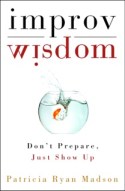
Rather than asking “What do I feel like doing?” when a free moment arises, instead ask “What is my purpose?”
I love this question for my class and I love this question personally. The question presupposes I have a purpose and assumes I know that purpose. The question assumes I am conversant with my purpose and assumes I am in the habit of articulating it to myself and others.
All these presuppositions and assumptions are worth pursuing. Going back to our purpose again and again sounds like bearing fruit over a lifetime.
And this: Patricia Ryan Madson should write more books.
###
Image credit: imgur

I miss cycling.
“Why let -2 degrees F and 24+ inches of snow stop you?”
Asked the guy in Duluth who bikes to work every day.
###
To My 19-Year-Old Self: Embrace the Timer
This Permission Tool Will Calm and Kick You
Look—I know you get all fidgety about the stuff you’ve got to do: the papers to write, the group projects to complete, the hours at work and the woman you’re trying to work up the nerve to ask out. Finals coming—have you even read the chapters? Plus all the pressure to assemble a plan for the rest of your life. Get on that! (Ha! Here’s a hint: your plans will scatter like water on a hot skillet. Again and again. But you still have to plan.)
That’s why I’m writing, lo from across these many decades.
Behold: the timer.
Like an egg timer only with more time and without the eggs.
The timer is a permission tool you can employ today. The timer will grant you focus and peace of mind. The timer will calm your fidgety, anxious self. The timer puts an end to the ridiculous argument that you can do several things at once. You may find this hard to believe, but in the decades to come people routinely kill others while driving and opt out of deep life-changing conversations because they “multitask” (big word in twenty years). Wacky, right?
Here’s how the timer works:
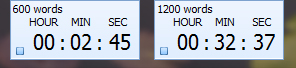
You’re not gonna believe the free stuff on this thing Al Gore invented called the “Internet.” Oh: buy Apple stock.
- Look at the big pile of stuff you’ve got to do.
- Pick the most important thing. Just one thing.
- Set the timer for 60 minutes.
- Start the timer.
- Do that one thing.
- Do that thing for 60 minutes. Don’t get coffee. Don’t talk to your roommates. Don’t daydream about that beautiful woman. Don’t stare out the window. Do the one thing.
- When the timer rings, get up and do all that other stuff.
- In fifteen minutes, pick the next thing, set the timer and repeat the process.
Sound simple? It is!
Listen, Mr. 19-year-old Kirkistan: this is how you are going to get stuff done for the rest of your life. Even enormous projects tremble when the timer shows up. Almost everything in life can be broken into manageable segments.
And this: You emerge a happier person when the timer goes off. Because you actually did something.
I think you have a timer on that big plastic watch of yours.
Try it.
Now.
###

 conversation is an engine