conversation is an engine

A lot can happen in a conversation

Get in the zone today.

leave a comment »

Written by kirkistan

February 27, 2014 at 5:00 am

Posted in curiosities

Tagged with

Can A Question Trump A Script?

with 5 comments

Don’t Prepare. Just Show Up. Improv Wisdom by Patricia Ryan Madson

A confession: it’s hard for me to break free from notes when speaking.

Maybe notes are a crutch. But I think there is more to it. I spend my days writing so I have an affection and affinity for words on pages. And this: there is specificity to writing that is not quite so available for speaking. It’s a specificity that allows me to work an idea and move the parts around even as I deliver that idea to my audience.

Speaking does not allow that.

Or so I thought.

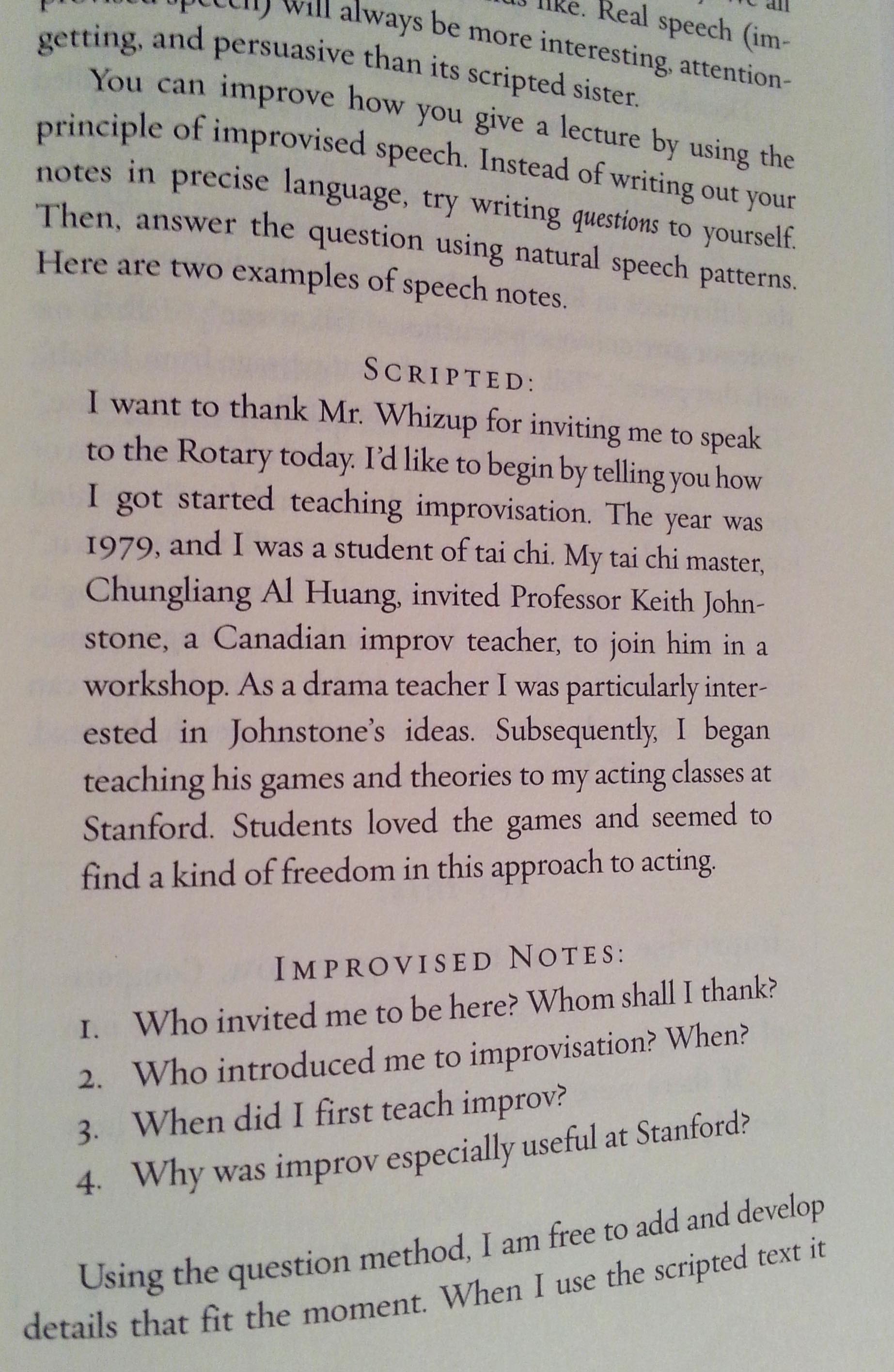
Patricia Ryan Madson’s Improv Wisdom is helping me see things differently. This well-written, easily digestible book (NY: Bell Tower, 2005) is full of all manner of notes about how to move off the page. In particular I’m struck by how Ms. Madson deftly turned scripted notes into an opportunity for spontaneity. 02262014-Cover-burgundyCheck out the photo below, where she reformats scripted remarks into a series of prompts—questions—that result in something alive and conversational versus the usual bad voice-over quality that comes from reading a script.

The result of her work and approach is spot on with all we’re trying to do at Conversation is an Engine: live out loud with each other, mistakes and passions all available to each other as we show up. Day after day.

Here’s Ms. Madson speaking at Google (Authors@Google) on her notion of just showing up. I cannot help but notice that she put lots and lots of time preparing before she just showed up. Plus: I am completely taken with Ms. Madson’s willingness to make mistakes in public.

Patricia Ryan Madson may be my new aural hero.
 

ImprovWisdom-02262014

###


Written by kirkistan

February 26, 2014 at 8:44 am

Abby Klanecky: Helping Scientists Tell Stories

leave a comment »

Sharing wants a room in your house

One rapidly changing perception is that only the PR people in your company or the C-suite folks should communicate with the rest of the world. That notion is swiftly falling away. Why? Because anyone looking can see the entire workforce is already in conversation with a whole lot of people.

We’ve been tracing social technologies backward to see where they bump against command and control strategies. We’re starting to see a sort of containerization of messages: we see multiple channels of communication goodness overlayed and overlapping through the relationships already present in our employees and partners. This effort is not about exploiting those relationships by pushing out selling messages (always a disaster with social media)…but simply recognizing there is mission-driving energy available when we help our people tell their story in their way.

That’s partly what is behind Abby Klanecky’s presentation about her work with Dow scientists. Part of her work is training in how to talk about science in a way anyone can understand. Part of her work is helping these scientists see exactly what is at stake with broadening the scope of their communication. Part of her work seems intent on aiding exploration—through involving others. Attaching social media wings to research may pay back in lots of ways. Part of Ms. Klanecky’s plan also has to do with connecting scientists with students—ensuring future researchers are queued. See her entire presentation on Vimeo here. Slides here.

I like Ms. Klanecky’s approach because of how it broadens an organization’s mission. More people become key people. I also like it because it gets at the changing nature and opportunity of communication today.

Say, for instance, you are a university and you just built a multi-million dollar research lab. It’s entirely unique and there is nothing like it in the world. In this research lab you intend to partner with industry. You will not share industry secrets, but you will help deepen the conversation about the processes and technologies used. In your communication strategy you will focus on producing research and presenting that research through the traditional channels of publishing research papers and speaking at conferences. But what if, in addition to those traditional strategies, you trained your scientists, researchers, even those in charge of the lab to locate and engage with people interested in this very thing?  And what if your employees found the social media aspect actually sharpened their questions and their research communication? And what if the result was genuine collaboration that helped further cement your lab and universities leadership position?

Training helps make this happen: training in communicating with an awareness of legal, regulatory and industry guidelines. These must be clearly communicated. But the most important thing is setting the expectation from the beginning so that researchers are already thinking along these lines.

The end result may look a lot like humans speaking to humans rather than PR people unspooling an endless stream of press releases.

###


Hat tip to Ward Tongen (@wtongen)

Written by kirkistan

February 25, 2014 at 5:00 am

When will Your Mission become Mutiny?

leave a comment »

Look Boss: It is Written

One of my favorite bosses, when privately presented with a wallet-sized card imprinted with the corporate mission and asked what he thought of it, pretended to use it to wipe his derriere.

Was my boss in open rebellion?

Not in the least.

My boss was responding to a ridiculous communication tool. At that point in the history of that particular medical device company, it was all mission and everyone knew it. Patients and physicians were front and center and no one needed reminding. We were all directly involved in the mission and to think otherwise was to dismiss the conscious and vocal choices people made to work there.

Then again, perhaps the communication tool was a bit prophetic. It wouldn’t be long before many in the firm started taking their eyes off the mission to focus instead on quarterly profit goals to the exclusion of patients, physicians and common sense. These things happen when big bonuses are at stake.

But it need not be that way and you may well be the one to say so.

Unless you simply wanted a job and any job would do, you likely joined your firm because of mission. You found yourself in some level of agreement with the firm’s vision and wanted to help move this thing forward. For many of us, the mission is a motivating and ennobling force, even if we may not think of it constantly.

We know that even the best-intentioned organizations stray from their intended goals and go rogue with evil intent. This happens at high and public levels. It also happens at day-to-day levels, in quick decisions and in small furtive meetings among colleagues. For-profit companies do it. Non-profits do it. Churches do it. Hobby clubs are also capable of it.

That’s when any of us needs to come back to the mission and openly ask whether this quick decision or that furtive meeting is accomplishing our shared mission. Sometimes our best and smartest move is to reprise the mission openly, verbally and with gusto. We all need reminding of our purpose and mission from time to time.

If you care about your organization’s mission, you may need to lead a mutiny today. You’ll want to count the cost, of course, because mutiny can be very expensive.

###


Written by kirkistan

February 24, 2014 at 8:32 am

Delivery is all about Finding the Right Transport

with one comment

Written by kirkistan

February 21, 2014 at 10:10 am

Power Distance Vs. Skunkworks (Shop Talk #8)

with 3 comments

Don’t Fax Me In

I’m anticipating a Social Media Breakfast Friday morning that promises dialogue about dialogue: how companies can get better at engaging employees for collaboration. Collaboration intrigues me because it forces this question:

How is it our organizations gather all these smart people and yet routinely fail to get them working together on big ideas? Why is true collaboration still a distant dream rather than today’s pressing reality?

Anyone can see we’re well beyond the “You talk. I Listen.” model of management relations. In my class we’ve been tracing the opportunity of social technologies backwards to where conversation bumps against command and control personalities and cultures. I’ve been coming to the conclusion that conversation is inevitable: with customers, with your own workforce. Especially with your own workforce. This is good news for anyone who works. To expect anything less than people talking back (where you can hear it or where you cannot hear it) is to settle comfortably into the pace and ethos of 1980 or 1990. Back when we might just fax in our order.

One celebrated model for collaboration is that of Lockheed Martin’s Skunkworks: smart people hiding from bosses (or some bosses) to work together on a particular passion. It was a skunkworks setup that allowed Steve Jobs to make his radical break that resulted in the Macintosh. The absence of bureaucracy and the concentrated abundance of resources contributed to innovation.

And this: slightly naughty has its own peculiar draw. If skunkworks promises to disrupt the social order, I’m in. So are a lot of other seemingly ordinary citizens.

Cubicle-dwelling life is often more about receiving messages rather than dialoguing. In my own life it was the rare boss (I count three) who was able to deeply engage teams and bring out the very best—the brand new stuff that would happen only when everyone talked.

My fear is that internal communication is mostly just another flavor-of-the-month HR stunt, only using new tools. Just another command and control technique that only climbers are interested in.

My hope is that leaders take their top positions and use them to demonstrate dialogue and make themselves vulnerable.

My observation is that a generation of Anti-Vladimir Putins and Anti-Kim Jong-uns is already emerging.

###


All social behavior is reciprocal

leave a comment »

My basic argument [is] that social life is partly economics and partly theater…. There are few cultural universals, but anthropologists agree that all societies are stratified and that all social behavior is reciprocal.

–Edgar H. Schein, Helping (San Francisco: Berrett-Koehler Publishers, 2008)

###


Written by kirkistan

February 18, 2014 at 8:49 am

Why You Must Tinker with Your Social Media “Why?”

leave a comment »

Strategy is a fuse. You must light the fuse.

Say you’re writing a blog.

Any blog. Maybe…a blog where you want to get people to tell their stories (purely hypothetical example). Or this: maybe you are running a blog aimed at pulling in people looking for insights about what our national obsessions say about us, as told through the press. Again: pure theory. Just making this up. Both blog examples sound a bit vague—but that’s the groovy deal with social media: you try something and see what happens.

So, say you try stuff.

Say you fail.

But…you learn stuff. And you tune it up.

You go back to your original strategy document and realize: Oh! Our stories must be more than just well-told (though that is certainly the beginning point). They must pull people in with tight surprises or well-crafted morals. Or something. Because these stories are competing with Angry Birds and Facebook and actual paid work—all manner of distractions that keep people from reading our blog. So those stories gotta be good. They’ve got to be better in a way we’ve not quite yet devised.

And so your strategy evolves.

Congratulations: this is what forward movement looks like.

These are the questions any brand faces, with the added goal of trying not to devolve into a selling spiel. This social media world is no static, set-it-and-forget-it deal. It’s more like a living, breathing conversation in a room full of people constantly walking in and out. And for your brand to be heard, for your blog to be recognized, for your insights to be caught, you must continue to tighten the focus on who you are trying to reach and get better at laying out the right content for your target audience to feed on.

And this: there is an aspirational part to providing strategic content. I like how Kristina Halvorson and Melissa Rach says it in Content Strategy for the Web:

Aspirational: it’s a stretch for the organization, focusing on what you want to become ideally (not what you can feasibly do).

Content must paint a picture of who we are that is slightly in the future and slightly a wish list. Brands do this constantly, of course, which is why people buy BMW or Coke or Apple. They buy into the vision as they purchase the product.

How can we do that for the community we want to build with our blog content? It starts and continues with focused attention on what this audience needs, today, tomorrow and the next day. Our content must paint a picture of we can be at our best.

This will always be a moving target.

###


Darling, let us now speak of love (Jacques Derrida)

with 2 comments

Or shall we speak of death?

Allow Mr. Derrida to dampen any small flicker of emotion you may still retain.

Oh, philosophers: You romantic…bunch.

###

via Biblioklept

Written by kirkistan

February 14, 2014 at 1:23 pm

Posted in curiosities, philosophy

Tagged with ,

Is blogging bad for writing?

leave a comment »

Thoughtful reflection from bottledworder on how blogging helps develop good writing, and perhaps where it does not.


bottledworder's avatarbottledworder

Do you want to become a good writer? Keep writing! Practice makes perfect.

Or does it?

Keep writing is usually the advice new writers are given to help them launch a journey onto the uncharted waters of how to write well, a practice that doesn’t usually have any proven rules of success although there’s plenty of advice going around.

I realized that as in every good thing in life, blogging too comes with its own share of pitfalls. Where there is opportunity for improvement in writing, there is also a need for tremendous caution.

Some of the pitfalls might not be that obvious in the first few months when the novelty of producing writing every week obscures many a nuance of habits picked up, where the unsuspecting traveler of the blogosphere might encounter a dangerous writer’s sinkhole.

Writing becomes work. A hobby becomes a job.

Most experienced bloggers recommend…

View original post 344 more words

Written by kirkistan

February 14, 2014 at 8:37 am

Posted in Uncategorized