The Problem with Collaboration: Can’t Touch This
You talk. We listen. (Not so) Simple.
Let’s trace social technologies backwards and watch them infiltrate the organizations that launched them. Social technologies carry with them an implicit demand to be heard—if not an outright demand for action.
That demand, from those voices, will—sooner or later—run smack into the command and control mentality: the top dogs who always delivered the monologues. The higher-ups and muckity-mucks who get their way.
This is a problem.
Is this a problem?
Because this problem may be the starting line for any company culture that wants to change. It won’t be pleasant. Because the kind of people that help facilitate the change are a different sort than the ones willing to tell everybody else what to do. There’s a happy move today, currently gaining cultural muscle, to identify the boss-bully in the corner office and make them play nice. This even as people throughout organizations are getting a vision for collaboration vs. command and control.

Letting employees and customers (and possibly congregants and constituents) into the smoke-filled rooms where big decisions are made. What a concept.
Groundswell offered the example of Salesforce.com, their Idea-Exchange and the grass-root effort to excise an annoying banner that always appeared. The company denied themselves, kept listening, and eventually removed the banner they loved and their customers hated.
Bravo!
The problem with collaboration is really an opportunity to become adept at identifying the things that cannot/must not change and holding the rest with an open hand.
###
Groundswell: Your Moment Has Passed.
So 2008.
I’m done with Groundswell.
Oh, I like the book. A lot. And the argument for an empowered people (via social technologies) continues to make excellent sense. Li and Bernoff did a great service by gathering facts and stories into a rational retelling of where we are today with hearing and connecting en masse.
When I first read Groundswell, emotive moments of recognition flickered constantly. Li and Bernoff led the way in helping me understand this unfolding opportunity lodged in my computer. But those moments are not just in my computer any more. They are on my phone, in my pocket and before my eyes as I walk.
It’s the ubiquity of the opportunity that makes everything look different.
Students in my class assume forums for support will be available, they turn to product and service reviews first—why wouldn’t they? Reviews from peers have always been available. These self-proclaimed 90s kids (I guess that’s a thing) interact in most of the ways that Li and Bernoff predicted. So there are few emotive flickers from them even as I shout “Yes!” (possibly to their “Huh?” and amusement). And these students demonstrate a familiarity with technology far advanced from students even two years ago.
So…wheels turn and time goes on and books fade to triviality. I’ll suppose I’ll check out Empowered next time I teach this class. The last thing anybody needs is another old guy in their life telling how things used to be.
And this: the Groundswell moment just passed has opened on a much wider vista that seems to invite collaboration like never before. To not listen to each other is starting to feel like a cardinal sin. Not because it dishonors the human condition (which it does) but because the opportunities in working together are beginning to look massive.
###
St. Paul: Still Cold
Please tell that story again. The one about “Spring.”

###
Image Credit: Kirk Livingston
Turn Up the Heat
Feel the burn.

A thing that happened today.
###
Image credit: Kirk Livingston
“Nothing Cheers Me…Like a Great Pair of Ears”
I like reading blogs because…detail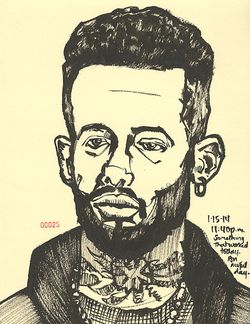
In regular life you might never hear the word combinations that people reveal in blogs. Bloggers can answer questions you’d never dream to ask—and suddenly you are enriched by some comment outta nowhere.
Like this quote (above) from Roz Wound Up.
I recently started following Roz Wound Up, a Minneapolis artist/sketcher/writer (designer/illustrator/teacher at the Minnesota Center for Book Arts) because of the detail she includes about how she practices her craft. A few days back she wrote a fascinating post about the ethics of sketching people in public. Hint: wear a large duck-billed hat so people cannot see your eyes. Today’s delightful post fixates on ears:
I’ve been watching tattoo shows again—Best Ink is the one that’s on right now. It was late, the day had been a complete wash up. Then this kid was standing there being judged on the show and I simple fell in love with his ears.
Read any of her posts and you’ll find in yourself a growing affection for pens and paper and seeing. Specifically:
- Pentel Pocket Brush Pen
- Fabriano Tiziano (8.5 x 11 inch sheet of cream)
- And this: the way the pen feels going across the paper. Especially that.
I once thought a pen was a pen and paper was just something you grabbed from the drawer on the copier (and money’s just something you throw off the back of a train—thanks for sticking that in my brain, Tom Waits).
No longer. Sketching is a sensual art. Maybe seeing is too. The focus of Roz Wound Up has piqued my interest. And with the little sketching I’ve done I’ve started to have a sense of the way my pencil graphite feels across the fine tooth surface of my sketch pad. Now seeing has a sensual element—it’s something I do with a pencil and paper in hand.
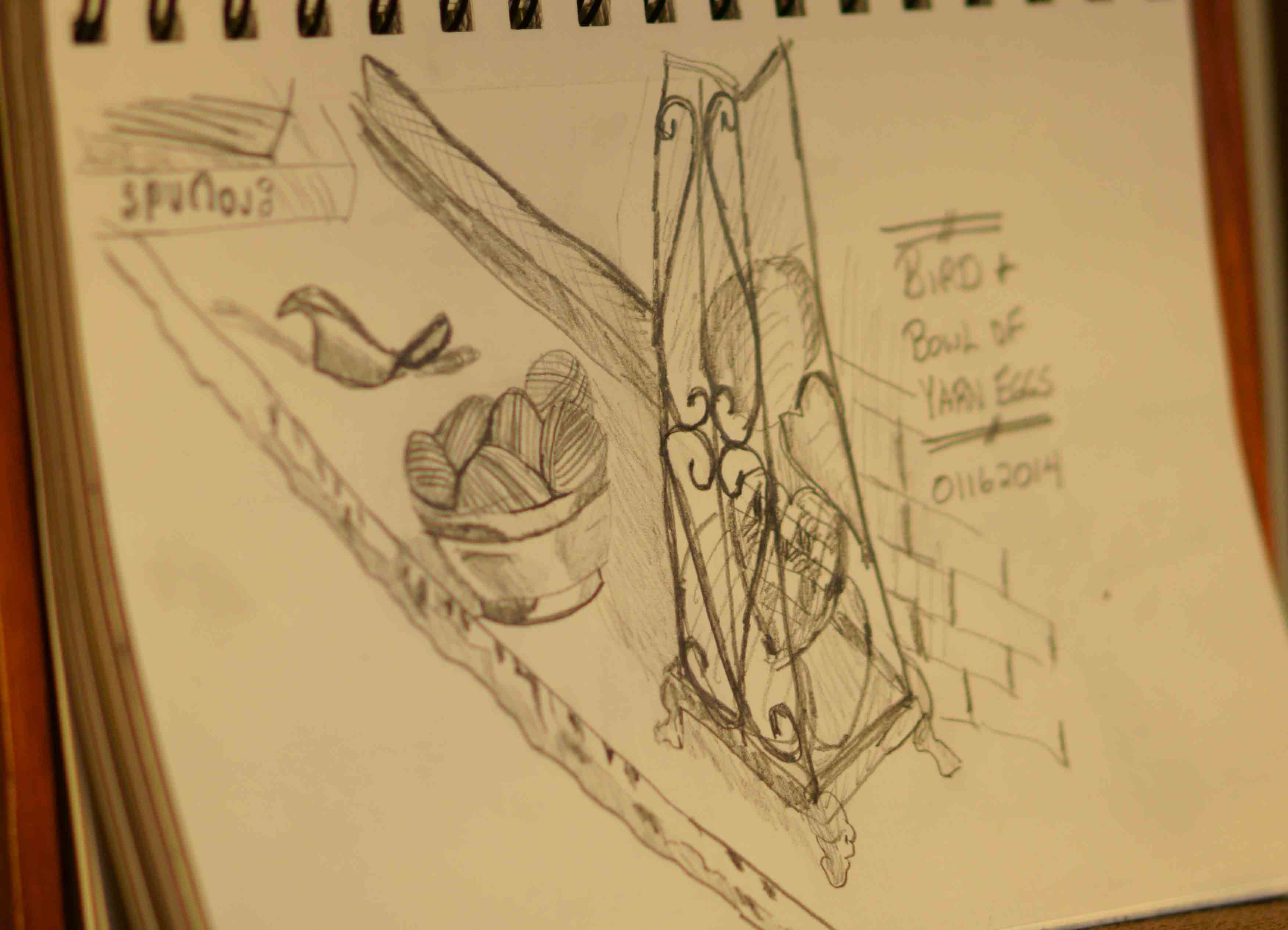
Seeing rocks. I hope to do more of it.
###
Image credit: Roz Wound Up, Kirk Livingston
Collaborate Starts S l o w
Catch me if you can
One must slow down to understand.
Way back: I’m thinking back to a statistics class in college. The theater-seating room in the Psychology building at UW-Madison was packed with well over 200 people. And at the last possible minute the professor would make a grand entrance, rushing down the side of the room with flowing scarf, his cologne preceeding him and wafting across the room. Then he talked nonstop for the next 50 or 75 or 100 minutes. In my mind a bell rang at the end, but I may have imagined that. He took no questions. His purposes were served to assume everyone was with him.
Few were, naturally.
Teaching assistants did the actual work of slowly going through the ideas and problems sets. They were the ones taking the time to tee up concept after concept and watch as some statistics-averse philosophy student slowly worked it out. That’s how a multi-layered idea passes between people: slowly.
Today: Sometimes Mrs. Kirkistan will ask how teaching went today. I consider teaching a success when we have had a robust discussion about the central concept for the day. When people bring in stories and draw connections—usually there is laughter—that is what engagement looks like. It is satisfying. Once upon a time I thought if I got through my slides in time that was success. Today I believe slides are the least important thing—because delivering slides to an audience largely absent is one of the more vacuous activities on the planet.
Tomorrow: My smelly, scarf-toting statistics professor from way back didn’t care about engagement. But that attitude won’t get anyone very far in a culture pivoting toward collaboration. Broadcasting an aroma and putting on a costume scarf doesn’t actually carry all that much weight for those interested in slicing and dicing a subject. What does carry weight is passion for a topic that slows and shares enough to bring others up to speed. Collaboration takes time while we each catch up and synchronize our language. But slowing to a human scale of understanding is worth the effort.
###
Create a Conversation Zone Today in 3 Steps
Make Talk Work at Work
If it’s been a while since you’ve had a truly collaborative conversation at work, take some steps toward that today. Collaboration is starting to register on the radar of many leaders in organizations. Collaboration is the love-child of the free speech we tout in social media and the world of work. Collaboration is freed speech working its way backwards through organizations.
Create a conversation zone in 3 easy steps:
- Acknowledge the human in front of you. “What?” you may say. “That’s pretty obvious stuff.” Not so fast: how many times a day does your mind go dark when the janitor says something, or the clerk—or the boss? It’s the automatic assumptions that run ahead of those conversations that poison the water. Start with this basic thought and you may be able to strip away some of the power distance that ruins conversations before they even begin
- Listen with your eyes. Eyeball to eyeball. No listening happens when my eyes are focused on my Samsung Note II. Don’t fool yourself that you are listening—you aren’t. Not really. Multitasking does not count when it comes to human relationships. I’ve taught enough college students to know instantly who is paying attention, and 93.2% of that is eye contact (6.8% of students have mastered the art of eye contact while entirely absent).
- Expose yourself. Really: tell what you honestly don’t know and what you wonder. Stupidity is endearing when offered without guile. Be the stupid guy. Ask the dumb question. Let it be known that you don’t know.
Good things will happen if you take these three steps today.
Oh, and report back, will you? What happened in your conversation today?
###

Philip Seymour Hoffman and the Human Character
How To Bring Words Alive
Philip Seymour Hoffman’s death over the weekend is one of those shocks we’re both used to and entirely powerless before. Any death is a shock, but for an actor at the peak of his powers, his sudden absence seems a stunning reversal of expectations.
I watched films where Mr. Hoffman appeared partly because of the topics and partly because he was in them. I knew his powerful portrayals would be riveting. And they were. How he could play both the higher-ed slacker David Davis in “Twister” (1996) and then authoritative but ultimately corrupted Lancaster Dodd in “The Master” (the 2012 Scientology send up) boggles my mind. His list of films and other work is extensive—far larger than I imagined.
As writers and communicators we think a lot about how to pull an audience toward and ultimately into a story or argument. It seems Mr. Hoffman’s answer to that question would be to explore the character beyond the monochrome rendering. Lancaster Dodd seemed good until he was clearly not. Doubt’s Father Brendan Flynn had diabolical layers and was a chilling portrayal given the current round of scandals. David Davis was an exact portrayal of many of the meteorology graduate students I’ve known.
Playing out the full-color, full-orbed, fully human version of a character remains an elusive goal. Fully illustrating a notion so it comes alive is something Mr. Hoffman was gifted in.
I’ll miss Philip Seymour Hoffman.
###

 conversation is an engine