
3 Moments of Unexpected Joy in this VW Spot
“Was that me? Was I singing?”
Building in order of sheer happiness:
- Joyful Moment #1: The soundtrack. I’m not sure who this is but it reminds me of the Moody Blues and so the late 70s/early 80’s come rushing back in all their triangular, puffy-shouldered wonder.
- Joyful Moment #2: When our man mouths the lyrics and they dance. Love it!
- Joyful Moment #3: “Was that me? Was I singing?” That guy nailed it. Let’s have more corporate meetings with that guy.
GC/BC says the idea has been done before. I’m sure it has. But I can’t stop watching it. And I feel more favorable toward the power of German engineering.
###
Via GC/BC
PostScript:
Well—I’ve been schooled. This entire concept is lifted from the 80’s band a-ha. Here’s their official Take On Me video. I vaguely remember the mid-80s. One thing I was not doing was watching MTV. So I missed it. Whatever: now I’m all caught up.
Oy! Getting a history lesson from advertising.
What next?

50 Years Later We’re Masters of Industry
Look how far we’ve come
 50 years ago, give or take, Herbert Marcuse and others struggled to understand where industrial society was taking us. He and others saw dark overtones in corporate goals and increasing standardization.
Would industrialization harness men and women? Or would it be the other way around?
Could it be the other way around?
“The industrial society which makes technology and science its own is organized for the ever-more-effective domination of man and nature, for the ever-more-effective utilization of its resources. It becomes irrational when the success of these efforts opens new dimensions of human realization.”
Herbert Marcuse, One-Dimensional Man: Studies in the Ideology of Advanced Industrial Society, (Boston: Beacon Press, 1964)
Social media is one place where technology has seemed to thwart efforts at ever-more-effective domination. Collaboration is increasingly common, and with collaboration, more instances of human realization. So the humans won, right?
Wait. The story’s not done.
###
Image Credit: Kirk Livingston
Show Your Work
In which Richard Feynman and Charles Weiner politely disagree

Hey–that’s my tree.
The physicist Richard Feynman once got into an argument [about the belief that genius breakthroughs come from our gray matter alone] with the historian Charles Weiner. Feynman understood the extended mind; he knew that writing his equations and ideas on paper was crucial to his thought. But when Weiner looked over a pile of Feynman’s notebooks, he called them a wonderful “record of his day-to-day work.” No, no. Feynman replied testily. They weren’t a record of his thinking process. They were his thinking process:
“I actually did the work on the paper,” he said.
“Well,” Weiner said, “the work was done in your head, but the record of it is still here.”
“No, it’s not a record, not really. It’s working. You have to work on paper and this is the paper. Okay?
Every new tool shapes the way we think, as well as what we think about.
From Clive Thompson’s [quite excellent] Smarter Than You Think: How Technology Is Changing Our Minds for the Better (NY: The Penguin Press, 2013)
###
Image Credit: Kirk Livingston
Getting at what others know but can barely say
We Learn When We Talk

A few days back I pointed to Nancy Dixon’s book Common Knowledge and her useful notion of tacit vs. explicit knowledge. Dr. Dixon’s recent post (Part II “We Know More Than We Can Say: How to Use Tacit Knowledge) over at Conversation Matters is worth a read if you are interested in how anyone ever gets at the depth and layers of experience of a seasoned colleague, for instance. Not surprisingly, face to face conversation with a person of deep experience transmits much more than the content of the words.
###
Image Credit: National Geographic Found
Get a Job. Or Don’t.
Rethinking My Standard Line on Employment
What to say to folks starting in this job market?
I’m gearing up to teach a couple professional writing classes at the University of Northwestern—St. Paul. I’ll be updating my syllabi, looking at a new text or two. I’ve got some new ideas about how the courses should unfold and about how I can get more discussion and less of that nasty blathery/lecture stuff from me. I’ll be thinking about writing projects that move closer to what copywriters and content strategists do day in and day out.

Yeah: don’t bind your legs when you really need to take action.
One thing I’m also doing is reconsidering the standard advice for people on the cusp of a working life. I usually tell the brightest students—the ones who want to write for a living and show every indication of being capable of carrying that out—to start with a company. Starting with a company helps pay down debt, provides health insurance (often) and best of all, you learn the ropes and cycles of the business and industry. I’ve often thought of those first jobs out of college as a sort of finishing school or mini-graduate school where you get paid to learn the details of an industry (or industries). Those first jobs can set a course the later jobs. And those first friendships bloom in all sorts of unlikely ways as peers also make their way through work and life. You connect and reconnect for years and years.
But I’m no longer so certain of that advice. While it’s true that companies and agencies and marketing firms provide terrific entry ramps to the work world, they also open the door to some work habits that are not so great. Every business has its own culture, of course. Sometimes that culture looks like back-biting and demeaning and discouraging. Sometimes the work culture can be optimistic and recognize accomplishment and encouraging and fun. Mostly it’s a mix of both.
But one thing I don’t want these bright students to learn at some corporate finishing school is the habit of just doing their job. By that I mean the habit of waiting for someone to tell them what to do. Every year I watch talented friends get laid off from high-powered jobs in stable industries where they worked hard at exactly what they were asked to do. And most everyone at some point says something like:
Wait—I should have been thinking all along about what I want to do. [or]
How can I be more entrepreneurial with my skill set? [or]
What exactly is my vision for my work life?
Some of these bright writing students are meant to be entrepreneurial from the very beginning. Though a rocky and difficult path in getting established with clients and earning consistently, it may be a more stable way to live down the road. Maybe “stable” is not quite the right word for the entrepreneurial bent—“sustainable” might be more appropriate. The quintessential habit to learn is to depend on yourself (while also asking God for help, you understand) rather than waiting for someone to come tell you what to do.
I’m eager for these bright, accomplished people to think beyond the narrow vision of just getting a job. The vision they develop will power all sorts of industries over time.
###
Image credit: arcaneimages, via rrrick/2headedsnake
Tell Me What You Know. Wait: Mime It Instead.
Nancy Dixon & Is there a best way to transfer knowledge?
Lecture is not effective.
As one who has lectured and been lectured unto, I’ll insist that listening is hard work when seated before a droning human. Sermons are the same species. Occasionally sermons are more spirited than lectures but both have roughly the same effect. Maybe there is a continuum for lecturing: previous generations felt ripped-off if the person in front did not speak at length and without interruption. For the generations I teach, 15 minutes is the absolute maximum before reengaging with questions or activities or just standing and moving chairs around the room.

Working alongside someone is amazingly effective at transferring knowledge. To have a common task with a colleague or mentor bypasses much of the resistance and passivity that comes with the classroom “listen-to-me-I’m-the-expert” experience. The focus is on the doing and learning takes care of itself.
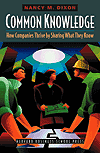
Nancy Dixon in her Common Knowledge: How Companies Thrive by Sharing What They Know (Harvard Business School Press, 2000), breaks the transfer of knowledge into manageable buckets as she shows how organizations do the work of helping teams and individuals learn. She starts by making a distinction between tacit knowledge and explicit knowledge: tacit knowledge is what we just sort of know. It’s the multiple bits of knowledge that would be difficult/impossible to write down. Explicit knowledge is written: it’s explicit in the sense that someone could pick it up, read it and know. Dixon cites five ways teams have successfully transferred what they know:
- Serial Transfer: team does a task and then does the same task again in a different location/venue. The team collects and discusses what they learned between, so each time they do the task a bit more efficiently.
- Near Transfer: Transferring knowledge from a source team to a receiving team doing a similar (routine) task.
- Far Transfer: Transferring tacit knowledge from a source team to a receiving team doing a non-routine task.
- Strategic Transfer: Knowledge transferred impacts an entire organization rather than just a team. Maybe that knowledge comes from the entire organization.
- Expert Transfer: Team facing problem beyond scope of its knowledge reaches out to an expert or expert team.
 I like how Dixon positions the expert as a sort of higher-order transfer: where the audience is engaged and invested and eager for the solution. I also like Dixon’s discussion of knowledge as both dynamic (knowledge is less of a warehouse and more of a river) and also becoming more of a group phenomenon.
Working alongside learners and experts is a great benefit of day-to-day work, though we don’t always appreciate it.
###
Image credit: exploitastic via 2headedsnake
Wedding Photo Rumble: Marquette’s Presque Isle
Just before the fisticuffs: punks versus glams

The aggressive eye contact.
The squared-off stance below the bridesmaid dress.
The feigned nonchalance.
The photographer’s clenched fist.
I should have called the cops earlier.
###
Image Credit: Kirk Livingston

 conversation is an engine