Why I Like the Dumb Sketch Approach to Life
The Lure of Rough Drafts, Quick Observations and Badly Drawn Lines
I made this dumb sketch when visiting our son working in Madison, Wisconsin. Madison holds lots of memories for Mrs. Kirkistan and I: we went to school and met at the UW, we met amazing people who remain friends today decades later and made big directional choices. It was a place for fiddling with and setting trajectory—it still is that today.
Like most summer weekends there was a concert on the Memorial Union Terrace. This jazz festival (see dumb sketch) was running all weekend. These days it seems all of Madison turns out at the Terrace.
 Yesterday I quoted photographer Henri Cartier-Bresson likening his camera to a sketchbook: it helped him instantly sort the significance of an event. And that is exactly what sketching does: it is an entirely imperfect representation (at least my sketches are) of what we all saw. Dumb sketches invite participation, which is why my colleagues and I often employ dumb sketches as we work through a direction with our clients.
One of the functions I relish as a copywriter is this responsibility to provide a rough draft. The rough draft is this work of writing out the position or power of my client’s product or service so others can respond. Or sometimes I’m summarizing and sharpening the science behind a product so we can see more clearly why it is important. Rough drafts are both right and wrong at the same time. The power of the rough draft is to set a thought out in the open where others can reach and tag it. After all, you can’t change something that doesn’t exist. The point is collaboration: how is this right? What do we know that can make this more right?
Saying aloud what we know and what we believe is the verbal equivalent of a rough draft. And saying aloud what we know is more than helpful. It is part of the human condition and not to be missed. Our conversations reveal who we are and what we know even as they and invite participation. Getting it wrong sometimes is part of the deal.
That seems like a good approach to life.
###
Image credit: Kirkistan
Cartier-Bresson: Zoom Lens is the Work of the Devil
To See. To Learn to See.
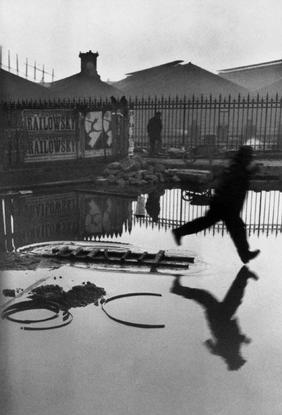
HCB must have framed this and simply waited for the decisive moment.
I’m not sure if Henri Cartier-Bresson actually said that about the zoom lens, but it would fit with his aesthetic. He spent his life getting close to his subjects with a small Leica and its 50mm lens (which he used all his life). That camera and lens brought him in close and kept him there. Someone recently described the big zoom lenses available today as akin to hiding and shooting as a sniper.
What impresses me about the photographs of Henri Cartier-Bresson is his ability to capture something deep in people. A moment of reflection. He called it “the decisive moment” and it was gone as quickly as it appeared. Cartier-Bresson could irritate people because he would sometimes take a photograph before his initial bonjour. But he also spent time just hanging around with his camera. People grew used to seeing it (the Leica) and him and he was quick to bring it up to his eye and put it down again: no big deal.
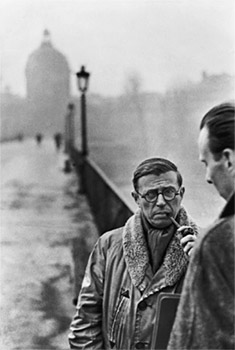
HCB caught Jean-Paul Sartre being Jean-Paul Sartre
In my quest to learn to see, Cartier-Bresson is a valuable guide. He photographed lots of famous folks (thinkers, artists and politicians—he shot Gandhi 15 minutes before Gandhi was, well, shot) and he captured lots of regular people—in a way that reveals a stunning beauty. Here’s a lovely collection of his Magnum photos. Two quotes from this remarkable man:
To me, photography is the simultaneous recognition, in a fraction of a second, of the significance of an event.
For me, the camera is a sketchbook, an instrument of intuition and spontaneity, the master of the instant which, in visual terms, questions and decides simultaneously.
Seeing takes work and practice.
###
Image Credit: Henri Cartier-Bresson
Fascinating: How Stanley Cavell Was Fascinated by JL Austin
Gimme a bigger brain. I’ll settle for a bigger trigger of fascination.
Stanley Cavell’s uneven memoir about becoming a philosopher (Little Did I Know: Excerpts from Memory) is interesting and boring and interesting. Like a lot of philosophy texts, it calls to you days and weeks after you’ve put it down and made peace with never finishing it. I’ve checked it out twice and twice have not finished it—usually a signal I need to actually buy the book with cash money.

Today I’m rethinking Cavell’s descriptions of sitting under the teaching of JL Austin when he visited UC Berkeley from Oxford. Cavell’s descriptions of Austin are not always becoming or charming. JL Austin was a brilliant philosopher but also a bit of a cad, it turns out. But what’s of particular interest is how blown away Cavell was by Austin’s “A plea for excuses.” It’s a pedantic text—like a lot of Austin’s writing. But for Cavell it was full of clarity and win and entirely energizing. Just based on Cavell’s enthusiasm, I’ll reread Austin’s paper.
Enthusiasm is humanity’s secret weapon. The boring teacher is the one unimpressed/unmoved/unchanged by the subject matter she drones on about. But the enthusiastic cheerleader for speech act theory or a particular camera lens or the lobster roll at The Smack Shack is enough to move me to action. As a copywriter I think a lot about how to present this priority or that piece of information so an audience will become interested. But human enthusiasm cuts through all technique and strategy, like sunlight burning off fog. Maybe that’s why word of mouth is the pot of gold every marketer seeks today.
###
Image credit: Lia Halloran via 2headedsnake
The Infallibility Problem
Sacred texts don’t change so it must be our reading
When I was a kid we made fun of Roman Catholicism because they had a guy in a robe and funny hat who told everyone else what was right and wrong for all time. But what was right and wrong for all time seemed to change depending on the robed/hatted officeholder. This was hilarious to us: how could what was right become wrong and vice versa? If things were really true they would not change. Ha ha—gullible people. My people took marching orders straight from the Bible and that didn’t change.
 Years later I realized nearly every one of us erects our own pope: someone who interpreted the sacred texts for us and whom we believed without question. Whomever stood behind the pulpit was a potential pope. For some it was Billy Graham or John Piper. Others looked to Carl Sagan. For a while Richard Dawkins seemed to be pope for hard-line atheists, but a new batch of atheists are sounding sympathetic to what can be learned from conversation with the faithful.
Mind you, I’m not arguing there is no truth. I believe in truth and I believe it can be known by regular people. And I’m arguing for sacred texts (not against): I scour the Bible, want to hear from it and I try hard not to believe everything I think. Only because we humans have this odd predilection to read whatever we want into a text. Any text. Especially a text composed hundreds of years ago in very different cultures by wildly different authors. But what pulls me back to the Bible is the sense of hearing what God might be saying to us today, across generations and cultures and centuries. And the stories about Jesus the Christ pull me back big time—has there ever been anyone like him?
That’s why I don’t believe any one guy or gal owns it. Just like I don’t believe any single reading is the perfect reading. We’re all flawed and we all have only imperfect understanding of the truth. But when we combine our understandings of the truth, that’s when stuff starts to happen. My point is that none of us has a handle on the complete truth—and we desperately need to hear from each other.
I was reminded of this as Alan Chambers, president of Exodus International announced last week the closing of the ministry that aimed to help gay folks become straight folks. His announcement included something of an apology for the people that had been hurt through the years, including the notion that the ministry had been responsible for “years of undue suffering.” How Chambers said it was pretty interesting, at least as reported by David Crary for the Associated Press (and appearing in the StarTribune):
“I hold to a biblical view that the original intent for sexuality was designed for heterosexual marriage,” he said. “Yet I realize there are a lot of people who fall outside of that, gay and straight … It’s time to find out how we can pursue the common good.”
Two things I like about this story:
- I like hearing people of faith apologize for inflicting suffering. Mr. Chambers’ apology strikes me as bold. People will take that apology as real or lacking or simply more PR (letters to the Strib include all of the above and Salon finds the apology lacking), but it is a statement out there in the open that would most certainly produce a substantial loss of funding, were the organization to continue. I like the apology also because I’ve wondered what suffering I’ve inflicted on others because of my faith. Apologizing seems like a good communication strategy for repentant bullies like me.
- I like hearing Mr. Chambers hold to his understanding of the sacred texts. There is no getting around the fact that the texts do not point to the broad acceptance our culture seeks. And for those of us who hold those texts in high regard as words from God, our deep listening must include lots of wrestling: were they just unenlightened back then or are there theological truths we must still unearth and process together in conversation? And what do those truths look like, given the great varieties of people on the planet?
###
Image credit: Kirk Livingston

Dan MacPherson: “Employees [will] make up their own reality”
Days of Whine and Poses
“At least you have a job.”
That used to be a compelling argument for paying attention and doing the work—but not so much today.
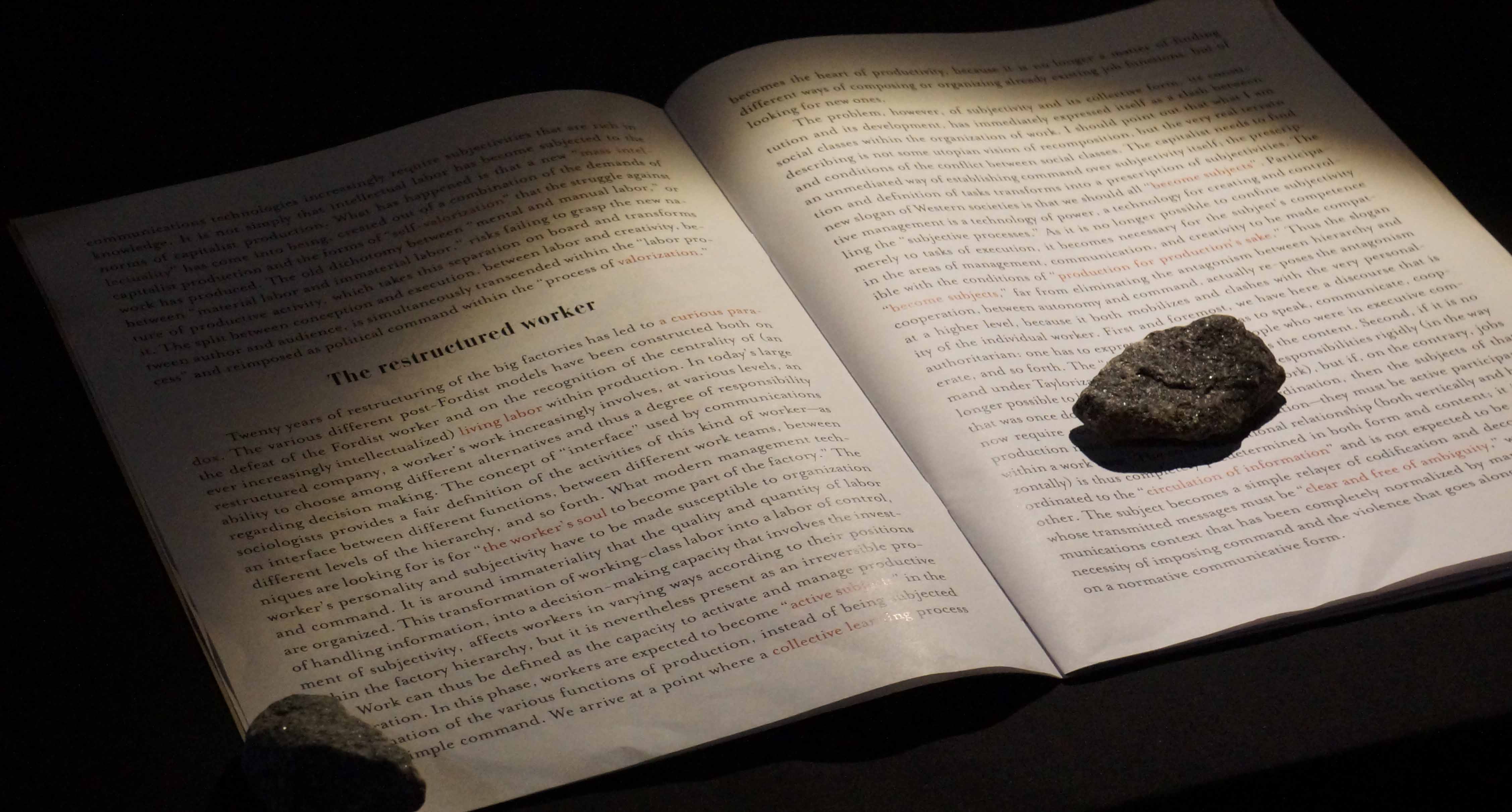
StarTribune columnist Neal St. Anthony recently teased out a few details about our work attitudes. He cited statistics about employee engagement from the National Employee Engagement Study conducted by Modern Survey:
Employee disengagement among U.S. workers rose this spring to a record 32 percent, MacPherson said of the semiannual National Employee Engagement Study. Another 36 percent are “unengaged’’ — or not fully committed on the job.
Meanwhile, the percentage of fully engaged employees fell to 10 percent this spring, down 3 points from last fall. The remaining 22 percent of us working stiffs are “somewhat’’ into our work.
St. Anthony talked with Dan MacPherson, a founding partner with Modern Survey, to get behind the numbers. MacPherson laid blame for disengagement on both employees and bosses—which seems reasonable. And then MacPherson did a good job of filling out the picture of why these things are so. The column is worth reading. And this quote caught my attention:
“It takes three to five years to change an organization,” MacPherson said. “If senior leaders don’t communicate effectively, employees make up their own reality.”
Three to five years to change an organization seems optimistic. And for those bosses still using power poses and monologue to enforce their will—I would argue such communication is near the heart of our problem with disengagement. Maybe we are just beginning to get a sense of exactly how vision for our day-to-day work oils the cogs that keep everything running.
MacPherson is dead right that vision will emerge, one way or another. The question bosses and employers should be asking is “What true thing can I contribute to that vision?” and perhaps, “What do my employees already know about this emerging vision?”
###
Image credit: Kirk Livingston
When Words Fail, Just Show Up
Nine minute film from Eric Gross: The Fortune Writer
Sometimes our words fit perfectly. Sometimes there are no words for our situation or for our desire. That’s when we fall back to just being present—just showing up. The words come eventually. Or they don’t. But being present with each other: that is the rock-bottom beginning point for everything.
We’re thinking a lot about what it means to show up with each other. This infographic making its way around the web points us toward the non-verbals we already heed. And this clip of Russell Brand making fun of the talking heads at Morning Joe for referring to him in the third person is worth watching.
But this short film by Eric Gross offers a meditation on when words need presence to do the real work.
Where do you need to show up today? And with whom?
###

Power Pose vs. Aggressive Emptying
Sunday Story for Monday: the Counter-intuitive Ways of Sheep among Wolves

The self-made man with his mind-crane.
Can words spoken from a low power position influence others?
This older Harvard Business School article (Power Posing: Fake It Until You Make It) describes how simply snapping your body into a power pose can have a physiologic effect. Read about the small study (N=42) by Cuddy, Carney and Yap here. Striking a pose for two-minutes stimulated higher levels of testosterone (hormone linked to dominance) and lower levels of cortisol (so-called stress hormone) in the study group. People literally felt more powerful and less stressed after their pose.
Every human dreams of more power. More power translates to being respected. Maybe power looks like speaking and being heard as one with authority. And perhaps with more power we’ll become benevolent despots bestowing good unto others as we stride through our own personal kingdoms.
The promise of more power is intimately tied with many of our messages about leadership development. Industries and institutions will always buy more technique about leadership development because, well, who doesn’t want to be perceived as capable and full of power?
In stark contrast, there’s an old story about how Jesus saw the authorities of his day use their power for their own aggrandizement while offering little help to the harassed and helpless crowds. So he organized and commissioned his own set of spiritual paramedics to go to the harassed and helpless.
Just before these spiritual paramedics hit the streets to proclaim and heal and cast out demons and raise the dead, Jesus told them how little personal power they would have. They would not be received well. Despite their hopeful message they would be beaten and tortured, and hauled in front of councils, governors and kings.
And that’s how it played out: powerful messages in powerless packaging.
Was there something in the powerless packaging that actually helped people hear the message? Powerful words and actions delivered by powerless, peripheral people could not be enforced or made into law. There was little outside incentive to listen. And yet what they said and did endures today, these many centuries later.
Tell me again: why is it we all seek power so eagerly?
When Constantine turned Christianity into the law of the land, the message lost much saltiness. Does my lust for power come from wanting to help people or just wanting them to play my game by my rules? Are there any truths I have to deliver today that might be helped by “aggressively empty” versus a pose of power?
###
Image credit: Kirk Livingston
Dear NSA: About my recent web searches for HCN and NaCN
 It’s not about bomb-making. Or Drugs. Honest.
Mr. Snowden’s revelations to the Guardian have brought me back to earth about how much of any private web work is actually public knowledge (ahem, everything).
So, to the NSA handlers following my recent searches: my interest in sodium cyanide has nothing to do with bomb-making. Can bombs be made of sodium cyanide? I’d google it but my NSA handler would only put me higher on the list of midwestern ne’er-do-wells.
And my interest in how to handle white powder—well, I can certainly see how that could be misinterpreted. Both hydrogen cyanide and sodium cyanide are byproducts of my client’s process. I’m just learning how others deal with them.
That’s all.
Nothing to see here.
Move along, please.
###
Image Credit: Frank Shepard Fairey

 conversation is an engine