Posts Tagged ‘conversation’
Stop On The Way
Ask: “What do you see from there?”
Mostly we hurry from this to that.
In this season we move from party to party. At work we move from meeting to meeting, hardly stopping to breathe, let alone reflect or appreciate the unique spot we’re in.
We do this because we are crazy-busy (always the right response in our culture). And sometimes reflection is uncomfortable, especially between things. No one really wants to dwell in the space between. But the space between has things to say as well. Things you would never hear otherwise.

Always “crazy-busy.”
We all know someone stepping between things. Maybe our friend has left a job or school or some relationship. Maybe we ourselves own some piece of life that has less than secure footing. All of us caught in between want the solid ground of the other side.
But we gain perspective by asking what we see from this liminal space. What does life look like from this uncomfortable, slippery place? What is important here—and should that thing be important when our footing is more secure?
Perhaps we do our friend a favor by asking what they see from that uncomfortable place—could it even be bit of mercy to ask that question?
###
Image credit: Kirk Livingston
Please Say More, My Radical Lesbian Feminist Friend
Mary Daly: Voice from the Fringe
Well, “fringe” for me.
I’ll confess: I’ve not been so conversant with feminist theology or philosophy. And this: it had not even occurred to me to think about it.

Sometimes a different perspective helps cut the fog.
But then I read our daughter’s college paper on Kierkegaard and his potential exclusion of women. Our daughter’s reference to the self-described radical lesbian feminist Mary Daly and her Beyond God the Father: Toward a Philosophy of Women’s Liberation (Boston: Beacon Press, 1973) was something like click-bait for me and I had to order the book. I’m glad I did. Mary Daly’s voice has been a playful, combative, eye-opening excursion into seeing things differently. I’m only a chapter in, but already she has named patriarchal theology and turned it on its ear. Ms. Daly has suggested all sorts of thought-exercises that would never occur to anyone living in the usual theological/philosophical grid system:
For example, women who sit in institutional committee meetings without surrendering to the purposes and goals set forth by the male-dominated structure, are literally working on our own time while perhaps appearing to be working “on company time.” The center of our activities is organic, in such a way that events are more significant than clocks. This boundary living is a way of being in and out of “the system.” (43)
You don’t have to be a theologian or philosopher (or even a radical lesbian feminist) to appreciate the different way of seeing things Ms. Daly offered. A quick glance through her Wikipedia entry suggests there was personal a cost to seeing things differently—especially in the male-dominated structures she worked within.
What I like about this particular quote is how it points beyond authority to the organic or self-directed work each of us knows as our own. Much has changed since Ms. Daly wrote this in 1973. We still have male-dominated structures and maybe those are changing, though too slowly for many.
But think about “structures” for a moment.
Reading the quote as a freelancer and entrepreneur, I cannot help but notice how exactly her description fits anyone with a growing sense of their own work or mission—especially where that work or mission differs from the work or mission handed down from authority.
Regardless of gender.
The point is not to agree with everything Ms. Daly said. The point is to begin to hear. And to begin to see—so then we can begin to name the framing system we live within. By noticing and naming, potential solutions may begin to appear.
###
Image credit: Kirk Livingston

Who We Are Who We Aren’t.
A lot rides on identity
- We aren’t torturers, that’s for sure. Except for…wait, it looks like we are (read the report here).
- We believe in the rule of law, unless we’ve been violated. Then we stand above the law.
- We believe in the level playing field, where everyone has the same opportunity. Except bankers and corporate boards and Wall Street and race are exposed nearly every week as rigging the game and handing big money and privilege to the rule makers.
- We’re not a police state, except for when we are. And it looks like we are building in that direction.

The personal and local and national conversations we need to have are getting harder and much less comfortable. Maybe that’s because we’ve put them off so long and been in denial for so long. Maybe it is because we remain afraid of talking with people unlike us.
But we need these conversations. These are the conversations that help us figure out who we are. These are the conversations that help us move forward.
###
Image credit: Kirk Livingston
Tune-up the Voices Talking Inside Your (Corporate) Head
Pitch the preachy. Scrap the sing-song. And definitely lose the lingo.
Sometimes a certain tone will flip a switch for me. And all the person says next is covered in darkness because the tone pointed me elsewhere—so I miss the message entirely:
- The VP standing before the group launches into a sermon and 93% of the audience tunes out before she takes her first breath
- The newsletter from internal communications plays out cheery, one-sided copy that feels as manufactured and questionable as a tuna sandwich from the vending machine
- A poetry recitation where the sing-song voice seems to have come from a different century
- The prayer that sounds like a sermon. The sermon that sounds like a lecture. The lecture that shows no interest in connecting with an eager audience.

Each communication event is an opportunity to pass information, true. But each event is also an opportunity to deepen relationship and build trust—both of which may be more valuable than the information in transit. To squander those communication events on vacuous, preachy or condescending fare seems a waste of time, money and consciousness.
Perhaps certain situations activate your autopilot and you slip into a particular communication mode. The status meeting, the Sunday sermon, talking to an employee. Talking to a child. Maybe we even have a special voice reserved for praying with other people. We may not even realize that we adopt a slow-meter pacing, using parlor words we pull from our big-bag-of-sacred-stuff.
Our autopilot mode can learn from the practice of that old poet-king. That old poet-king had a special voice for prayer too, but it wasn’t from the big-bag-of-sacred-stuff. Instead, it was the voice of desperation, of falling and not being able to get back up, of righteous anger on the dudes who done him wrong. The poet-king’s voice was a real voice, based on real bad stuff that seemed to be happening.
The lesson from the poet-king is this: keep it real.
Employees appreciate hearing what’s really happening, not some vetted-party-line version. Use your real human voice as often as possible. Real voices—the ones that we believe—find a way around buzzwords and corporate lingo.
Real conversation with real voices is the engine moving all of us forward.
###
Image credit: Kirk Livingston
Policy is the Gulag of Good Ideas
Good Ideas Sour and Stink When Enshrined as Law
“We’ll do it this way going forward.”
If you could do a quick, very honest poll of employees listening to their boss say those words, how many would silently be saying, “No. We won’t do it that way.”
- 50 percent?
- 99 percent?
- 100 percent?

HM Prison Geelong
It is possible the very nature of the hierarchical or “push” corporation lends itself to sapping motivation from good ideas. When ideas come from above as pre-packaged laws-of-this-workplace, a piece of humanity goes dormant in the otherwise engaged employee. Enough of those pre-packaged laws-of-this-workplace and work becomes full of half-functioning automatons.
A room full of automatons working only for the weekend or the money or to keep a job or to avoid the boss’s wrath may have succeeded 50 years ago, or even 25 years ago. But smart corporations and organizations will study how to turn their hired automatons into full-fledged, interactive humans while at work, not just after work.
Inevitably, that involves hearing from employees. It must be about hearing from more than the boss or those favored few. And know this: engaged people talk and discuss. That is the way of owning a process. Automatons cannot own a process. But engaged people can own a process, no matter where they fit in the organization.
Once upon a time, the lovely Mrs. Kirkistan and I spent a few years at a volunteer organization that had a compelling mission. But that mission was hindered by a hierarchical leadership approach that treated volunteers as cogs in an unyielding machine. There was no room to engage, revise, add-to or direct from within the roles we played. Only a few key leadership voices could do that. We eventually walked, as did other talented people in a variety of roles.
Coming generations of working stiffs will expect their voices to be heard. Or they will walk.
We can all grow in listening for engaged voices with solid ideas.
###
Image credit: Kirk Livingston
Don’t use that (brand) voice with me
Brand Voice Should Invite Not Forbid
My friend Dimitri* asked leading questions.
They weren’t the impossible questions like “What is the meaning of life?” or “Why five toes? Why not four or seven?” where you could speculate together and combine ignorance.
No, Dimitri’s questions were contrived and assembled to manipulate your emotions and response. In conversation with Dimitri, you knew he was looking for some specific answer. But he would never tell what he wanted. He engineered his question so the one plain answer was what he wanted you to say. Then he could launch into a lengthy response. That game left us weary, frustrated and eventually vetoing most of Dimitri’s questions.
Lots of firms play Dimitri’s game: their communication is guided only by a desire to sell (which is, after all, the point of corporations and not necessarily bad). But when the only conversation a company will entertain is one that leads you to buy their product, that looks more like monologue. People veto those conversations and/or walk away.

No one wants to be reduced to a number on a spreadsheet or a statistic. That’s why the used car salesman with the plaid jacket is a favorite target in our culture. It’s also why manipulative sermons and boring lectures are easily dismissed. Of course, some brands are famously annoying, like the “Save Big Money” voice of Menards and we tune it out—except for when we remember it because we want to save big money.
There is more opportunity today to invite participation instead of hijacking it. And invitation, while harder because it requires thinking about someone else’s need or desire, has the advantage of building relationship.
Monologue and the preachy/lecturey voice have limited shelf-life.
###
*Not his real name. His real name was Smitty.
Image credit: Kirk Livingston
Can You Engineer a Conversation? (How to Talk #2)
Depends: Are you looking for control or insight?
In Moments of Impact: How to design conversations that accelerate change (NY: Simon and Schuster, 2014), Chris Ertel and Lisa Kay Solomon argue that some of our most productive conversations come from deciding ahead what we want from the interchange. Their book presents a system of on-ramps that will be particularly useful for anyone charged with gathering a group with the intent of going further than the old, fallow brainstorming sessions allowed.
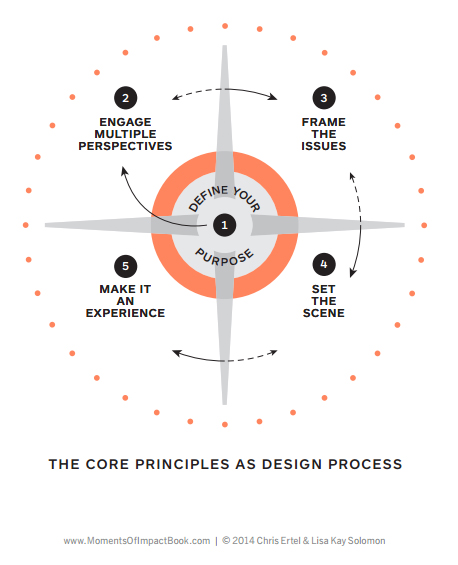
Conversation, as everyone knows, can be far from benign. For those looking to control a conversation, unless highly skilled, the better (and far less productive) option may be to continue with monologue.
Because a strategic conversation consists of live interactions between people with different perspectives and passions, you can never predict exactly where it will lead. (41)
That is the beauty of conversation: the whimsy factor can drop participants in places they never expected to arrive. That is also the danger—especially in corporate settings where a particular outcome has been strongly hinted at, if not guaranteed.
For those daring souls willing to let go, but who still retain a preferred outcome, Ertel and Solomon’s notion of a “strategic conversation” may just fit the bill. Start by sorting what you are trying to accomplish: build understanding, shape choices or make decisions. And then employ divergent and convergent thinking and other group exercises as necessary.
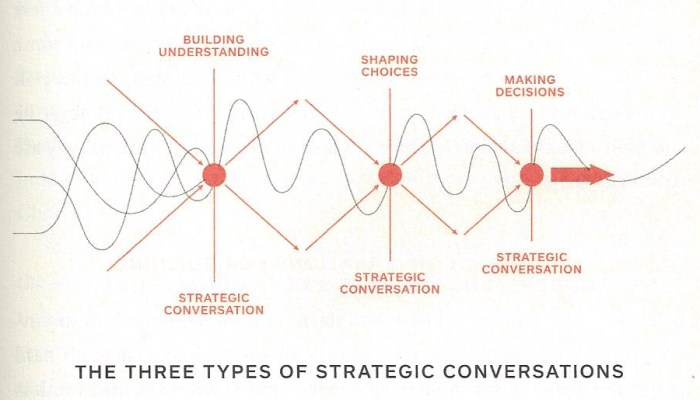
What I appreciate about Ertel and Solomon’s work is they have built a framework around the basic serendipity of conversation and brought it as a tool into even very hierarchical structures.
I am convinced we’ll find strategic conversations a formidable tool indeed, especially as we create brand new stuff out in the world.
###
Image credit: http://www.momentsofimpactbook.com
Thought Leadership Takes (too much) Time
And don’t be deadly-boring
In content-creation, I talk with clients and potential clients about telling their story in a way that promotes them and their business as thought leaders. Most clients have a business expertise that is poorly understood outside their niche or industry. And that is always the way: who really knows or cares how someone else spends their day?
One of the big challenges with our social appliances (Twitter, for example, and blogs) is telling the details of our story in a way that, a) shows we know what we are talking about, and b) communicates something not-deadly-boring to a casual passer-by. This is a huge challenge because most of us are interested only in what we are interested in.
Telling what we know in a way that engages the passerby is the challenge. That’s why I often use the metaphor of talking with the stranger or telling something to a ten-year-old. When eyes glaze or when they simply walk away, then you know you’ve not told your story well.
The thing is, our social appliances do not let us off the hook with the casual passer-by. Yes, we write our messages to our core audience, those are the people we seek to help and serve and engage. But those messages still must have enough hook to stop and (possibly) engage the conscious human passing by our web page/tweet/handmade sign. Building our brand, whatever that looks like: whether marketing a medical device, marketing a specific line of knowledge about medical devices/healthcare or marketing your own book—all these require that we tell our story in a way that keeps detail in focus while showing why it all matters to life on this planet.

Of course, the best way to do this is to know your topic well. Once you know your topic, mix in notions of how a stranger or passer-by would react and adjust accordingly. I find that knowing a topic and then adjusting the topic to the needs and interests of a particular audience has a miraculous effect of providing something I simply must say:
https://twitter.com/AdviceToWriters/status/529996620620763136
And that is a beginning of thought leadership: building out from what you know, day after day. It is very time consuming but if you are passionate about a topic, product or service—or a particular way of looking at life—than you can hardly keep from building the topic anyhow.
By the way, whether you write or not, everyone on earth should follow Jon Winokur’s tweets (@AdviceToWriters). His tweets should make anyone eager to create.
###
Image credit: Kirk Livingston
Burning Down the House: Stop. Drop & Adopt.
How social greases the gears of change
One way we begin to dispose of our sheltered and separatist clubs and churches and work is to talk about them out loud. When we start to tell a stranger about a sacred ritual inside the walls of our church, we stop and realize, “Wait—this probably sounds like nonsense.” And so we back up to start earlier with the “Why?” and “What for?” And then we drop the insider words and adopt common words.
Same with our work: when someone asks how we spend our day, we don’t use our office or shop-talk words. Most people don’t understand lingo of the workplace (especially folks in the workplace). So we stop. We drop the shortcut words in favor of the basic words used by the rest of the humans that speak our language.
And then we paint that ritual or work or favored topic in the best possible light. It’s a little rhetorical flourish we do without realizing. I want you to be excited by what excites me, so I talk it up. I punch it with bits of enthusiasm and look for ways and words that help you get the same vision I have.

Do what you must to pull in the stranger.
Getting others interested by telling the juicy bits of what interests us is one of the basic ingredients of any social media. It also happens to be a basic expectation of story-telling.
What’s that?
You don’t have contact with strangers?
You only talk with other insiders?
Is it time to reconsider your circle of friends to pull in outsiders? There’s much to be gained from relating your passion to someone who has no clue what you are about.
###
Image credit: Kirk Livingston

 conversation is an engine