Posts Tagged ‘conversation’
About the Node Not Taken
Steady There, Young Philosopher
My hardworking, entrepreneurial colleague surprised me in conversation the other day:
Sometimes I wonder what it would be like had I stayed in the corporate world—what would I be doing now?
My friend was in one of the periodic slumps that happen to anyone building a business of their own. Those slumps squeeze out long-suppressed questions. These are the questions that precipitate momentary crises of faith for those constructing wings as they plummet.

No. Really. Is there an actual “Afton State Park”?
Young philosophers like to ponder the “What ifs” of life:
- What if I had dated that person rather than this person?
- What if I had taken that job rather than this job?
- What if I had studied engineering rather than philosophy? (One certain answer: the world would have to cope with a very bad engineer.)
- What if had dived 12 inches to the left and missed that rock in the lake?
One problem with our casual “What ifs” is that they often assume a straight line from the point of decision. You go this way. You go that way. Two roads diverging in a yellow wood.
But what if our lives are composed of nodes that become roads? What if each decision is followed by another so that our paths are constantly changing in real-time?
Another problem with casual “What ifs” is they forget the tiny but forceful pinpricks of relationship and conversation and motivation that accompany every choice. Thousands of tiny insights and histories and dreams contribute to each action as well as each subsequent action.
Personally, I cannot help but wonder if the nodes that become roads all lead to the place/people we were meant to be in the first place. Wait—don’t call me a determinist yet. Stick with me: what I mean is that whether we stayed in the corporation or went on our own or dropped everything to join the circus, would we end up as the kind of people we were meant to be?
This is not a perfect thought: we build things into our lives, good and bad, by daily habit. We grow, or not, because of those habits and subsequent opportunities. Admittedly, the determinist take on choice has holes.
But I’m reminded of that inveterate letter writer who wrote his friends about walking in the “good works” begun in them.
Today I’m looking for nodes and roads.
And I hope to step in a good work along the way.
###
Image credit: Kirk Livingston
Moments of Impact: Making Work Conversations [actually] Work
This third kind of work conversation involves divergent thinking
In Moments of Impact: How to design conversations that accelerate change (NY: Simon and Schuster, 2014), Chris Ertel and Lisa Kay Solomon make the case that we need a third kind of conversation at work. Here’s how Solomon and Ertel categorize most work meetings:
- Typical meeting where someone stands at the front blathering on with slides while attendees multitask with Facebook, Twitter and occasionally, actual work.
- Brainstorming meeting where people attend to think brand new thoughts (and to eat donuts). But brainstorming meetings are routinely dismissed today as producing far fewer ideas than if the attendees sat in isolation producing ideas before coming together.
- Strategic Conversations. This is Ertel and Solomon’s new kind of conversation. Rather than engaging in the typical presentation/multi-tasking meeting, they want attendees to deeply and viscerally engage in a compelling question.

Mindful like a hungry hawk.
Moments of Impact is all about how to make this third kind of conversation happen. The book develops five points to help make strategic conversation an experience versus another bout of human downloadment:
- Declare objectives/define the purpose

- Identify participants/engage multiple perspectives
- Assemble content/frame the issues
- Find a venue/set the scene
- Set the agenda/make it an experience
Nothing earth-shattering so far, right?
And yet, as it is so often, our connections provide the earth-shattering stuff, rather than any consultant’s formula. Where we connect—with 100% attention—that’s where the magic happens. In connection there something mystical that lies beyond engineering technique and management principles. Moments of Impact is about setting the stage for that connection.
One thing is becoming clearer very day: when we employ mindfulness rather than pursuing mindlessness, we find ourselves deeply engaged rather than seeking more distractions.
Mindfulness in the service of creating an experience also seems to honor humans as human (versus as corporately-owned human capital to be rejiggered at will).
That old attitude may have worked for an assembly line (doubtful), but for our volatile, uncertain, complex and ambiguous world, we need the best each of us can bring.
###
Image credit: Kirk Livingston
Collaboration in Real Life: The Book Cover
Self-promotion is stinky poop
This week I spoke with a copywriter who writes plays and novels on the side. But he doesn’t work too hard on promoting his finished bits of literature. He prefers to stick to the writing part (who doesn’t?). This copywriter is not atypical on two counts:
- If you don’t need to get your message out (that is, move product to earn the feeble coin a book represents) you can let it languish.
- Copywriters are bad at self-promotion.

Roger’s cover
Not all copywriters, and probably not the copywriter I spoke with. But many are bad at self-promotion. It’s funny because while copywriters have insight into the psychology of business problems and use divergent thinking to solve those problems, they have a hard time turning that insight onto their own projects.
And that is true for all of us.
It’s not just because self-promotion has the feeling of swimming in a septic tank. It is also because we are truly blinded to the very things we are most passionate about. We’re typically deep inside those passions, and we have no clue what it all looks like from the outside. That’s why we need to tell others and get the outside insight that telling affords.
A client and friend provided a quick insight that has proved far better than anything this insider could produce. My first book, ListenTalk: When Conversation is an Act of God, is on its way through this marathon called publishing. Encapsulating the message into an image and a few words has proved daunting to me. Roger’s cover, with the fire, well, most people love it better than my covers. I’m not bitter, I’m grateful: grateful to have people around who can offer very tangible insights. These insights regularly, well, cover my arse. And I’ve always maintained that I am neither a designer nor photographer.
I thank God for people with such quick insight.

My covers.
A word about ListenTalk versus “conversation is an engine”
If you’ve dropped by this blog, you may have noticed I hit on different topics as they relate to conversation. Business and the business of writing, and the business of how faith and craft and work fit together are key drivers for me as I write.
My first ongoing project along these lines was to develop a sort of practical theology of persuasion—something I was desperate to understand as a copywriter who regularly trusts in God. That is what ListenTalk represents. It takes some topics from “conversation is an engine” but develops them specifically for people of faith. Here’s the draft copy from the back cover:
“Talk is cheap.”
So we say, but deep down we know different.
We know talk is a potent engine for war and love and all that lies between. Talk is our entertainment and our tool for exploring every relationship. Talk is an economic engine. Lives change—culture changes—when we talk together. In many ways, the future is patterned after our speech.
And this: even God responds to talk.
Yet we pay scarce attention to the working parts of conversation: the listening, the words used, and the intent behind the words. And we hardly think about God’s purpose in speaking, and how God speaks today with fierce desire for reunion—and how that desire motivates all God says and does.
Every day, people work out God’s desire in thousands of ordinary ways. Not so much through sermons and high-minded programs as through the ordinary conversations among themselves.
ListenTalk will help you to re-think what God accomplishes in even your smallest, most ordinary conversations.
“ListenTalk is a wonderful book with deep wisdom, practical advice, and heart-warming encouragement. Read it, converse with it, and share it with others.” –Dr. Quentin Schultze, Calvin College
“In our contemporary world where words and ideas seem to divide far more than they unite, ListenTalk provides an antidote of balance and sanity. ListenTalk reminds us of a power that can lead to greater understanding, intimacy, collaboration, and even personal transformation…culminating in deepening our life with God.” –Judith Hougen, University of Northwestern—St. Paul
Hey—wait a second. You could buy ListenTalk!
###
Image credit: Kirk Livingston
Are Doctors “Ethically Obligated” to Tweet?
No.
Although Wendy Sue Swanson, MD (@SeattleMamaDoc) feels that way about her social media presence (as demonstrated in this clip).
There is one piece of the Hippocratic Oath that calls for casting a wider net in “all my acquirements, instructions, and whatever I know” to those within the physician’s circle. The original oath also called all gods and goddesses to witness and observe, but these days the NSA serves that function (despite HIPAA).
Yesterday’s MedAxiom post by Ginger Biesbrock (“Has anyone seen my Dictaphone?”) makes the excellent point that any new technology adopted should make taking care of patients easier. New technology should not get in the way of treatment, it should not be another hurdle to jump. Instead, technology should simplify meeting the patient’s need. That’s why I’m pleased with the movement to hire medical scribes to complete the electronic medical records in the moment—freeing doctors to treat patients versus keyboarding.
Dr. Swanson’s strong feeling about casting a wider net is likely shared by many if not most physicians. And it just so happens that putting correct information out where regular folks might read it may also be a way to grow your practice—which has been the capitalistic promise of social media from day one.
Sure: doctors are busy. But I cannot help but wonder if more and more physicians will make outward communication (blogging, tweeting, connecting) a priority as they work to free themselves from some routine tasks.
Many already are.
###
Image credit: Kirk Livingston
Should a Doctor Blog?
Only if they want to grow their practice. Or connect with other physicians. Or with patients. Or provide thought-leadership.
Greg Matthews, author of Missing the Forest for the Trees, has been studying the online presence of physicians for years. He’s found that the credibility of their position and the connections within that position can translate to large and devoted followings today.
But all that was counter-intuitive in 2007.
Back when Mr. Matthews was formulating his questions about physicians online.

Back then he was sure—we all were sure—that talking about health information online would never fly. It’s just too personal. What kind of nut would diagnose and prescribe in public/online?
Plus, well, HIPAA.
But some physicians found a way to talk with regular folks (that is, us non-experts who live on the web) about pressing topics. Diagnosis and prescribing on the web was a non-starter, but presenting topics in a way that made sense to regular people did happen. And as we all took to the web to sort our maladies, these authoritative, personal voices became trusted sources of information.
According to Mr. Matthews, today 61% of physicians access social media weekly, 5000 physicians post daily to blogs and Twitter, and 50 physicians are followed each by more than 500 other physicians. Some physicians even feel “ethically obligated” to share on the web. Download Mr. Matthews PDF for more stats.
In this blog (conversation is an engine) we talk about conversation. We’ve noted how conversation is a two-way street: not just in words exchanged, but actually causing conversation partners to go and do different stuff. We leave our best conversations changed and with new resolve for the most important things facing us. It’s a sort of speech-act theory for anyone willing to take a dumb-sketch approach to life.
And even physicians and even patients can gain from this. And what they both gain is far more than mere information.
It makes me wonder what paths might open for collaborative conversations in lots of different work settings.
###
If a Customer Shouts in the Forest and No Customer Service Rep is Around to Hear it…
Should she post a comment on Yelp?
Nancy Beiersdorf of Medtronic’s e-Commerce and global strategy hinted (in this SAP talk) at the medical device company’s evolution from a product company to a solutions and service company. One important ingredient in this new recipe will be hearing from the people with problems (people in need of a solution) and helping them solve those problems (that is, service).
But hearing from customers is not easy—even for other customers.
If you’ve ever used Yelp to locate a restaurant while traveling through a new city, you know to toss 30-50% of the comments as someone having (a) evil intent or (b) a bad day. Even our favorite national parks suffer from poor Yelp reviews:
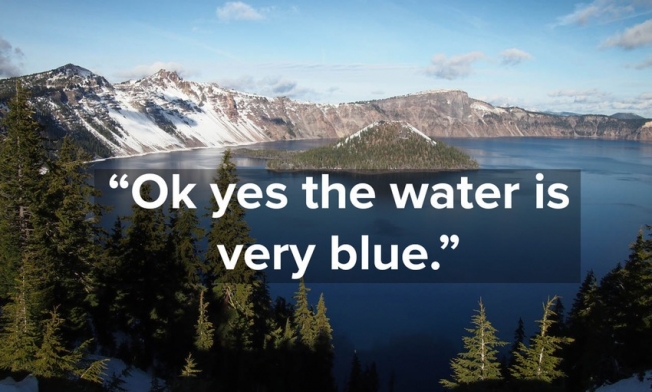
Sorting fact from fiction has been a traditional problem with hearing from the customer. Customer service must wade through long, rabbit-trail narratives to finally get to the actionable item. That is the way of human conversation—sometimes it takes a while to get to the point. All this unquantifiable blather plays havoc with our quality systems. Surely customer service will soon chart a metric like “Time to actionable issue” and pay employees accordingly.
Hearing from customers is an inherently messy business. Especially for Medtronic: where reps once talked only with cardiologists and electrophysiologists now there will be all sorts of real people on the phone (or more likely, placing orders and comments on a web site).
All this conversation cannot help but change things upstream and downstream. In particular I expect at least two results:
- Increasing masses of consumer-to-company interactions will train consumers over time to use certain words and press certain buttons to get what they want. Much in the same way we are conditioned by repetition to bypass our bank’s introductions to get to a real human.
- Corporations may grow more sensitivity toward customer voices–the very thing Ms. Beiersdorf advocates. By that I mean conversations have a way of working backward into the machine-gears of a corporation. As solutions and service show up more clearly on the P&L sheets, people will start to pay more attention to human interaction.
At least that is what I hope.
Let there be more advocates for the customer voice.
###
Image credit via Adfreak
Talk With Those Who Talk With You (DGtC#25)
Humans just want to connect
Social media, like sales, seeks an ever-expanding public. All tweeters want more followers. All bloggers—same thing. Just like the TV networks of yore, where Nielsen Media Research rated efficacy by numbers (and types) of viewers they brought in. Which just happened to coincide with increasing amounts of cash they could wring out of a sponsor for a 30 second span of monologue.
How to measure audience (and collect cash) continues in today’s social media world as various metrics are embraced and/or disgraced: clicks, views, comments, engagement, time spent on a site.
But real humans in earnest conversation don’t care about size of audience. They care about connecting with a person to tell the important thing they have to say or to hear the important thing a friend or colleague has to say. They want to remark on what is remarkable.
Call me a mystic (please!), but I still embrace the notion that the people peppered through our lives are there for reasons beyond our understanding. And those talking to you—today, right now—have something you need to hear and they need to say. Those people right beside you are worth attending to. For their sake. And for yours.
It’s not wrong to widen your audience.
Just don’t lose sight of this moment with those right before you.
Also see:
- Listen to other people’s stuff (#6)
- Dialogue is a scenic bypass (#12)
- “Good to know” and a failure to communicate (#23)
###
Image credit: Kirk Livingston
A Tale of Two Meetings
Collaboration in person and on paper
Meeting #1: The entire department was gathered at tables shaped into a horseshoe, to facilitate discussion. Twenty to thirty of us waiting for the director to come in and explain his vision. And his vision was that the creatives needed to become analysts. Art directors, designers, copywriters, production personnel—everyone an analyst. Everyone focused on metrics. Give away the creative to outside agencies.
The director talked for 30 minutes and then asked for questions.
Not a single question.
Meeting #2: The entire group was gathered at tables shaped into a horseshoe, to facilitate discussion. Twenty to thirty of us waiting for a series of speakers to come in and explain their vision. Speaker after speaker explained their vision, the metrics they used to decode that vision, and the outcomes they experienced.
Each of the seven speakers spoke for a few minutes and then paused and waited for responses. Then they spoke again and waited. The entire group learned quickly that each speaker truly sought interaction.
Every pause elicited questions. Tangents were followed despite time constraints. After all, the point was the responses.

In my social media marketing class we spend time talking about how to get interaction and comments from the communities we are building. At first it is discouraging for the students, their work feels like shouting treasured thoughts into a hillbilly hollering convention. Nearly impossible to be heard.
But gradually a few people show up at each student’s attempts. And we learned to treat comments from these few with great care: responding immediately. Thanking those who show up for reading. Engaging the thoughts of the people who showed up. Then the students learned to go visit others building similar communities and listen and comment. And soon they found their community growing (in the social world, people follow back those who show up). And they learned not just to put questions at the end of diatribe but to design pauses in the middle of their thoughts so people could respond. And they learned to break up a lecture into a series of engaging posts. And they learned to let their thoughts be shaped by what the people who showed up said.
Those two meetings had key differences: In Meeting #1 each audience member reported to the director so there was very little debate. Debate in that particular firm seemed not too far from mutiny. But in Meeting #2 (same company, oddly enough), the audience was composed of potential customers. And as each speaker spoke, they did their best work with verbal and body language to engage the audience. And each of the potential customers spoke freely, calling “BS” when they heard it, disagreeing vocally, undaunted by executive titles.
Our verbal collaborations point to our literate collaborations. Pauses in copy, short copy, even shorter copy, copy that talks about what people are interested in—all of these allow collaboration. But the key is how you think about the audience: do you really want their response? People are not stupid: they know when someone is lecturing. And lecturing is a sure-fire way to shut down collaboration.
###
Image credit: Kirk Livingston
Ditch Your Job to Woo Collaboration
Sure it’s a mess. But it’s a glorious mess.
Focused, nose-to-grindstone is certainly simpler. Get it done so you can go home on time and watch TV.
Bring another person into your process and suddenly things get messy. You find yourself explaining rather than doing. And explanation is a time-sink—just like small-talk. Plus collaboration is not guaranteed: will you have to redo everything your collaborator attempted?
This is why students groan audibly when I introduce a group project in a writing class. Especially when their grade depends on successful interaction. They hate it hate it hate it.
And that is too bad. I’ve often wondered why we don’t teach collaboration alongside math and biology and writing and literature in grade school. But it seems collaboration is a thing you are primed for later in life, when you start to see you don’t have all the answers. It is a bent that takes root after we have an experience or two of utter delight at someone else’s contribution.
Wooing collaboration starts with shop talk: where you step out of your job’s established tracks and ask others about their experience. How do they do what they do? What do they delight in? Where does meaning enter into their work? Those answers play into our daily conversations. This is where we learn the eccentricities of our colleagues and see how they bring their diverse knowledge and experience to bear on the work. This is where we learn what it means to be alongside someone.
Just doing your job is isolating—especially when you think you have mastered it and have nothing left to learn. Inviting others into the thinking behind the job is incorporating. Yes it takes time and can be a mess, but in the end it is our connections that pull us forward.
How do you incorporate others into your work?
###
Image credit: Kirk Livingston
How to Make Your Message Permanent
A tip from a prehistoric consultant
First: Forget about it. Nothing is permanent—at least not in the way advertising mavens augur.
Second: OK—if you insist—make your message about someone else. Make your message give back more than it takes in. “GE” branded on a rock would never last. Even the Apple logo will be chiseled away by Microsoft rebels. But a man with jointed wings, well, who can resist that story?
![Who can resist the story about the “Thunder Being”?]](https://conversationisanengine.space/wp-content/uploads/2014/10/birdman-2-10022014.jpg)
Who can resist the story about the “Thunder Being”?
Prehistoric peoples stopped by these ancient rocks to tell their version of the human condition. So they carved/picked/incised/abraded their messages into the exposed Sioux quartzite outside Comfrey, Minnesota long before there was a Comfrey or a Minnesota or a U.S. of A. Maybe before the pyramids and Stonehenge. Ancients left messages here to direct and entertain passers-by.
Why make your message permanent? We understand marketing communications for companies—it’s about keeping the wheels of commerce turning. But you personally—what messages do you have to communicate? And why would you make them permanent? I argue that your take on the human condition comes out in the way you do your work, the way you interact with family, friends, colleagues, and even the way you see/refuse to see the homeless guy at the end of the exit ramp. And all these daily interactions amount to a carving and incising that is far more permanent than any of us imagine.

The Jeffers Petroglyphs tell a story that became a destination.
Our conversations have an enormous (cumulative) effect on the people around us. An effect that may move through generations.
What exactly is your message, anyway?
###
Image credit: Kirk Livingston

 conversation is an engine