Posts Tagged ‘dialogue’

Richard Rohr: “be prepared for much resistance”
Maybe real wisdom first helps others see the path and potential obstacles.
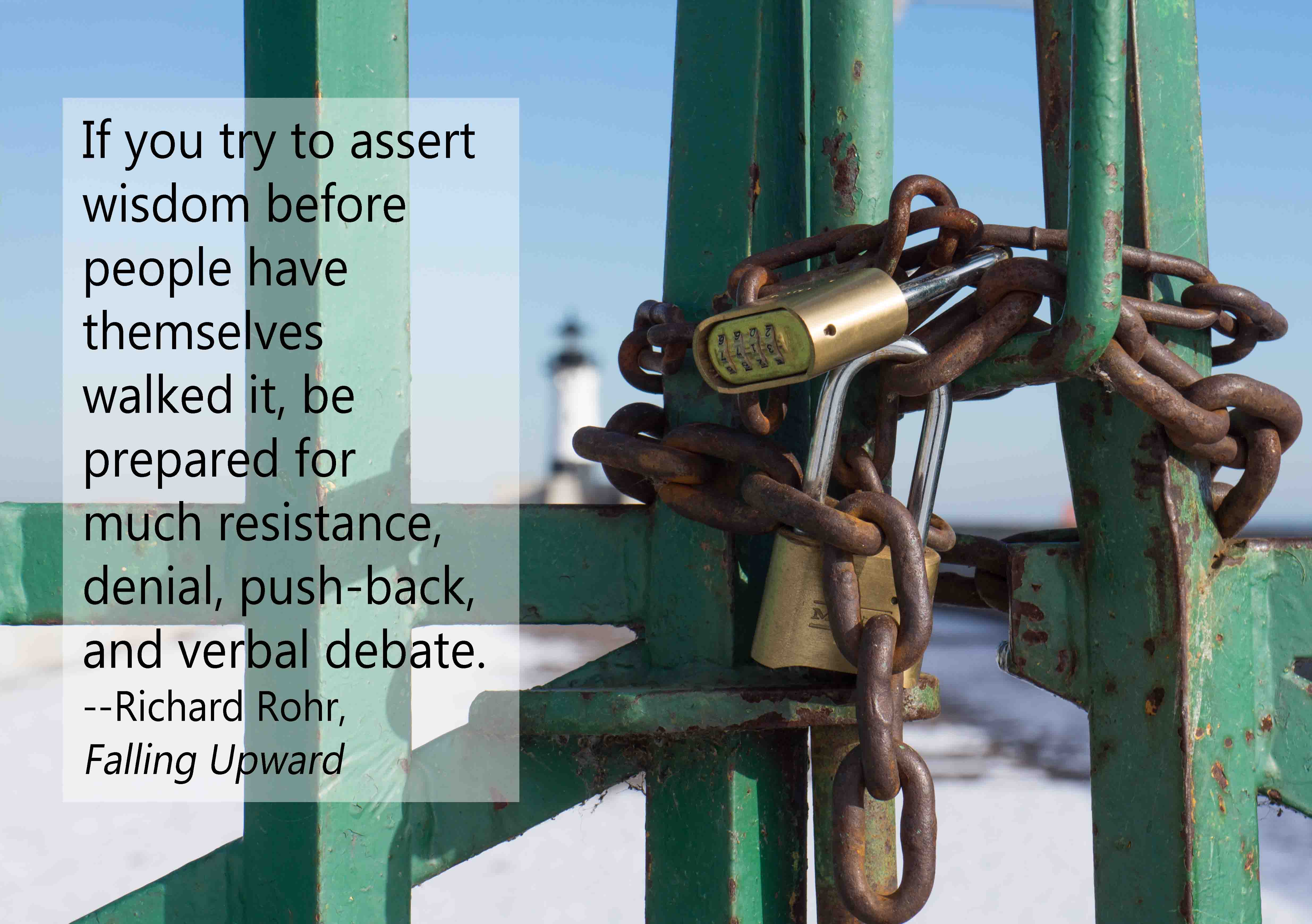
And maybe real wisdom also listens for the additional perspective.
###
Image credit: Kirk Livingston
Moments of Impact: Making Work Conversations [actually] Work
This third kind of work conversation involves divergent thinking
In Moments of Impact: How to design conversations that accelerate change (NY: Simon and Schuster, 2014), Chris Ertel and Lisa Kay Solomon make the case that we need a third kind of conversation at work. Here’s how Solomon and Ertel categorize most work meetings:
- Typical meeting where someone stands at the front blathering on with slides while attendees multitask with Facebook, Twitter and occasionally, actual work.
- Brainstorming meeting where people attend to think brand new thoughts (and to eat donuts). But brainstorming meetings are routinely dismissed today as producing far fewer ideas than if the attendees sat in isolation producing ideas before coming together.
- Strategic Conversations. This is Ertel and Solomon’s new kind of conversation. Rather than engaging in the typical presentation/multi-tasking meeting, they want attendees to deeply and viscerally engage in a compelling question.

Mindful like a hungry hawk.
Moments of Impact is all about how to make this third kind of conversation happen. The book develops five points to help make strategic conversation an experience versus another bout of human downloadment:
- Declare objectives/define the purpose

- Identify participants/engage multiple perspectives
- Assemble content/frame the issues
- Find a venue/set the scene
- Set the agenda/make it an experience
Nothing earth-shattering so far, right?
And yet, as it is so often, our connections provide the earth-shattering stuff, rather than any consultant’s formula. Where we connect—with 100% attention—that’s where the magic happens. In connection there something mystical that lies beyond engineering technique and management principles. Moments of Impact is about setting the stage for that connection.
One thing is becoming clearer very day: when we employ mindfulness rather than pursuing mindlessness, we find ourselves deeply engaged rather than seeking more distractions.
Mindfulness in the service of creating an experience also seems to honor humans as human (versus as corporately-owned human capital to be rejiggered at will).
That old attitude may have worked for an assembly line (doubtful), but for our volatile, uncertain, complex and ambiguous world, we need the best each of us can bring.
###
Image credit: Kirk Livingston
A Tale of Two Meetings
Collaboration in person and on paper
Meeting #1: The entire department was gathered at tables shaped into a horseshoe, to facilitate discussion. Twenty to thirty of us waiting for the director to come in and explain his vision. And his vision was that the creatives needed to become analysts. Art directors, designers, copywriters, production personnel—everyone an analyst. Everyone focused on metrics. Give away the creative to outside agencies.
The director talked for 30 minutes and then asked for questions.
Not a single question.
Meeting #2: The entire group was gathered at tables shaped into a horseshoe, to facilitate discussion. Twenty to thirty of us waiting for a series of speakers to come in and explain their vision. Speaker after speaker explained their vision, the metrics they used to decode that vision, and the outcomes they experienced.
Each of the seven speakers spoke for a few minutes and then paused and waited for responses. Then they spoke again and waited. The entire group learned quickly that each speaker truly sought interaction.
Every pause elicited questions. Tangents were followed despite time constraints. After all, the point was the responses.

In my social media marketing class we spend time talking about how to get interaction and comments from the communities we are building. At first it is discouraging for the students, their work feels like shouting treasured thoughts into a hillbilly hollering convention. Nearly impossible to be heard.
But gradually a few people show up at each student’s attempts. And we learned to treat comments from these few with great care: responding immediately. Thanking those who show up for reading. Engaging the thoughts of the people who showed up. Then the students learned to go visit others building similar communities and listen and comment. And soon they found their community growing (in the social world, people follow back those who show up). And they learned not just to put questions at the end of diatribe but to design pauses in the middle of their thoughts so people could respond. And they learned to break up a lecture into a series of engaging posts. And they learned to let their thoughts be shaped by what the people who showed up said.
Those two meetings had key differences: In Meeting #1 each audience member reported to the director so there was very little debate. Debate in that particular firm seemed not too far from mutiny. But in Meeting #2 (same company, oddly enough), the audience was composed of potential customers. And as each speaker spoke, they did their best work with verbal and body language to engage the audience. And each of the potential customers spoke freely, calling “BS” when they heard it, disagreeing vocally, undaunted by executive titles.
Our verbal collaborations point to our literate collaborations. Pauses in copy, short copy, even shorter copy, copy that talks about what people are interested in—all of these allow collaboration. But the key is how you think about the audience: do you really want their response? People are not stupid: they know when someone is lecturing. And lecturing is a sure-fire way to shut down collaboration.
###
Image credit: Kirk Livingston
Edward Bernays and Jolly Manipulation
Gather round, kids: here’s how you sway public opinion
Edward L. Bernays is called the father of public relations and his book Propaganda (NY: Horace Liveright, 1928) shows why. Bernays is absolutely jolly as he lays out the psychology of manipulation. He doesn’t just talk about the formulas, he gleefully demonstrates them in paragraph after paragraph. Much like one might describe building a shelter to a group of boy scouts, Bernays is positively beaming as he writes about how to pull self-interest into the equation to get publics to do your corporate bidding.
The modern propagandist studies systematically and objectively the material with which his is working in the spirit of a laboratory. (48)
Edward L. Bernays is the ur–flack.
If you can influence the leaders, either with or without their conscious cooperation, you automatically influence the group which they sway. (49)
Reading Propaganda today, it is clear Bernays thought corporations and government leaders and those in power would certainly use his manipulation techniques for good.
How could it be otherwise?

Look through here. You’ll see what you’re supposed to see.
But World War II was just around the corner and every nation developed their own propaganda machines. In the US, we still react viscerally to the imagery and code words used by Nazis. Today old Stalinist imagery has it’s own unique draw. The US had powerful PR apparatus as well. We continue to feed that machine. And since, then, of course, unending sets of military skirmishes/wars, each equipped with God-given reasons for why we must respond. Then Watergate and totalitarian despots revealed and deposed, and, well, it’s a long list of fails that contribute to today’s cynicism and “Question Authority” stance. People found their voice and collected it to push back with outrage at corporations and governments and to call attention to wrong doing when it appears.
Eighty-six years later, the entire population of the US—possibly the planet—is wise to Bernays’ techniques. Not that we’ve studied them: those techniques study us all day every day. Especially in countries like the US where consumption is our patriotic duty. We know manipulation from the inside out.
Bernays would be impressed were he alive to see it. I imagine him smacking his head and saying, “Wait—they know they are being manipulated, and …they still buy it? This is even better than I hoped.”
Why talk about manipulation? Not just because Bernays book is fun to read and easy to contrast with today. In particular, why would a copywriter talk about manipulation? Isn’t that secret sauce you trade in all day? Why pull back the curtain?
As a copywriter my goal is to tell my client’s story in the best possible light. I continue to argue that persuasion is a natural piece of how people interact with each other all day long. It’s part of the human condition. But I argue our efforts at manipulation damage actual conversation. When we use words and techniques with manipulative technique, we shut off further conversation. At that point it is about winning not connecting. Maybe there is a fine line between persuasion and manipulation. Propaganda is the textbook for manipulation.
As a copywriter, I want my clients to engage in conversations not endless manipulative monologues. That seems a more human approach to communication. I continue to think conversation is what today’s market will bear.
###
Image credit: Kirk Livingston
Letters to Father Jacob
And when your life work is revealed as futile:
Stacks of letters arrive daily at blind Father Jacob’s house. People ask for help and he prays for them. Sometimes he does more. Father Jacob’s previous reader is now in a nursing home. So he hired the convicted murderer who was recently pardoned: Leila. But these readings, followed by Father Jacob’s out loud prayers, feel particularly pointless to Leila.
And they start to feel pointless to Father Jacob as well.
And quite possibly Father Jacob is slipping into dementia.
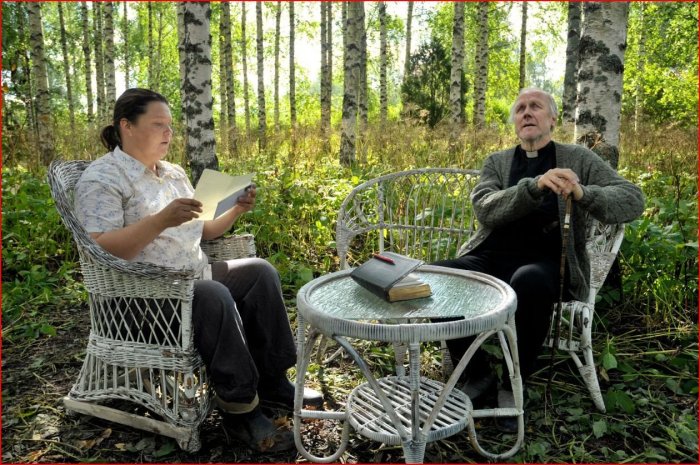
This 2009 Finnish film, which is beautifully photographed, has the pace you might expect of a hermit or ascetic. Not exactly slow, but each frame full of meaning. The film asks about the result of our life work. Where did that passion lead and what was the result?
Our literature of success in the United States hints that passion + patience + perseverance lead directly to success. But real life is more full of falling forward and marching backward: ups and downs that depress and invigorate. Despair swings by. Elation makes an appearance.
Letters to Father Jacob is more like real life than our success literature. And the conversations between Leila and Father Jacob reveal far more than mere words let on.
The storytelling in this film will stay with you long after the 74 minutes it takes to watch it. That is because after joy turns to sorrow you begin to see the real story threaded already in your brain.
It’s masterful stuff.
Letters to Father Jacob left me hopeful.
###
Image credit: IMDB
What Photography Teaches About Writing
Look for what reflects light
With camera in hand I look first for what is reflecting the light.
And then I shoot that thing.

It’s all about catching some sort of reflected glory.
The best writing does that too.
###
Image credit: Kirk Livingston
How LinkedIn Helps Before You Are Between Jobs
Generate The Thing Between
LinkedIn is a powerful tool for connection. But lots of people, once they land the job, put connection on the back burner. Some take it off the stove entirely—and that is a mistake, especially in this economy. I know this because many friends and colleagues are on radio silence most of the time. Until rumors of layoff float by. Then it’s connections galore.

Don’t let connections go dormant.
Connection is something that happens long before you have a need or want to generate a sale. In fact, connection is not about the need or the sale, it is something entirely different. And we make LinkedIn frenemies when we mistake connection for a sale.
For those who understand the importance of connections outside immediate work and building relationships widely, there is a great joy in getting to know people and simply seeing what might happen. It’s not even an introvert/extrovert thing. It is a possibility thing. Maybe it is a thing for dreamers, but I think not. It is for anyone who starts to wonder what is possible outside the structure that encases their days.
This openness to others—this beckoning to others, this waving them close—is the early move toward collaboration. It is the ordinary conversation that starts to generate new things between you, seemingly by magic. It is the beginning of finding common ground that eventually leads to “Wait—what could we do together?”
Curiously, openness to others has a way of working backward into our present job so that we start to see new ways of working, collaborating and connecting.
When teaching college students about professional writing, I try to help them understand that the best jobs are the ones not advertised. The best jobs open and shut before ever posted on a web page or printed as a classified ad. Those jobs are available only to connections. Those jobs are almost incidental to the connection: friends see what you do, how fun you are to work with. Their synapses fire and they say to themselves, “She might be perfect for this need we have.”
Maintaining and growing connection is not for a someday need or someday sale. It is a piece of being human and carries a glory all its own.
###
Image credit: Kirk Livingston
Could Your Organization Grow Your Spirit?
LEED-like certification for human-spirit-sustainable workplaces
LEED certification is a rating system that recognizes a building’s sustainability. LEED or Leadership in Energy and Environmental Design, rates a new building project using five different categories:
- Site location
- Water conservation
- Energy efficiency
- Materials
- Indoor air quality
Businesses and organizations with the highest ratings display them as a sort of badge of honor for the public to see.
What if there were some system to measure and rate the culture within a company or organization? Since we worry about bullying at school and we’re starting to recognize bullies in the office and toxic corporate cultures, does it make sense to start thinking about organizations that sustain people rather than beat them?

For instance, what if any organization was judged by these four categories:
- Bias toward collaboration
- Employee engagement indicators
- Mix of top-down messaging with true conversation
- Ratio of CEO-pay to rank-and-file pay
Seem ridiculous?
It would be difficult to measure many of these, especially since most of the categories seem so subjective. And yet, would it be impossible to measure? Would it be worthwhile to measure? Are we already moving in that direction?
In Minneapolis/St. Paul—like any set of cities—insider talk has long identified those cut-throat corporate and institutional cultures that routinely toss human capital to the side. Insider talk also identifies those bosses, managers and C-suite people without empathy and/or ethical moorings. New employees are generally forewarned when they sign up.
Of course, business is still about earning a living for the people involved even as the organization serves some human need. So don’t think I’m championing some communistic collective. Profits will and must be made to help society move forward.
But as we move toward fuller employment, workers will become more choosy about where they spend their days. And those cultures that have a less sustainable ethos will not be the winners.
I’m not convinced I’ve identified the right categories to measure. What categories would you include?
###
Image credit: Kirk Livingston
…The…Slow…Talker…. So Boring.
What can you learn from the slow guy?
Q: My colleague is the slowest talker in the world.
Each sentence he forms takes forever and we can all see where he’s going long before he gets there. I’m tempted to take up knitting whenever he makes a point in a meeting. We all finish his sentences.
Is that so wrong?

Not every conversation is electric quick.
A: Some people want to be sure of what they are saying. For some people the internal editor stands with a bullwhip as words cower by the tongue. It could also be your colleague is intimidated by your work team. Do you or your team tend to jump in to argue or quickly quibble about word choice?
Consider counting to ten (or 50) when your colleague speaks.
And consider not finishing his sentences.
Being heard is a basic courtesy we offer each other. When we slow our listening to the pace of our conversation partner, we extend a bit of tangible grace and we demonstrate this person has value—no matter how boring they are. Maybe waiting in expectant silence will begin to change our slow-talking colleague. Maybe he will begin to feel more confident and less like he’ll be mugged for his word choices.
But even more importantly, waiting and expectantly listening trains us to listen for more than words, with more than our ears, to more of what might be going on. We’re used to instant, but not all of what we have for each other lends itself to instant. People need to process words and experiences and thoughts. If we rush them to the end, we likely speak for them, with our words, not theirs.
If your slow-talking colleague drains you with his long pauses and predictable boring comments, consider limiting time with him, just to save you both hassle. But when with him, give him time.
You may be surprised.
###
Image credit: Kirk Livingston

 conversation is an engine