Posts Tagged ‘photography’
Can we finally reject being defined as “Consumers?”
How about “citizens” or “persons”? Maybe not “fleshists.”
Must everything in U.S. life be about ingesting?
Eating. Watching TV. Shopping. Listening to music. Watching movies. Amassing tablets and apps that allow us to consume more and faster and on-the-go. Talking about what we are eating/watching/buying. These are our pastimes. These are the things that define us. None are bad, many are necessary, but should they be at or near the core of our essence?
Is this why we landed on the planet?
I like all these things as much as anyone, if not more. But I wonder if my rush to consume has blinded me to other definition-inducing activities? Consuming is good for brand managers because they can play on this emotive, definitional piece of life and squeeze money from our attempts to be a certain kind of person. We buy this car or those dungarees or those shoes (or watch that show) because of certain aspirational desires. If we own that property, then we become that person. Yes?
In Cognitive Surplus, Clay Shirky makes the cogent point that watching TV is very like a full-time job for many of us. It consumes our hours outside of work like nothing else. I understand why: many of us are so busy at work, spending so many hours, stressed about so much that all we can muster—all we can look forward to—are those blessed, mind-numbing moments on the couch before the screen.
I’m right there. That’s me, too.
Shirky’s book goes on to point out example after example of people banding together in groups small and very, very large to accomplish things that would not otherwise exist. Wikipedia comes to mind, along with open-source software. As social media allows us to connect, I wonder if our collaborative selves will beckon us from the couch more and more often. It’s not some new magic of social media I’m talking about, it’s the very old and known quantity of human connection. Relationship stuff has always motivated our species.
But we’ll need to step away from constant movement and blessed numbness to get back to seeing ourselves as co-creators and collaborators. Relationship-builders rather than consumers.
###
Image credit: Kirk Livingston
Get More Aha’s Per Hour (Dummy’s Guide to Conversation #17)
Dance + Sit + Open = Insight
Who doesn’t crave that sudden influx of insight, the aha?
It is the aha that helps us turn a corner, change a behavior, or to finally, effectively, say “No!” to a persistent bad habit. The aha is a change of mind/heart where we suddenly have insight into a persistent question and then realize we can do things differently. And we will, starting now.
Over the weekend Henry wondered aloud how to have more aha-moments. I speculated that generating more aha’s starts with a dance of definition (DGtC #4) and moves to sitting with the question (DGtC #5). Both the dance and the sitting force the troubling question or decision toward the surface—like a bubble rising slowly through a thick malted milk. And then as we take the vulnerable move of voicing our vexation (DGtC #9 and #10) and then wait (DGtC #8), that is precisely when we are most prone to experience an aha moment. That’s because we are searching and listening. And the next conversation may just connect the dots.
Getting more aha’s per hour means living openly with our questions as well as asking them of the people around us. Insights flow from conversations, often unbeknownst to the conversation partners.
What vexation will you voice today?
###
Image credit: Kirk Livingston

“The readiest way of working on understanding is often through talk…”
Douglas Barnes on Exploratory Talk
The readiest way of working on understanding is often through talk, because the flexibility of speech makes it easy for us to try out new ways of arranging what we know, and easy also to change them if they seem inadequate. Not all kinds of talking (or writing) are likely to contribute equally to working on understanding. A great deal of the writing that goes on in school is a matter of imitating what other people have said or written, and the same is true at least in part of the talk.
–Douglas Barnes, “Exploratory Talk for Learning” in Exploring Talk in Schools, edited by Neil Mercer and Steve Hodgkinson (Thousand Oaks, CA: Sage, 2009) 5
###
Image Credit: Kirk Livingston
Work: blessing or curse?
Make Your Own Meaning
Whether you’re on the people’s tram to join a raucous celebration with Socialist or Communist overtones or just sitting at your desk working the typical Thursday, it’s worth reflecting on the work we do every day.
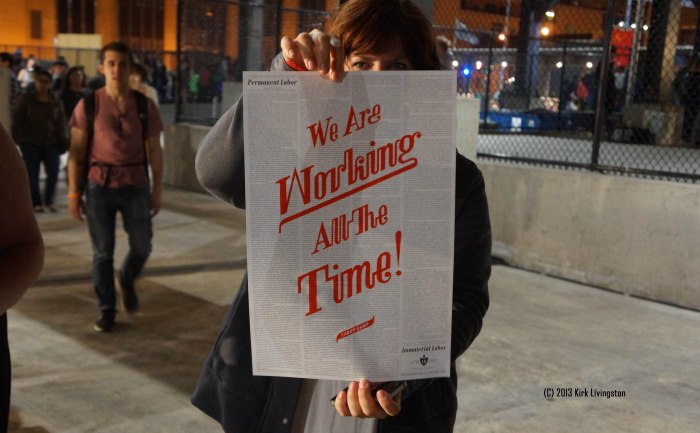 Sometimes we forget that the old story in Genesis placed work securely on the blessing side of the equation: Adam and Eve got to hang in the garden and work it. Their work had purpose. But after the curse, work changed. Painful became a key descriptive. And purposes got all crossed. It’s that painful, cross-purposed stuff we most often think on when we reflect on work.
I’m with the writer of Genesis on this one: work is way more blessing than it is curse. Learning to act in some purposeful way out in the world is a pretty good way to go through life. Picking up skills and using them to earn and help others and provide insight and move projects along—it’s all meaning-making stuff. I’m also of the opinion that we make our meaning as we go. We have to find our own reasons for working. And often those reasons come from somewhere deep inside (versus from a wallet-sized card produced by the public relations or human resources department).
When we start see how our work makes a difference, each day becomes something of an adventure.
###
Image credit: Kirk Livingston
Listening has an Ugly Step-Sister: Waiting
Surprise: She Has a Lot to Say
The problem with listening has always been the other person talking. When will they stop talking so I can talk about myself and my interests? You know—the important stuff.
And so we wait.

Turns out there are lots of opportunities to wait in life. Beyond waiting for our turn to talk or the sheets to dry, there are lines at the grocer, lines for on-ramps, waiting for Netflix to load, waiting to get a job/spouse/house/liver/reprieve/break/two-bedroom spot in the nursing home.
What we do while we wait—that’s key. Some say stay busy. Some say pray (seems a good strategy to me). Some say stay curious. Some say pursue your passion.
And then there is listening
Listening while you wait.
Intently.
Deep in the spinning cogs and meshed gear-works of waiting there is a mechanism that also tunes interest. If I listen intently I may just see my desire shift ever so slightly. I scraped and saved for years for a new car but when I had the money, I realized desire shifted: I didn’t want to spend it on the new car. A used car does fine, and I’ll spend that savings for the other thing that became important in the meantime.
Is this partly how prayer works: deep desire and constant asking followed by shifts in desire and asking that turns to listening?
When we wait we are ripe for deep listening.
What are you hearing while you wait?
###
Image credit: Kirk Livingston
Let’s get visceral: Choose your signal before you gut-punch
What forms say before we know anything
I recognize a business card because of the shape and size. I recognize a sermon more by a particular tone and rhythm (which signals a certain intent) then I do the presence of a pulpit or podium. I know a joke is coming because Letterman is on stage and it is 10:37pm. I know the joke will have a setup and a payoff. Or perhaps the third of three statements will be funny. I am ready for the joke because of these forms.
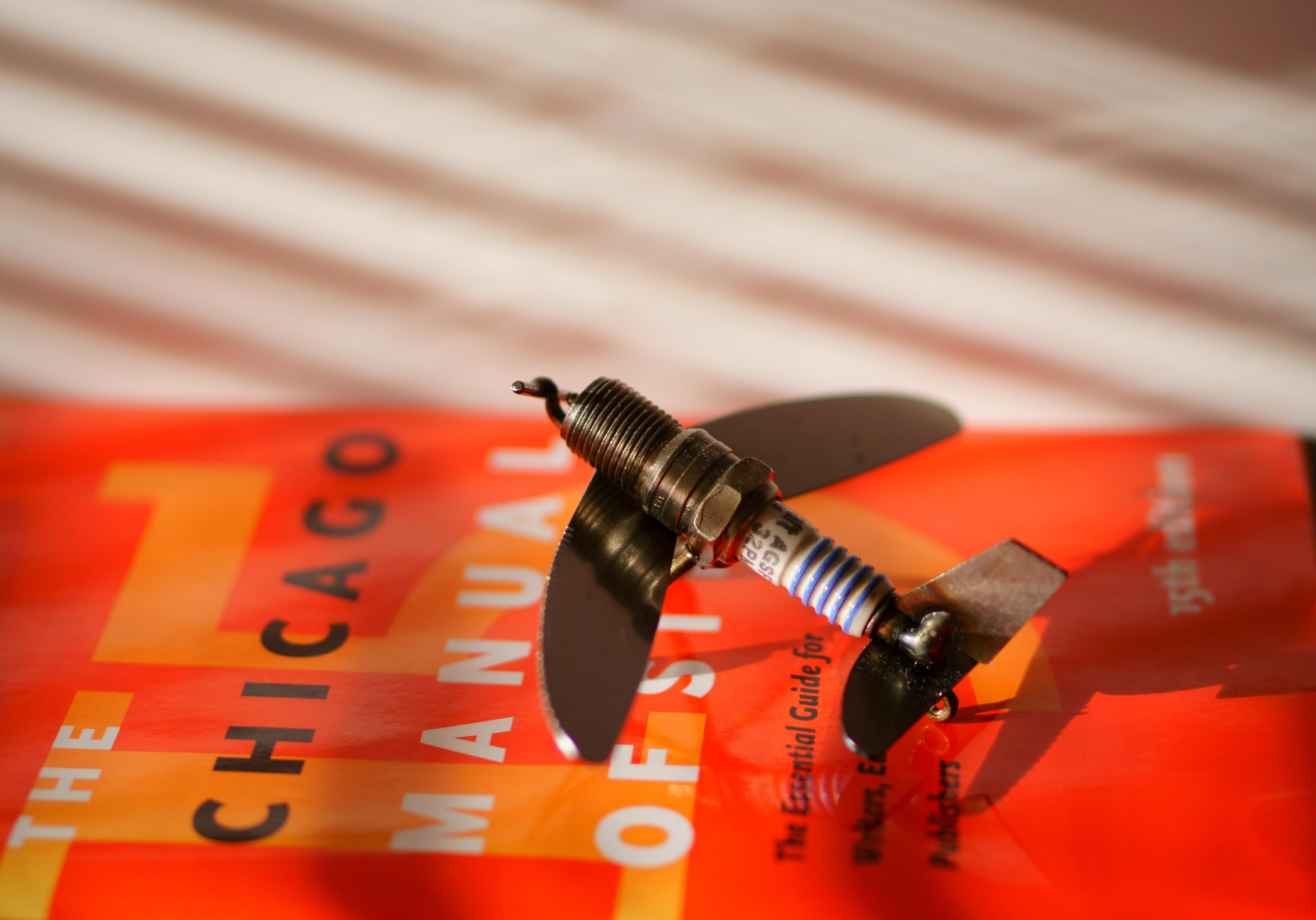
Before we know anything we recognize a form. Our brain sorts how to react to that form, and then, once that is settled, we process communication content. Long before I hear any content, I know what category to place each of those communication events. It is the context that prepares me: when I see X, I know Y is not far behind. My nervous system anticipates the next piece.
But what if the form is out of whack?
What if I hear preaching on a street corner? What if a clever copywriter uses a rubber stamp instead of a business card (“Here, give me your hand and I’ll stamp my contact stuff on you palm.”). And what if Letterman was serious? He has been a few times: right after 9/11 his serious tone—entirely uncharacteristic—began a bit of national healing.
I tell my copywriting students to follow the forms at times and to bust the forms at other times. For instance, we must make our ideas as easy to understand as possible, and so we present our ad concept to a client in a form that is immediately recognizable—even if the idea itself is challenging. And sometimes one thumbs one’s nose at the form on purpose, just to bust through (that is, the communication gut-punch).
In any case, following the form or busting the form is a conscious decision.
And the form is not God (not even a god).
By the way, Dan Pink has a great story about the Pixar way of presenting a concept here.
###
Image credit: Kirk Livingston
What happens when we say stuff?
An Epistemology of Writing
I just realized I run my college writing courses in ways possibly dissimilar to how others do it. We have texts, of course, and readings. We have my dry lectures, which I try to turn to discussion (with limited success). We have examples of excellent copywriting and we talk about why they work and when they don’t. We have questions. We have answers (some from me, many from the class). We have cordial fights and the occasional snark (more remains unsaid, I think). We have yawns and longing looks at the clock.
And we have assignments.
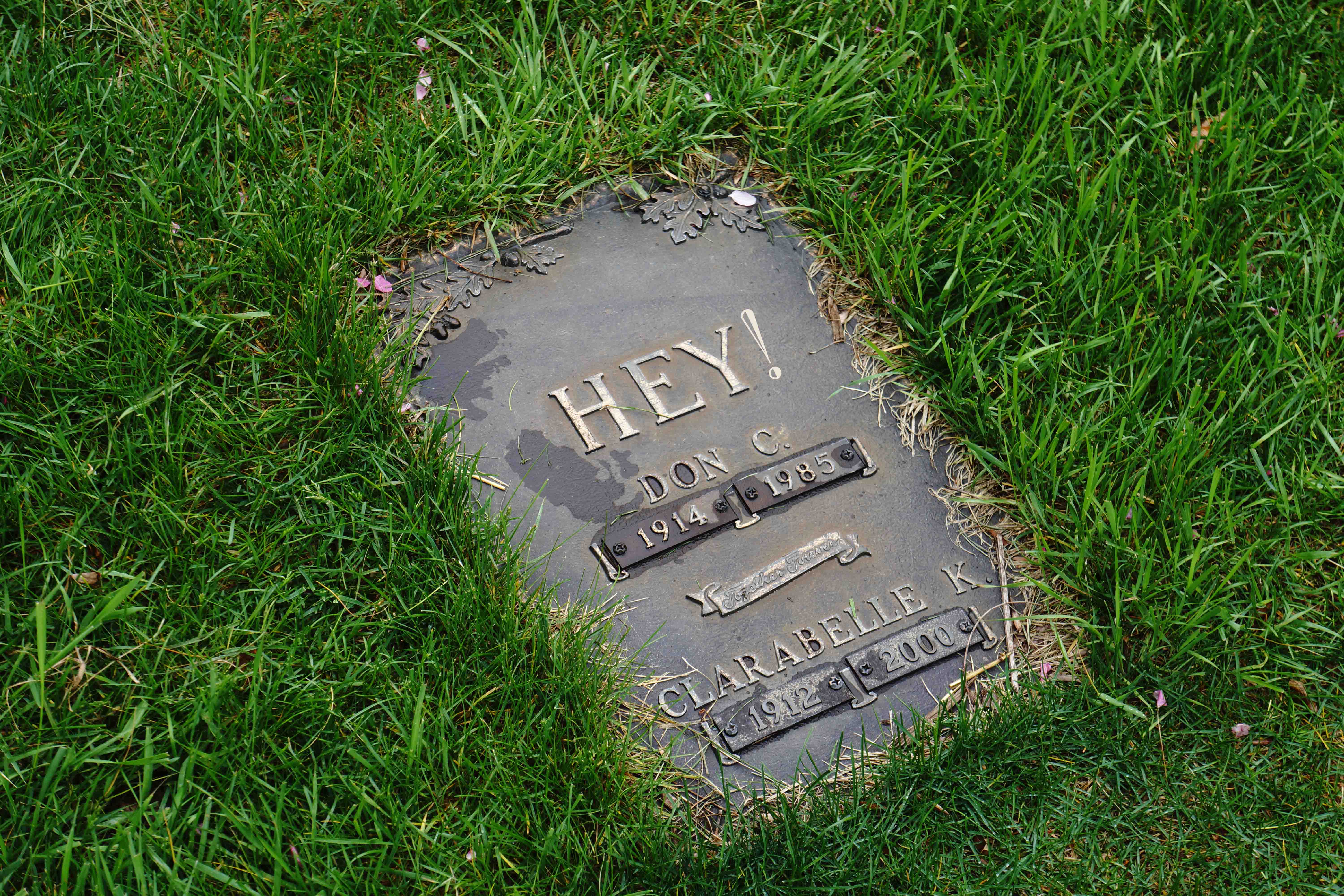
You have my attention.
A portfolio addition due ever Saturday night, five minutes before the stroke of midnight. Way to ruin a perfectly good weekend, right? (Ahem: for the record, one need not wait to start an assignment until 10pm on Saturday night).
It’s the assignments—these portfolio additions—that are the real teachers. I try to direct. I try to offer my small ways of thinking, but the real work of this education happens deep in a student’s brain pain: where sparks fly and catch the dry tinder of panic: “What do I say—and how?”
So it has always been with me: I learn as I write. I often don’t know what I think until I write it. Or say it. Just ask Mrs. Kirkistan. But when I research a topic and begin writing about it, all sorts of synapses fire and connections meet and angels sing and the sun shines on my keyboard, where doves and baby deer have collected. Especially after three cups of coffee.
And this is what I depend on in my class: that the threads of our discussion will come together in the doing thereof—the writing of copy. This capturing of a brand, or a dream. The useful words that direct and possibly encourage as they launch into a reader’s mind.
But this: just doing an assignment dampens the angels singing. This class is less about getting my grade and approval and more about creating something you will proudly show to Ms. Creative Director or Mr. Small Business Owner who can hire your magic for their capitalistic endeavors. I can already see those who get this concept. Their work shows it.
Bless them.
And bless all the rest of us, too.
###
Image credit: Kirk Livingston

 conversation is an engine