Archive for the ‘Collaborate’ Category
Keith Sawyer: Surprising Questions Emerge
Where will you find transformative creativity?
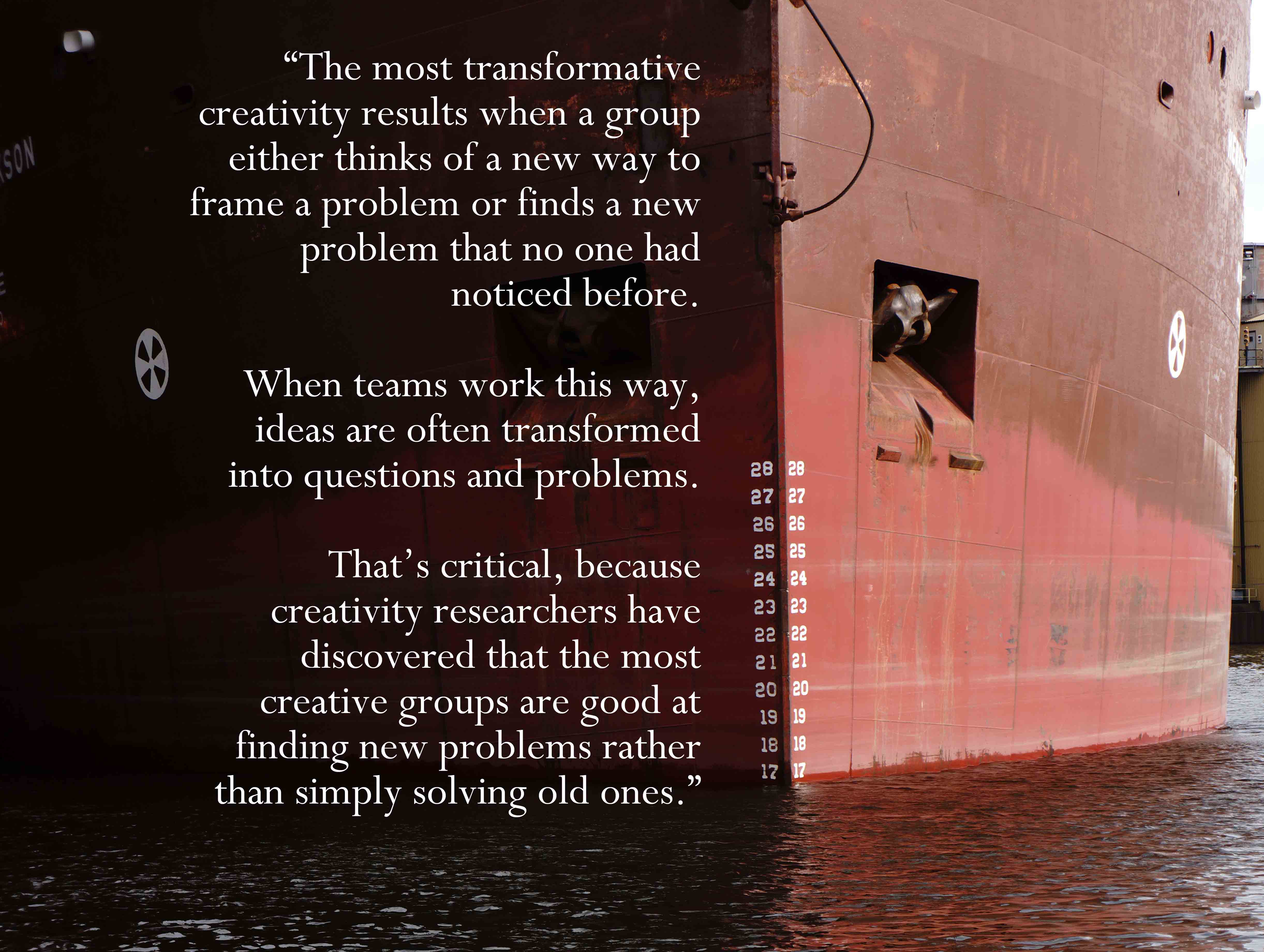
–Keith Sawyer, Group Genius: the Creative Power of Collaboration (NY: Basic Books, 2007) 16
###
Image Credit: Kirk Livingston
Why Name a Problem?
“They won’t recognize a great solution until they see how big the problem was.”
Along the way to becoming a copywriter one must learn to name problems. This is an essential skill for anyone trying use their creativity out in the world of real people and real issues. Because when you present your bit of inspired copy to a prospective client (as one does when planning for serendipity), they will not see how inspired it is until you tell the problem the copy solved. Once they understand the problem, they can begin to appreciate the genius of the solution you created.

Naming a problem is best done in story form: there was this nasty condition and people worked around the nasty business in this way, which was inconvenient and bad. But we saw that this could be done, and so I created this. Which seemed to work and everyone was happy. Problem solved.
But naming a problem can sometimes be uncomfortable. Not usually after the fact, when everyone can easily see that it was a problem. But before: if you are the first one to notice a problem it takes a bit of courage to say it out loud to others. What if you got it wrong? What if you just don’t understand? If you name the problem, will you be responsible to fix it?
Here’s where a lesson from work fits back into real life as a human: naming a problem is the first step toward fixing it. That is true with my clients and it is true with students and it is true in all sorts of relationships and life situations. To name something is to register that a problem exists. It puts the problem on the radar and communicates to others that there may be an issue.
Until you name a problem you have very little opportunity to address it.
Naming is a bridge to fixing.
###
Image credit: Kirk Livingston
Tag:
Best Work Direction Ever: “Avoid giving the impression of diligence…,”
Said the boss to the worker:

Hermann Hesse, The Glass Bead Game (Magister Ludi) (Holt, Rinehart, Winston, 1969) 158.
###
Image Credit: Kirk Livingston
Custom Answers to Personal Perplexities
What does a good conversation look like?

###
Image Credit: Kirk Livingston
Collaborate is the New Black
Listening looks good on you
Work often looks like a flavor-of-the-month shop. Depending on which consultants get the ear of those with a budget for adjusting corporate culture, we could be talking about mindfulness, or total quality commitment or getting the right people on the bus—there is no end to the analogies and training seminars and tightly-packed sessions to buy.
Always these programs promise change. Sometimes they deliver.

Here’s why you should care.
But the constant impetus behind these attempts is employee engagement. The days of just showing up to stand on an assembly line or sit in a cubicle are long gone. Putting in hours is not enough—was it ever enough?
Engagement is tricky, of course. Employees work with BS filters set on high, which is why suggestion boxes rarely worked. Everyone knew putting a well-reasoned argument on a slip of paper and dropping it in a box went exactly nowhere.
No—the will to listen, which is near the heart of collaboration—must come from within rather than without. There must be a kernel of mission that speaks to listening to the good people you’ve brought in. The trick is to find that kernel. Engaged employees have done that work, usually on their own time.
I’m excited about a particular client of mine with a compelling, collaborative mission. They’ve invested millions in a particular process that is doing something brand new in the world. My client is lining up eager collaborators from industry and from academia. They are just now setting up systems to deepen their collaboration with researchers across the globe.
But how far are they willing to go with collaboration?
Working and learning together is the stated center of their mission—and this organization lives it out in countless ways. But are they willing to make messages that reach out and pull people in—even with ongoing research? Are they willing to set themselves apart as leaders willing to share knowledge in endlessly accessible research bites that are media and social media ready? After all, my client is partnering with an industry known for its secrecy, so what will collaboration and the inevitable transparency look like with these steely customers?
All that remains to be seen.
But one thing is certain: the will and gifts and curiosity of engaged, collaborative partners and employees is the only thing that will help this move forward.
###
Image Credit: Kirk Livingston

Dialogue 2.0: Can a Marketer Game a Conversation?
Yes. But maybe no?
Lots of us try to figure how to turn a conversation to our advantage.
Marketers increasingly slip us information just when we want it, like Google giving directions to the donut place on the way to my next meeting.
Bad Google.

Carefully observe, one must.
Carl Griffith, writing over at ClickZ, wants marketing websites to recognize and reengage with returning customers via their behind the scenes content management system. He wants websites to engage in dialogue like people do: no need for reintroductions. We know you—you know us—where did we leave off last time? Cookies help this happen, of course. Amazon is an example of picking up where you left off and adding suggestions for more purchasing joy. That is likely where all web properties are headed.
Mr. Griffith goes further: what if we programmed into our content management systems a way to pick up on non-verbals? He means those signals that pass between animate conversation partners (I wrote human first and then remembered how much non-verbal information dogs pick up): the open or closed hands, the orientation of shoulders or head toward or away from the speaker, the eye contact (or lack thereof)—all these bring depth and context to our conversations. That depth and context adds to the words exchanged or belies the words exchanged. Listen to Mr. Griffith:
You will be familiar with the throw-away lines in everyday conversations around the importance of non-verbal communication and what we have now in the world of digital are ways of understanding the more silent and less obvious conversations and dialogue we now have with our consumers driven by context and the insights we should derive from the sum of interaction and engagement.
As a consumer—or for anyone increasingly wary of how our own national security apparatus listens in at will—it’s easy to read sinister overtones into these marketing improvements. Marketers will want to be wary of any resemblance to the NSA, although all the players are starting to look like classmates from the same surveillance school.
But in a human conversation, we start to get the sense of when our partner is yanking our chain—or outright manipulating facts and/or lying. And we back away. Quickly. Perhaps the computer programs that touch our web conversations will go the way of 30 second TV spots—a chance for us to cognitively check-out because we know we’re being sold something.
Mr. Griffith’ vision of dialogue 2.0 is starting to sound like a return to monologue, only in shorter bits and micro-fitted and shoehorned into seemingly ordinary conversations.
Caveat emptor.
###
Image credit: Kirk Livingston (Weekly Photo Challenge: Street Life)
“Just Exactly What Are You Up To?”
Then ask: “What is your point?”
We ask this of each other constantly: “What’s your point?”
We also ask it of poems and movies and op-ed pieces and windy monologues and sermons and sacred texts and profane screeching. Is this desire to quickly get to the nub a peculiarly American trait?
 Maybe.
Or maybe it’s just a sign of these fast-paced, self-important times. Unfortunately, the question allows little room for dilly-dallying with ambiguity or gray.
Because we got stuff to do.
We want the point. And we want it now. So we can reject it. Or, possibly we’ll agree (but with provisos. Naturally).
Authors and friends who take time to really get to know a subject or to get to know another person’s thought are great counterweights to this tendency. Mortimer Adler’s How to Read a Book comes to mind, with his intense working-over of a text so as to master it. This is the opposite of reducing this to that. And I’m lucky enough to have people in my life who listen carefully without reducing. I’m trying to learn from them to do the same
I’ve just begun a book by Joseph Harris, Rewriting: how to do things with texts (Utah State University Press, 2006). Mr. Harris’ book has lots of wise and useful things to say about how to handle other people’s thoughts in ways that allows you to hear them, while allowing room for moving the topic forward. He advocates a generous approach with a text: trying to understand. The generous approach to another person’s thought reminds me of Wayne Booth’s notion of listening-rhetoric: looking for similarity of thought before blindly reducing and striking back with counter-arguments.
“Pursuing truth behind our differences,” is how Dr. Booth would say it.
One thought Mr. Harris puts forward is that rather than forcing a text to get to the point, it might make better sense to ask, “What is the author’s project?” This question is about the intention behind the text. What was this poem/movie/op-ed/monologue/sermon/text trying to accomplish? Why did [whomever] write it and what did they hope to persuade the reader of? After you guess at that you stand a better chance of understanding their point (if there is one point). And this is particularly helpful when an author is presenting multiple points—like in the back and forth of a conversation, when someone is trying an idea on for size. This appeals to me because I’ve sat through too many meetings and preachments where the speaker’s point was forced out of a text that had zero to say about the topic. I have also been guilty of this violent approach to a text.
I like the notion of being generous with the texts we read and the conversations in our lives.
I am also persuaded we are all in the business of persuading each other all the time. We all have projects.
###
Image Credit: Kirk Livingston
“Do You Know Bob? You Should Meet Bob.”
Listen when your friend says this.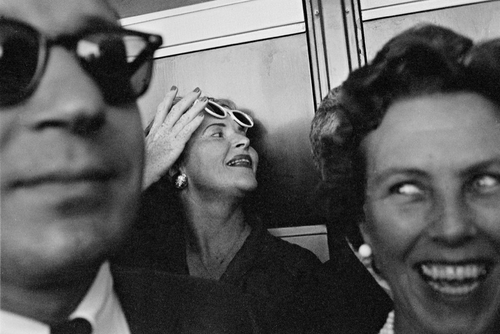
After your friend hears what you have to say and then responds with,
Hey—have you ever asked Judy about that? Because Judy talks constantly about that very thing.
Listen.
And then go meet Judy. Or Bob.
Because a friend’s recommendation—after seeing a similarity or spark of sameness—can be telling. The connection your friend saw to make the recommendation implies you have something in common with this other person. Some way of thinking that will form a third-rail for communication.
And that is worth following up on.
I think Keith introduced me to Steve—likely through some offhand comment. Steve is a C-suite communication guy who also teaches and we talk about communication strategy, corporate life versus freelance life, life in agencies and the demands of teaching. I’ve had coffee with Steve a couple times and I honestly don’t think I could find more wisdom and excellent advice and weathered perspectives if I paid Seth Godin’s consulting fee for an hour of talk.
We have no clue what might happen with a connection. No idea where a conversation will go.
This remains amazing to me.
###
Image credit: Garry Winogrand via MPD
Boss: With this ping, I have now pled
Think Globally. Act Tactically.
Sometimes we just do our job.
Sometimes we think bigger thoughts and help our boss sort out what next—long before being asked.
I maintain our best work comes from that place where we think strategically and act tactically. Our best work comes from big thinking harnessed to this moment’s need.
Today in our copywriting class we talk about relationships with clients. My line on this is to cherish, honor and protect your client—which starts to sound like a marriage—not quite the right analogy.
Then again, maybe it isn’t far off.
Clients are people who trust us to handle their message. They’ve hired us to do something they cannot do. This is a privilege. Our favorite clients know the best work comes from well-articulated need and parameters followed by the freedom to go and do. And sometimes our clients depend on us to help articulate those needs and define those parameters—simply because we get very close to the need.
This is where the copywriter’s outside perspective helps immensely. It’s also where we deploy our skill of listening into the deep waters of what our client eats/sleeps/breathes/knows. Because sometimes what seemed like only tactical work can turn into an opportunity even the client didn’t realize was before them. And we need to say so.
Such is the opportunity with collaborative teamwork and trusting work relationships. And that’s why it is important copywriters always think Grande or even Venti rather than Short.
Here’s to clients! (Jaunty raising of the ice water glass)
Long may they…, well. Hire.
###

 conversation is an engine