Archive for the ‘Collaborate’ Category
On Creating: “Hello Problem, Please Sit with Me”
From Distraction to Focus
We stare at the problem until we can’t think straight. And when blood runs from our ears, then we have just begun.
This quote from a Minneapolis copywriter describes the creative process that drives his role in the industry. What does it take to come up with a creative solution that is beyond the first 5, 10 or 20 thoughts that pop into anyone’s head? What is creativity, anyway, and why should I care?
- First the bad news: creativity requires deep focus.
- And now the good news: you are capable of deep focus.

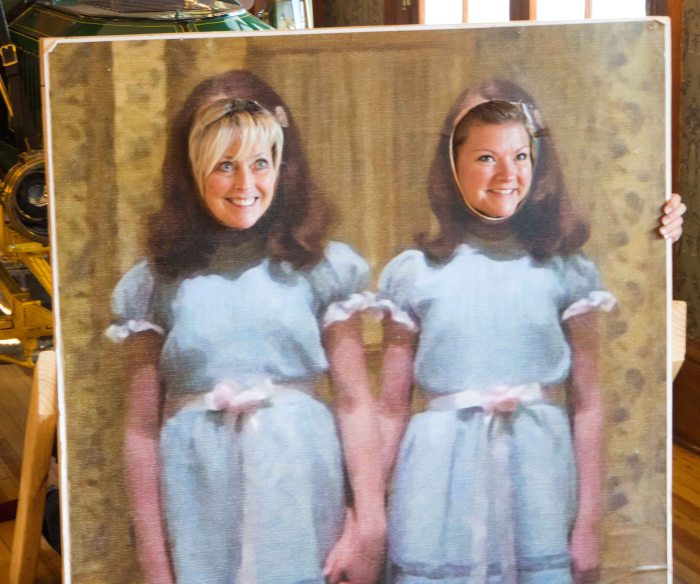
“Look Again: Expanding Feminist Possibilities,” Groot Gallery, St. Olaf College
In our age of near constant distraction, how does anyone slip into the focus-cave? How does anyone keep distraction at bay, apply sustained attention, and lose track of time in the process? It turns out there are solid answers to those questions. Those answers arrive from a mix of personal experience from people who create regularly, from a bit of theory, and then from experimentation with what works for you.
One thing is certain about focus: it can bring a healing wholeness with it. Just ask any person who regularly creates, and hear them talk about “flow” or the zone or getting into that space of just doing it.
Creating is not for the faint of heart. Because to create is to dwell with ambiguity: could be this. Could be that. If you change this piece—or flip the entire story or image—everything looks different and maybe even makes more sense. Very little is defined when creating and, in fact, you are doing your own defining
A group of students and I have turned a corner this week. We’ve gone from feeding the internet with content that builds communities to feeding creativity that can solve real-world problems. And just like when we work different muscles with cardiovascular versus weight training, this move from rapid creation to deep problem-solving wants a different set of brainwaves. We’re moving from intense listening and rapid creation to sitting with a problem and iterating our way out.
One of our bigger tasks is to train ourselves not be satisfied with the first, easy solution. We’ll learn how to bend time and write fast while you still know nothing, and how to lift and separate and how to map your way around a problem and how to start at the top again and again. And how to grind through to get to a better solution.
But all that needs focus.
And focus means not picking your phone up for 60 minutes.
And that is a struggle.
###
Image credit: Kirk Livingston
Why Honesty is Catnip for Collaboration
In Class Today: Here’s Where I Failed
I first encountered “fail faster” in Clay Shirky’s book Here Comes Everybody. In that book it started to make sense to me that getting something right was a goal, but perhaps not the first goal. Maybe I saw traces of “fail faster” in The Cluetrain Manifesto. As a writer I knew I had to write many (verily: many, many) drafts before I started to approach the thing I really wanted to say. I also knew that the work of moving toward that thing I wanted to say was built on failure after failure, and that each failure left me with something closer to what I intended. Each step in the work shaped the next step in the work And each step in the work also shaped the one doing the work.

motivational pictures
In our Social Media Marketing class last week students presented their critique of their community-building activities (we publish content to define and attract the student’s desired target audience). Midway through these presentations I remembered why I love this day so much. There is an honesty to it. Students describe what they’ve used blogs and Twitter and Facebook (and Instagram and Pinterest and Reddit) and other tools to create for the past six weeks. They show successes. They describe failures. They talk about what they would do differently. In some cases they reimagine the entire exercise for themselves and their team. And sometimes I can see the seeds of a much larger purpose. Sometimes it is quite clear that this person’s passion will push them toward building this community for a long, long time.
And then we discuss failure. Truly, these are fascinating moments in the Q&A that follows each presentation. The great news: everyone fails. Not the course, but in building the grand vision they set out to build. Six weeks in they realize how they could have adjusted their purpose, how they could have set more clearly defined metrics to reach very specific goals. Some realize they did not give it their best shot but instead rushed through and sort of wasted their moments of contact with their target audience. Some realized they could make a solid point with 350 words when they came into the class needing at least 1000 words. Some realized their target audience lived over in an odd unlit corner of the Interweb and this other particular tool would have faithfully delivered them to this audience.
The Big Reveal: It isn’t until you try to actually build something real, with real people and real purposes toward a real end, that you realize life doesn’t not just coalesce around your pet purpose. In fact, this shouting into a crowded, noisy concert hall that is social media must be very deliberate for even the smallest thing to happen. And I mean even the tiniest purpose to move forward.
And as we detail our failures together (I have my own dozens of examples to share), new ideas pop to the surface and classmates who had not talked with each other are now offering ideas and are engaged in the purposes of this other community.
It’s the honesty bit that pulls in collaboration—the telling it like it is. The missing the high mark in a major way that when shared, evokes collaboration rather than pity.
That seems like a solid life lesson to me.
###
Is it Better to Sound Smart or to Communicate?
Please stop me before I commit an act of literature.
We had this discussion in class. A literature student was talking about how writing for social media was different than, say, literature. Popular writing—so our discussion went—is aimed at a different audience (here we picked our way around classist terms), and is not as, well, interesting, as literature. All her other classes required a compacting of ideas into sentences that grew rather long. Sentences that required a fair amount of attention. Sentences that required grappling with theologically heavy terms, or the whimsy of philosophers who felt compelled to make up words for their new ideas. Or writers who committed acts of literature in the most tortured fashion.

I maintain that writing for social media requires that we let go of jargon and the complex sentences that shout “College!” or “Graduate School!” At our best, our writing is nearly transparent: leading right into the topic without stopping to say “Look at me.” Does that mean we use dumbed down ideas and language? I’ve said no to this several times. Erasing our jargon so smart people from different disciplines can understand us is not the same as dumbing down. And, in fact, when we do the work of translating our tribe’s jargon into regular English, we are poised to find a certain elegance and cadence that sounds more human, more fresh and less like the forced and predictable tribal language.
Respecting the reader is central to this project of communication—this bridge-building activity. If you think the reader is an arse, that comes through in your word choice. If you think the reader cannot be trusted, that shows. If you think the reader is intelligent and can handle the topic in words any human would understand, your reader will know.
One irony of the discussion is that many of the writers we celebrate as having written literature were themselves seeking for the simplest way to say things. Countless writers talk about kill your darlings and omit needless words and how nearly anyone can write to confuse. But the real artist takes a meaningful notion and makes it clear to someone else. And this: we are more likely to say something memorable and possibly even elegant the farther we get from our tribe’s insider language.
Will you commit an act of communication today?
###
Image credit: Kirk Livingston
How to be an Object of Pity
Hint: Grow a gray beard and present folding-money
Twice now young women have bought me coffee at the coffee shop on the campus where I teach. Just standing in line like everyone else—minding my own business—I pull out my $2 (cash-money) and the young woman in line behind me says, “Just put it on my card.”
I resist: “No! I wouldn’t hear of it,” I say. “You can’t. You must look after yourself with that—or at least spend it on your friends.”
I went on in that vein, until the cashier reached past my $2 (cash-money) for the woman’s card.
“She’s not going to spend it all anyway,” said the cashier, repeating what the woman said.
So. Free coffee. Thanks profusely offered.
Yesterday: same thing. I pull out my $2 (cash-money) and the young woman behind me says, “Just put it on my card.”
I resisted. This time with less velocity. Free coffee. Thanks profusely offered.
 I’ve puzzled over this phenomenon. What I know for certain is that the students here are some of the kindest people you’d ever hope to meet. And earnest. Looking around I also see that I have landed from the planet “old guy.” Though I know even recent grads feel that way when revisiting their alma mater. Still, it’s been a long time since I was an undergrad.
But I think it’s the folding money that triggers the pity. What kind of a person uses cash-money on campus? Clearly someone in need and, frankly a bit out-of-touch. We all use cards.
You must not be from around here.
“Let me help you.”
The other day a student reflected on her community-building work in our social media marketing class:
“It’s also important to create a presence that encourages interaction,” she said.
I can’t get her comment out of my mind, partly because of getting two free coffees and partly because of the riddle of how to write in a slightly-unfinished, slightly-needy way.  Like how Columbo conducted investigations: you pity the unkempt, needy fellow until you realize he is canny like a fox.
I’ve long puzzled over the magnetism of a dumb sketch. Stepping up to the white board and drawing something badly as a way of explaining an idea is a sure-fire way to invite others in. And they step up—not to correct, just to collaborate. Because it’s sorta fun to draw badly and without the pressure to create art. And it can be fun to think together. And, like presenting folding-money in debit card economy, you clearly need help.
What are you willing to leave unfinished to draw others in?
###
Image credit: Kirk Livingston, The-Toast.Net
The Alchemy of a Thought Remembered
Follow the Instinct to Say Again
We talk endlessly about the question “What is remarkable?” in my social media class. I am convinced that the bits of life that we remember to tell someone else are the very things that make for great conversations. It is that instinct that also powers engaging social media.

Say I run into an old friend and remember I finally read that book she told me about two years ago. Why did I wait so long? “The chapter about the train ride through the Alps was unbelievable and may have changed my life,” I say. I just remembered all this when I saw my friend and she said “train.” I can see that she is happy I read and enjoyed the book—one of her favorites.
Curiously, it is the running into the friend that pulls the trigger on the remembered thought. That instinct to pull from memory a thought stored for a particular person is one to follow. But maybe I did not store a thought for a person. Maybe I just registered a reaction to the book and I’ve been telling anyone who will listen—simply because I think they might find it interesting
Three things about this instinct to remark:
- We often remember for someone—we know they will like this thing and so we tell them.
- In a simple remark, we break complex thoughts into pieces and parts that can be verbalized. We want to be heard so we anticipate the questions our friend will say and pepper our talk on the fly with the answers they seek.
- The connection powers the thought and the communication. And so this memory or thought that becomes a remark goes on to cheer or enlighten or delight our friend.
The answer to “What is remarkable?” has its roots in a mystical intersection of connection, remembering and communicating. We might wish for such connection in our social media practice. The model for true connection is our plain old remarks to friends.
###
Image credit: Kirk Livingston
Tell Me a Story
On the Mindfulness of Listening
Listening is such a simple thing. How hard can it be?
But we all know that listening is harder than it appears, because listening means we have to shut up. And good listening means not just shutting up but also not using someone’s moments of speech as a time to plan counter-arguments.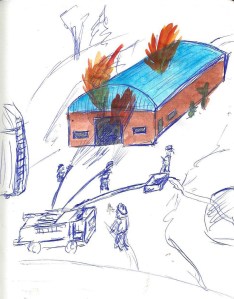
Real listening happens nine hours into a car trip, after you’ve exhausted the common topics and celebrity gossip and a silence settles. For miles. Which can feel weird. And then you pass a broken down Quonset hut and your spouse/friend/acquaintance/ride share starts in on early memory of a fire at her parent’s farm, and how all the kids huddled in blankets watching the barn in flame and hearing the gas tanks in the tractors explode one after the other and how the firemen pumped water from a pond into a little pool they created and then onto the barn. And how the whole thing left her feeling sad and, well, bereft.
It had been a kind of turning point, she says, now that she thinks about it. And then she collects memories of what was different with her family after that and how it was different. She has very specific points.
And you have not said a word. Because the fire story had and entirely engulfed you as well. You were there—as she told her story—shivering on the side and hearing the pop of gas tanks.
Most listening is not that dramatic. But sometimes it is.
We’re talking about how to listen in our social media marketing class. How to listen to the audiences and communities we want to interact with. We want to hear the concerns and the jargon and the voices and the rhythm of those voices.
It occurs to me that we listen in stages. Or perhaps we hear—or comprehend—in stages. When new to a community, we hear the words and perhaps can make out only the broad outlines of the bigger story. The more we listen, the more we hear specificities and nuance The more we listen, the more stories we hear the emotion and motivations that bind a community together.
Good listening means sitting with and through the stages so that we burrow into understanding the people of the community. Our best friends are often great listeners because they sat through the bursts of story that followed silences.
Most of us have little time for listening.
Pity.
###
Dumb sketch: Kirk Livingston
Forget Content Strategists: We need Village Storytellers.
Begin the Begatting!
“Content strategy” has such a corporate feel to it. Such strategized-promotional-content-puzzle pieces, dreamed up in isolation, will move forward whether or not anyone cares. But here is exactly where strategy and art must date, marry and get busy begatting fecund stories.
No human will be interested otherwise.
No amount of strategizing can actually make that happen. Art must take over. Art connects with emotion. Art is a human meaning-making activity not easily controlled by a corporate agenda. If controlled too-tightly, art quickly becomes something less than art.
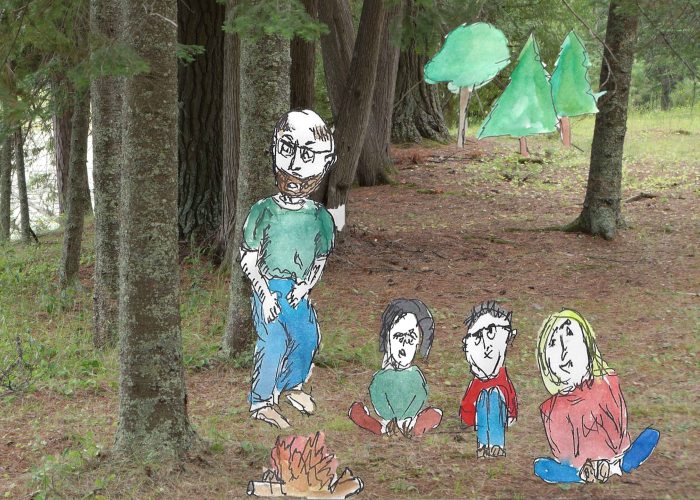
I’m working with a group of writers who need to understand this. Their task is to pull people into the causes they have begun to champion. They will identify their mission and purpose, complete with telling details about their target audiences. They will strategize about content and assemble editorial calendars, but in the end, it is the art of storytelling that has the power to pull anyone forward.
My theory is that strategy works best as a beginning point. You do your best to get a strategy in place, but then you move forward. As a writer, I know from experience that stories and strategies grow up best together. Each talking to the other. That is because the weaving of the story actually makes new strategy elements available (and vice versa). Elements appear that would not be apparent except that the artist has accessed that deep subconscious, chaotic place where connections are made and much foolish talk swirls around very bad ideas before anything worthwhile appears.
Sometimes when I get stuck in the analytical side of strategy, I set it aside to tell stories just to open possibilities. I am not alone in that practice.
There is a push for strategists today. But I would rather work with their more human cousins: story-teller strategists.
###
Image credit: Kirk Livingston
Stuck and Reframe
Just How Real is Our Imagined Beginning?
I’m stuck on a client project. Late in 2015 I devised a social media communication strategy that calls for weekly themes. But one of my weekly themes provides very little fodder for producing content. And so I’ve been spinning my wheels and getting exactly nowhere.

Maybe it’s a good time to be stuck, because this is the season of reframing. Old things ended as 2015 shuffled out and new things began with the calendar change. Everything outside my window looks the same, but we’ve all group-thinked (group-thunk?) ourselves into what we call a new year. Is it an imagined new beginning? Of course. But that doesn’t make it any less real. Somehow that calendar change gives a bit of courage to consider releasing the strategies that don’t work.
Reframing—trying to see a problem or need differently—is a way out of stuckness. My tools for building a new frame around a client need or personal problem include words on pages and dumb sketches and mind-maps and fartleks and conversations. You already know that conversations hold quite a bit of promise: telling someone else about your stuckness has the effect of bringing to light a problem and beginning to find your way through it.
If you are of the tribe that makes resolutions, you also know that telling your resolution to someone can have a positive effect on keeping those resolutions. And you may even have someone who holds you accountable.
I’m stuck on a client project.
I’m going to talk with my client.
Staying stuck is not an option
###
Image credit: Kirk Livingston
Marcia Brady and ListenTalk and Learning in 2015
Even the Gray and White Outside Points In
 Surely you notice all the 2015 retrospectives: photography, music, film, advertising. Every industry has some writer summing the year into the ten best. These waning days lend themselves to a bit of reflection.
2015 was a year for trying things. Today I’ll produce my 365th dumb sketch—a sketch a day since January 1, 2015. Did I produce art? Not a single time. But I did learn to see shadow and light and the crazy, limitless variation in the people around me.  I did learn that very few lines exist out in the physical world and that Marcia Brady can look like the Joker when drawn spectacularly wrong.
From publishing ListenTalk: Is Conversation an Act of God? I learned that I need to simplify my argument for listening to each other. In fact, the mystery and promise of conversation has taken hold of me so that I am listening to conversations in a new way. I continue 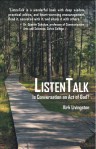 to wonder what might happen if people at work listened to each other more closely. I continue to hope my nation can learn to listen to people outside our tribe rather than label and dismiss them. I suspect conversation is an engine will continue to sketch out the parameters of useful conversation in 2016.
Outside my window are variations on gray and white. Gray sky. White snow. Dark gray 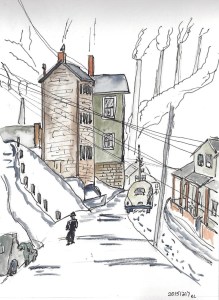 branches thrusting up toward blue-gray clouds. Lighter gray shadow on snowy edges. It’s the perfect climate for asking about the fruit of a year’s worth of effort.
How about you? What’s got your attention as 2015 melts into the gray?
###
Dumb sketches: Kirk Livingston
When Hoax-Busters Give Up
And so we descend into irrationality
Our Bright Shining Future
The end of the Washington Post’s “What was Fake” column had the writer quoting academic Walter Quattrociocchi, head of the Laboratory of Computational Social Science at IMT Lucca in Italy:
Essentially, he explained, institutional distrust is so high right now, and cognitive bias so strong always, that the people who fall for hoax news stories are frequently only interested in consuming information that conforms with their views — even when it’s demonstrably fake.
The entire last article is worth reading: What was fake on the Internet this week: Why this is the final column.
To sum up this moment: we read what agrees with our viewpoint, we talk with people in our tribe who agree with us, we label those who disagree with us and we generally see facts as “facts.”
This moment does not represent the future I hoped for.
###
Image credit: Kirk Livingston

 conversation is an engine