Archive for the ‘Communication is about relationship’ Category
Dan MacPherson: “Employees [will] make up their own reality”
Days of Whine and Poses
“At least you have a job.”
That used to be a compelling argument for paying attention and doing the work—but not so much today.

StarTribune columnist Neal St. Anthony recently teased out a few details about our work attitudes. He cited statistics about employee engagement from the National Employee Engagement Study conducted by Modern Survey:
Employee disengagement among U.S. workers rose this spring to a record 32 percent, MacPherson said of the semiannual National Employee Engagement Study. Another 36 percent are “unengaged’’ — or not fully committed on the job.
Meanwhile, the percentage of fully engaged employees fell to 10 percent this spring, down 3 points from last fall. The remaining 22 percent of us working stiffs are “somewhat’’ into our work.
St. Anthony talked with Dan MacPherson, a founding partner with Modern Survey, to get behind the numbers. MacPherson laid blame for disengagement on both employees and bosses—which seems reasonable. And then MacPherson did a good job of filling out the picture of why these things are so. The column is worth reading. And this quote caught my attention:
“It takes three to five years to change an organization,” MacPherson said. “If senior leaders don’t communicate effectively, employees make up their own reality.”
Three to five years to change an organization seems optimistic. And for those bosses still using power poses and monologue to enforce their will—I would argue such communication is near the heart of our problem with disengagement. Maybe we are just beginning to get a sense of exactly how vision for our day-to-day work oils the cogs that keep everything running.
MacPherson is dead right that vision will emerge, one way or another. The question bosses and employers should be asking is “What true thing can I contribute to that vision?” and perhaps, “What do my employees already know about this emerging vision?”
###
Image credit: Kirk Livingston
When Words Fail, Just Show Up
Nine minute film from Eric Gross: The Fortune Writer
Sometimes our words fit perfectly. Sometimes there are no words for our situation or for our desire. That’s when we fall back to just being present—just showing up. The words come eventually. Or they don’t. But being present with each other: that is the rock-bottom beginning point for everything.
We’re thinking a lot about what it means to show up with each other. This infographic making its way around the web points us toward the non-verbals we already heed. And this clip of Russell Brand making fun of the talking heads at Morning Joe for referring to him in the third person is worth watching.
But this short film by Eric Gross offers a meditation on when words need presence to do the real work.
Where do you need to show up today? And with whom?
###
Power Pose vs. Aggressive Emptying
Sunday Story for Monday: the Counter-intuitive Ways of Sheep among Wolves

The self-made man with his mind-crane.
Can words spoken from a low power position influence others?
This older Harvard Business School article (Power Posing: Fake It Until You Make It) describes how simply snapping your body into a power pose can have a physiologic effect. Read about the small study (N=42) by Cuddy, Carney and Yap here. Striking a pose for two-minutes stimulated higher levels of testosterone (hormone linked to dominance) and lower levels of cortisol (so-called stress hormone) in the study group. People literally felt more powerful and less stressed after their pose.
Every human dreams of more power. More power translates to being respected. Maybe power looks like speaking and being heard as one with authority. And perhaps with more power we’ll become benevolent despots bestowing good unto others as we stride through our own personal kingdoms.
The promise of more power is intimately tied with many of our messages about leadership development. Industries and institutions will always buy more technique about leadership development because, well, who doesn’t want to be perceived as capable and full of power?
In stark contrast, there’s an old story about how Jesus saw the authorities of his day use their power for their own aggrandizement while offering little help to the harassed and helpless crowds. So he organized and commissioned his own set of spiritual paramedics to go to the harassed and helpless.
Just before these spiritual paramedics hit the streets to proclaim and heal and cast out demons and raise the dead, Jesus told them how little personal power they would have. They would not be received well. Despite their hopeful message they would be beaten and tortured, and hauled in front of councils, governors and kings.
And that’s how it played out: powerful messages in powerless packaging.
Was there something in the powerless packaging that actually helped people hear the message? Powerful words and actions delivered by powerless, peripheral people could not be enforced or made into law. There was little outside incentive to listen. And yet what they said and did endures today, these many centuries later.
Tell me again: why is it we all seek power so eagerly?
When Constantine turned Christianity into the law of the land, the message lost much saltiness. Does my lust for power come from wanting to help people or just wanting them to play my game by my rules? Are there any truths I have to deliver today that might be helped by “aggressively empty” versus a pose of power?
###
Image credit: Kirk Livingston
Table 7: The typist’s quiet laugh is every writer’s dream
Four minute film from Marko Slavnic
###
A Stage for Prince and a Grave for Tiny Tim: What Music Says About Minneapolis/St. Paul
Minnesota Theology of Place: Live Performance Matters in the Twin Cities

If one were rooting around trying to sort what values and practices make a place unique, music would be a good start. Jon Bream, music critic for the StarTribune recently wrote about why Minneapolis/St. Paul has become a home away from home for many rising musical stars. Bream cited four very different artists/bands (Dawes, Brandi Carlisle, Eric Hutchinson and JD McPherson) and noted how audience turn-out in the Twin Cities fuels these artists. Mr. Bream commented:
The key factors are open-minded audiences who love live music; a variety of venues that help artists build a career, and support from radio and other media.
The Current, of course, is a vocal apologist for the new music that grows outside the mainstream (and often, eventually, moves mainstream). I would argue the Cedar Cultural Center has been doing that same good work for years and years. Then there are the high profile, historied venues like First Avenue that have helped audiences and artists form connections. There are many more, of course.
A few days back I wondered aloud what a theology of place might look like for Minnesota. I cited all sorts of influences that would speak to that question.  Developing a theology of place is to look at a community from a perspective unfamiliar to most of us. It is a perspective that begins with a commitment to belief in God and then wonders what God is doing in that place, among those people, through their history. It’s a deeply rooted sort of activity: digging down and back to find out who did what and asking what they thought when they did it. And then asking how what they did affected others. And also asking how their belief structure enabled the outcomes before us.
To be intensely local for a moment, what would a theology of place look like for the Twin Cities—just starting with music? Bream’s observation of how audiences love live music fits with the general interest in theater in the cities. Apart from the Guthrie, there are dozens of small theaters in the cities that are producing memorable performances. Does a population that welcomes new music and new artists and helps support dozens of very small theaters mean we like the notion of “live performance” and see it as a way to connect with each other? Maybe we like to see our meaning made right before us—because we know that an audience is part of the meaning making.
Maybe the notion of a fondness for live performance accounts for the 20,000 people who showed up in St. Paul’s Lowertown last weekend for Northern Spark. And maybe our love for live performance accounts for the bike and craft beer cultures that are all about connecting (this year’s Artcrank pulled in an overflowing crowd).
Not that we’re unique in these things—but there’s something happening. As a curious person and one with belief in God, I cannot help but wonder what it means—even as I rejoice in the vibrant commitment to connection.
###
Overheard: “I’ve never felt more effective.”
Every Day We Create Conditions Around Us
My friend had finished his Ed. D but had no luck finding a teaching position. We blamed it on the glut of Ph.Ds and the poor economy and higher education cost-cutting and whatever. And yet as we talked he said this memorable phrase which I’ve rarely heard anyone voice: “I’ve never felt more effective.” In fact, my friend had continued with the same work he had been doing for the past two decades, but something was different. Yes he had expanded responsibilities and slightly-widened authority—but it still was not the final vocational resting place. Or was it?
Walk with me.
 There’s an old, old story about a warrior-king who wanted to build a house for God. But God said, “No—there’s too much blood on your hands.” So the warrior-king laid up stocks of all sorts of precious materials so his son could build this house.
Warrior-king died.
Poet-philosopher-son king took his place and commenced building the house for God. But the Poet-philosopher-king understood no building could house God. The best he could do was to make a place where people could come and seek God. The Poet-philosopher-king understood that despite his power and wealth and position, there was much of life still outside the control of even the most powerful person around.
Back to my newly doctorated friend: though he had not found the permanent faculty position of authority or leadership he wanted (yet), his old work yielded a fresh effectiveness. Why is that and how?
Feeling that you are in a place of effectiveness is a rare and memorable event—at least from my perspective. Much of life is spent wondering if what we do impacts anyone at all, let alone feeling effective at it. Sometimes we see results from our work, but not nearly as often as we might like.
I wonder if the best any of us can do is to work at creating conditions around us that help others walk as they are meant to walk. The Poet-philosopher king created a space where people could cry out to God with their needs. My newly doctorate friend bundled his expanded learning/vision into his old work found new ways to help the students he spent time among.
Maybe seeking out some fabled position of effectiveness is less the answer than finding ourselves effective where we live right now today this moment.
###
Image credit: Kirk Livingston
How To Speak Stupidier
To Know Deep, Speak Freely
My early college days taught me this valuable lesson: “Shut up.”
When I didn’t have a clue what was going on in class, when the professor appeared to speak English but I couldn’t make sense of his words, I remained quiet and took notes. Maybe the notes would make it clear. Eventually.
Later in college and then in graduate school I learned an even more valuable lesson: “Speak my ignorance.” I learned there are worse things than appearing foolish. Not knowing is worse than looking foolish. Bypassing an opportunity to learn is way worse than looking foolish. Looking foolish, it turns out, is not an inhospitable place to hang out. Today I’m settling into general foolishness quite comfortably, thank you. If I want to know how stuff works (how a millstone works, why Ulysses S. Grant didn’t buy a home in the swank section of Galena, Illinois, why flour explodes), I’ll need to risk looking foolish. I’ll need to ask.
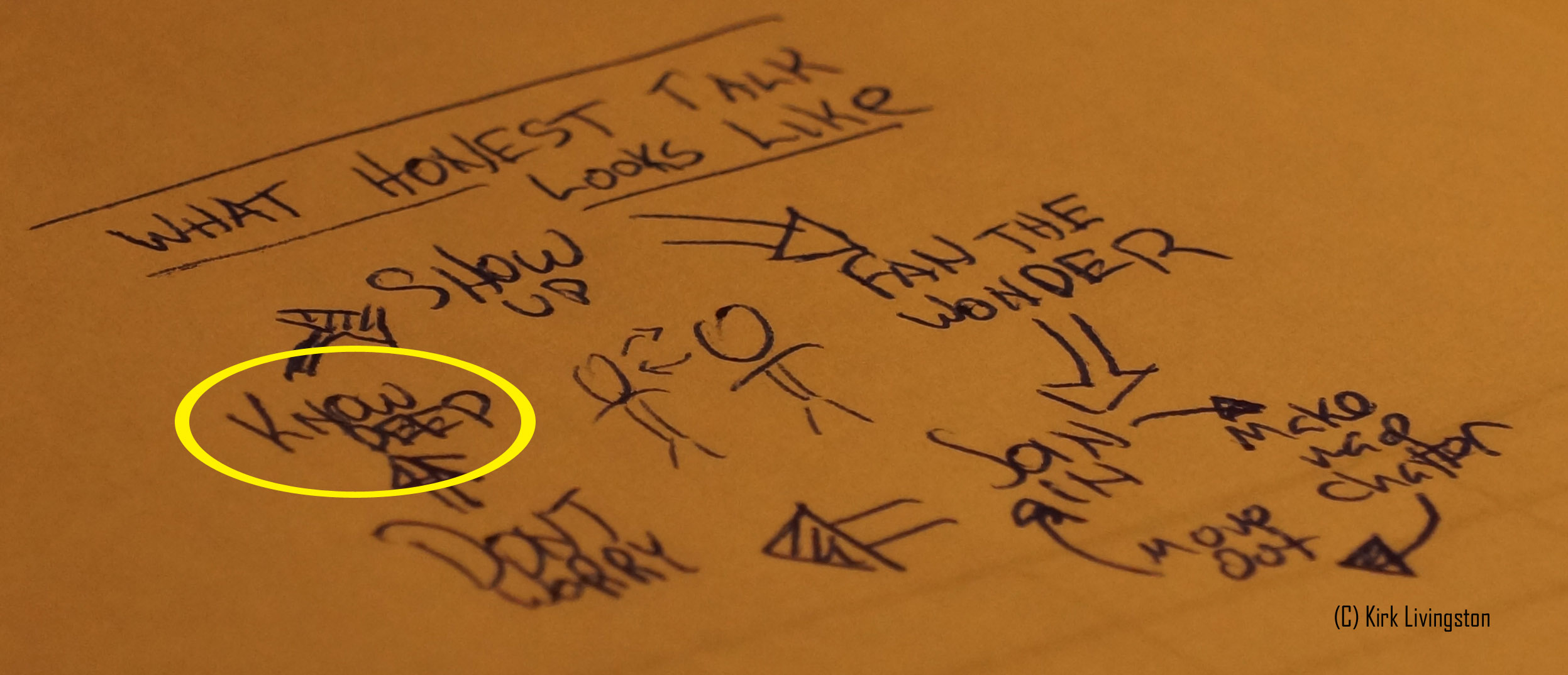 In this cycle of events that occur when we connect with each other, the “Know Deep” part is standing out to me today. What I know depends on what I’m willing to ask, which means I’ll need to reveal I don’t know something. Such revealing can be hard. But if I don’t tell someone what I don’t know, I risk never knowing. In the end, I must name the things I know so I can begin to realize what I don’t know. This may be a lifelong process.
Not knowing and being willing to look foolish can make for stimulating conversation: people like to help us know. And a child’s “why” and “how” questions can be refreshing, no matter what aged person they come from.
###
Theology of Place: Minnesota
WWFD: What Would Fred Do?
Ever since I read of Fred Sanders’ work developing a theology of place in California, I cannot stop thinking what such a set of thoughts and conversations would look like for Minnesota. Mr. Sanders developed the notion after teaching a summer undergraduate class at Biola University focused on California authors and essayists.

Here’s Sanders describing his project from the EPS blog:
I wanted to apply that great books approach to California literature, about which I knew very little. I just had an instinct that the perennialist approach, in which we read the proven classics, “the best which has been thought or said” in the history of the western world, would benefit from a little dose of localism, where we investigate a regional heritage and get to know our own surroundings.
A Minnesota-based project would have a lot of moving parts.
There are the obvious Lutheran influences, of course. From Germany and Sweden. Catholic influences are also strong and vocal and from everywhere. The two cities where the majority of Minnesota’s population lives, Minneapolis and St. Paul (plus surrounding suburbs), are themselves launching grounds for waves of immigrant communities. Irish folks, Northern Europeans of every stripe. More lately Hmong and Somali folks have entered the area. There are communities of people from India and Ghana and Thailand. The Native American community should be an anchoring presence. Just walking the neighborhoods reveals much about what is important to the different groups.
Then there are the literature pieces: from F. Scott’s newly rejuvenated Great Gatsby to the benign(ish) Lake Wobegon characterization of Minnesota to Augsburg Fortress publishing insightful theological tomes to the nationally recognized Milkweed Editions. I’m missing lots and this is just for starters.
There’s all the science and medicine and vast amounts of research taking place at various colleges and universities. Medical devices and industry headquarters. The advertising and design and communication communities are clever and vocal. How would one start to get a handle on a theology of place: what are the priorities of the people of these communities? How does faith mix into the public and private lives of the people who live here? And what have the results been and what can we say about what is likely to develop in this vast mix?
Maybe the beginning point is to follow the lead of Minnesotan Andy Sturdevant who’s MinnPost column The Stroll is a weekly chronicle of pedestrian interestingness in the Twin Cities. Stuff we typically we don’t see because we rarely leave our cars.
Maybe we need our theologians and philosophers and artists to take group hikes through the cities, followed by a beverage and a discussion about what they saw and understood and what it all meant.
I’d sign up for that walk.
###
Image credit: Alli Livingston
“You can’t change something that doesn’t exist.” (Copywriting Tip #7)
Where to find courage to create
Designer/entrepreneur Mike Lundborg uttered it dozens of times over a few projects we collaborated on. For me this quote nearly perfectly encapsulates the dance between creativity and work that is the business of freelance life. That’s why I keep the quote front and center in my work space.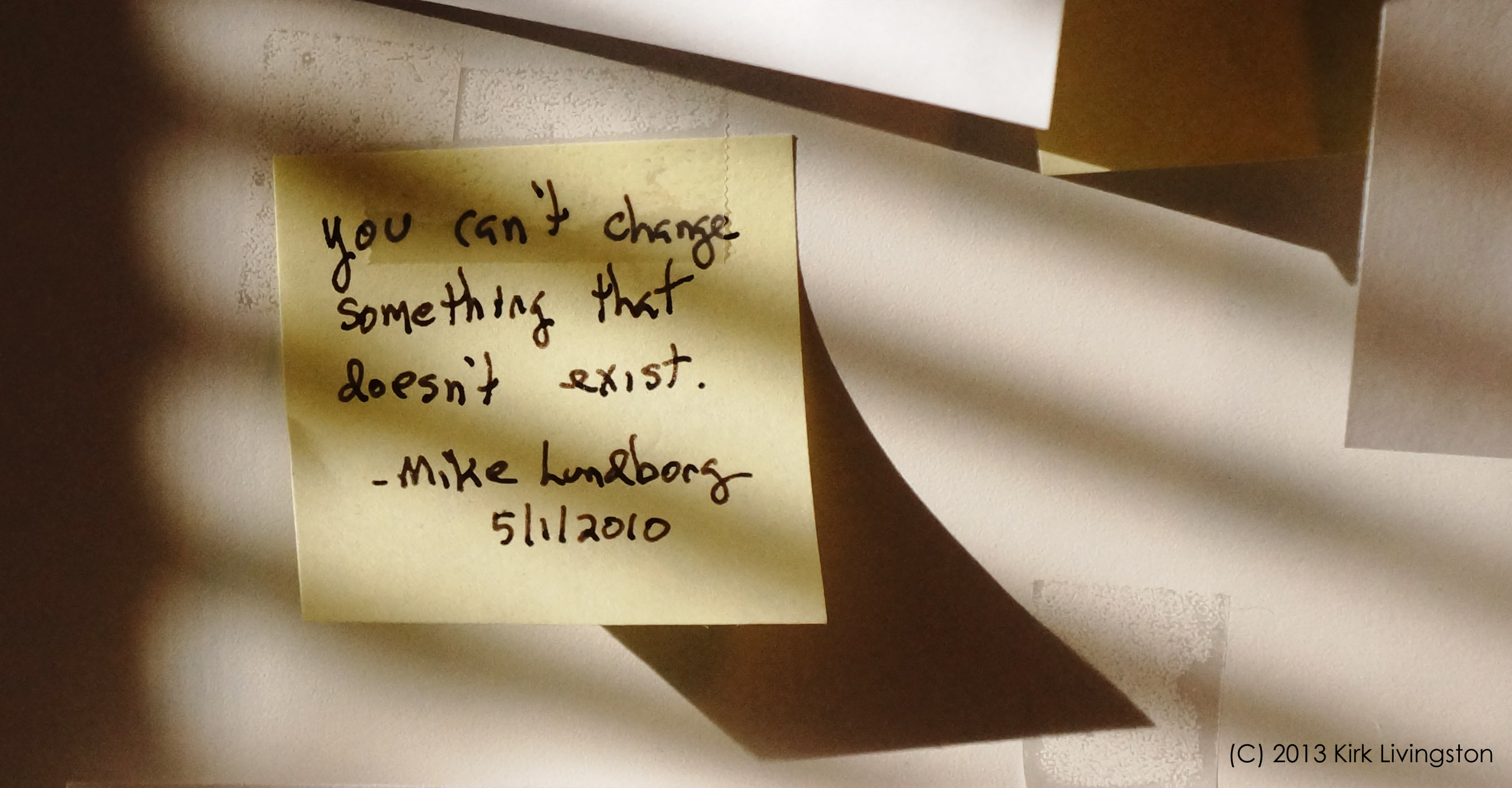
Even today I’m working on a story intended to invite prospective patients to participate in a clinical trial. But early review comments indicate my client wants to buff out the narrative parts (that’s right, losing the story itself) and swap it for clinical and corporate language. The story was meant to pull prospective patients toward a clinical trial, but it won’t if the corporation keeps talking.
But this is not a lament. It’s only a statement of reality and maybe a celebration—because this is how we create together. My sizzling hot interpretation of a marketing objective is held in the tongs of review and hammered into shape by my collaborator. And by me. This is my expectation for my ideas and the resulting words, just as it is my expectation for each part of the process.
And now this: as we release a few of the projects physical constraints, my story bounces back—which makes me glad. This is what collaboration looks like. Successive drafts change but the central objective continually informs all the collaborators as we take our turns shaping the project.
Amazingly, it is this very collaborative process that needs to inform my less commercial writing projects. The courage to create actually springs (again) from the sometimes difficult conversations that surround the project. But it also takes courage to produce a rough draft.
###
How to Hack the Bully’s Monologue (Dummy’s Guide to Conversation #16)
Resist the rhetoric of control
Every person has worth. Every person has something meaningful to communicate to us and vice versa.
But sometimes the guy in the corner office just wants to yank your chain. Sometimes your colleague comes in your cube too close and berates you for something that riles only her. And sometimes these work contexts make you question your worth. Today we call this bullying and officially frown on it, though bosses of all stripes let their primordial managers get away with it as long as they post results.
 In the face of the bully’s monologue, we may need to set down our goals of understanding and hearing each other. We may need to pick up tools that will help protect us from the bully. And especially as our culture talks more about innovation, we must recognize that the enemy of innovation is the bully who uses monologue to quell thinking and drive over dissent.
- The hack begins with dropping sycophancy. Just because the VP of marketing is telling you a personal story about his cabin doesn’t mean he isn’t trying to put you in the low place he wants you. There’s no need to continue to play the prop: the underling enamored by all the person in power does.
- Be present. Don’t go to the Bahamas while the bully drives his verbal tank into position.
- Stand. Even if sitting, assume a mentally poised place to challenge.
- Challenge. Is there another way of looking at the perspective the bully shouts? What is the truth here? Speaking fast and loud does not make something true.
- Know two things
- You are a person, too. A person of value.
- That language can be encouraging or damaging. Every communication encounter has a shaping effect on both conversation partners. Don’t let the bully continue unchecked.
- Turn the other cheek. Yes: quite. Back to Jesus the Christ who knew something about handling the bully. He knew the most effective thing long-term was to offer the bully even more. Not in every case, but dealing with the bully from a place of peace and, yes—faith (in God)—may just cut power to the BS generator the bully madly operates. This counter-intuitive step holds much promise for moving forward as a human.
Some reading this may think no modern/post-modern workplace has bullies like this. You could not be more wrong. It is interesting that the tools used to shine a light on the bully’s madness are also effective in ordinary conversations.
How do you handle the bully’s monologues?
###
Image credit: Used with permission from Paul Rivoche via 2headedsnake

 conversation is an engine