Archive for the ‘Communication is about relationship’ Category
How to catch elusive thoughts
Tell someone. Or just tell yourself.

Check your web of relationships early and often, before those thoughts vanish.
###
Image Credit: Kirk Liviingston
If you order my book, I’ll kiss you.
No I won’t.
But I’ll be grateful.

Another friendly sculpture from Lakenenland Sculpture Park
A friend emailed today that he ordered my book and thought my title and description worked well. I felt like hugging him. Mind you, I’m not a big hugger. Nor a big kisser—apart from the lovely Mrs. Kirkistan.
But there is something about finding people who resonate with my story that makes me weak at the knees (figuratively). I’m fascinated by all the crazy wondrous stuff that happens in even the most mundane conversations and now I’m starting to run into others willing to be fascinated as well. People are now telling me about the big life direction changes that came from random (seeming) conversations.
As I start to look for venues to talk about the book: book clubs, radio shows, churches or small groups, I am grateful for the opportunity to have conversations about, well, conversation.
###
Image credit: Kirk Livingston
How to Talk to Yourself for Fun and Profit (DGtC#29)
How can you learn something?
It seems like teachers stand and teach. But the truth is more like teachers stand and talk. Teachers try to arrange words so students will grab an idea and monkey with it themselves. The learning is in the student, not the teacher. Same with preachers and CEOs: when they blather on endlessly, chances of some party line changing anyone’s mind diminish greatly.
Copywriters and artists and comedians and sculptors and storytellers know this. So they trim their words/images/jokes/granite/story to the bare essentials. Among those bare essentials must be something that resonates with your experience. Something among those bare essentials must ring true—otherwise you won’t listen and you’ll go back to playing Angry Birds. Those few bare essentials stand the best chance of actually engaging you to work with the idea and even try it yourself.

Talking to yourself can build a way to let light in.
Successful communicators want you to talk to yourself. They want you to ask questions and to question assumptions and to wonder how your old behaviors fit your old assumptions. Working with an idea is part of processing an idea. The end result of processing an idea is a change in behavior.
But it comes back to talking to yourself. Even when talking with a friend or spouse or family member, you are also talking to yourself: testing words to see if they are true. Processing life stuff. You are even listening to and learning from what you say.
People who find a way to hold a conversation with themselves about what they see, think, hear and believe are some of the most interesting people you can run into. They are interesting because their self-talk and interior questioning boomerangs out to project a different way of looking at those things we thought were a done-deal. Their self-talk often resonates with the questions ambling about in our own minds.
Where is self-talk leading you? And with whom does your self-talk resonate?
###
Image credit: Kirk Livingston
See Also: Dummy’s Guide to Conversation
Q: My friend has lost all desire and curiosity.
What can I say to bring him to life again?–Lazarus’s friend
Dear conversation is an engine
My friend has lost all desire and curiosity. What can I say to bring him to life again?
–Lazarus’s friend

Dear Lazarus’ Friend:
Your friend may be depressed. Does he look at his smartphone a lot—that could be a sign. Tell your friend to hie unto a physician for a thorough physical–because it could be physical. It could require a counselor or mental health professional.
But from a friend’s perspective, find ways to be present. Take your friend out for coffee and get him to spill the beans: what’s going on? Friendship is about talking all the way through your friend’s understanding of life just now. Touch on what he fears and what he hopes. Touch on what next steps he might. This will take time—maybe many cups of coffee over a long time. Or take a long walk together–do something that takes the pressure off talking.
Being present with your friend may look like conversation. Or it may sound like silence. But being there, whether or not words show up, that is the first point.
Start there. Because showing up may be just the glimmer your friend needs.
###
Image credit: Kirk Livingston
What Would it Take to Change Your Mind?
Let me draw you a picture
Howard Gardner, in his book Changing Minds: The Art and Science of Changing Our Own and Other People’s Minds (Boston: Harvard Business School Press, 2004) talked about the different kinds of intelligences he thinks exist. Dr. Gardner is a professor of cognition and education at the Harvard Graduate School, so he has solid reason to be espousing counter-intuitive theories of intelligence. Linguistic and logical-mathematical are two of the more primary and recognizable kinds of intelligence. And those two, in particular, are the focus of much our schooling.
But there are other kinds, says Dr. Gardner, including spatial intelligence, for instance, where one has “the capacity to form spatial representations or images in one’s mind, and to operate up them.” Sailors and airline pilots depend on this sort of intelligence, as do chess players. Or bodily-kinesthetic intelligence, where a person has “the capacity to solve problems or to create products using your whole body.” Artists, craftspeople, surgeons, dancers, football players, basketball players and many others work out problems in a very physical way.

Early in the book Gardner cited this important factor in changing one’s mind:
Presenting multiple versions of the same concept can be an extremely powerful way to change someone’s mind.
–Howard Gardner, Changing Minds, p. 16
I’m not yet to the end of Gardner’s full argument, but I suspect none of us are just one intelligence. We each have several (perhaps many) ways of knowing and depend on our different intelligences to walk through life. So hearing multiple versions of a concept may trigger something inside us that suddenly opens our eyes or our empathy. As advertisers well understand, presenting the beautiful woman next to the car or perfume bottle spurs an emotional leap that can bypass rationality. Words alone don’t do that as often.
My own daily experiments with drawing, though uniformly not up to par, have still showed a way forward with understanding. When stuck with words, I can switch to dumb sketch mode and begin to move forward again.
All this makes me wonder about the work we each need to do to find new ways to express those deep things inside that need to come out but have so far fallen on deaf ears.
###
Image credit: Kirk Livingston
Editorial Cartoon vs. Rough Sketch
Pique a place to begin.
Charlie Hebdo meant to disrupt and paid dearly. That is what every editorial cartoonist wants, well, not so much death as to disrupt. I’m a fan of Steve Sack at the StarTribune, who every day tips some social issue on its ear.
The contribution of the editorial cartoonist is to change the status quo conversation by putting forward an opinion in whatever outrageous way that gets attention and is instantly understandable. Most of their work is an image that evokes a passionate response. The editorial cartoon is typically polarizing, immediately dividing those in violent disagreement from this in violent agreement.
In contrast, the rough sketch is presented to people who are already with us. They may not agree with our nuanced vision of a project, but they at least have the project on their radar.
We use the rough sketch to present our vision for the project, to show more precisely what we mean and to invite discussion. The whole undone sketchy ethos of it can accomplish all those things.
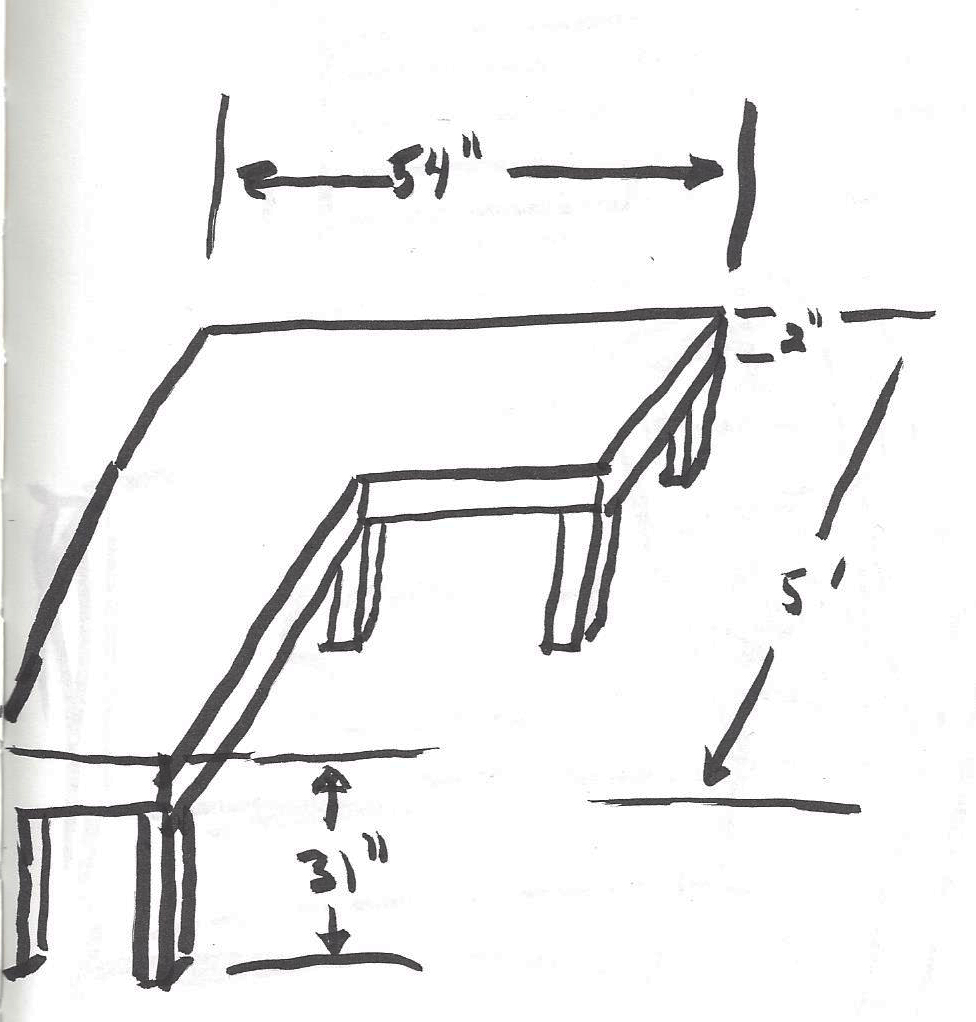 Sometimes we need a rough sketch to present our idea in the easiest possible way—so our friend or client cannot misunderstand us. And sometimes we need to disrupt a status quo conversation and risk passionate ire.
###
Image credit: Steve Sack, StarTribune
Dumb sketch: Kirk Livingston
Cemetery Graffiti
That’s just not right.

Or is it?
###
Image Credit: Kirk Livingston
Decentered. As in “not the crux of all things.”
A place for everything and everything in its place
I’ve put a recurring early-morning block on my calendar titled “Decenter.” The block or early morning quiet and focus has actually been on my calendar for decades, but I’ve recently retitled it based on a cue from Merold Westphal, a philosopher who teaches at Fordham University.
Westphal, writing in The Phenomenology of Prayer (NY: Fordham University Press, 2005), introduces prayer as a “decentering” activity. As a conversation, prayer takes me out of the center of my universe. Like the prayers of the old poet-king or the prayers of the inveterate letter-writer, these are conversations that recognize some other as the center of everything. Those two saw God as the center—I’m with them on that.

There is mystery beyond our convenient placeholders.
Of course, “de-centering” is not the way we could describe many of the prayers we pray. We send up endless lists to some imagined order-taking god, with caveats about when (“Now works for me. How about now?”) and where and how. And especially how much. But listen to Westphal:
…prayer is a deep, quite possibly the deepest decentering of the self, deep enough to begin dismantling or, if you like, deconstructing that burning preoccupation with myself. (Prayer as the Posture of the Decentered Self, 18)
Again and again I find myself at the center of all existence. Maybe you do too. We’re sorta set up for that, given eyes and ears that operate from a central pivot, constantly swiveling about to take in all we possibly can.
It seems natural enough to think everything revolves around us.
The truth is we need help to back away from this “burning preoccupation.”
###
Dumb sketch: Kirk Livingston

 conversation is an engine