A Story: When Pinky Proposed to Bette (#323)

NaNoWriMo in Progress
One weekend I flew in to Atlanta on my way to a conference. I had a day layover and I had arranged a dinner with Bette, at her favorite Vietnamese restaurant. It was a warm place, full of every tasty smell you can think of. Cabbage and long-simmered pork and beef broth. The place was a kaleidoscope of people, every ethnicity. Every shape and size. Each table a crazy combination of hues. All tucking into bowls of pho and vermicelli salads. I would be tempted to come to this place just to see the people.
But my business that evening had a more long-term ring to it. That is, I had a ring, which I brought out toward the end of the meal.
“Bette,” I said.
I held her hand.
“I know I can never replace Howie,” I said. “And I don’t want to. Howie was my…
View original post 249 more words
The Tiny Capital
Breaking from NaNoWriMo for four minutes because, well, you’ll see
###
The Naked Copywriter (NaNoWriMo)
I’ll be absent for a month or so.

November is National Novel Writing Month. Last year I wrote the 50,000 word Fresh Water Fetish. This year’s 50,000 words are dedicated to story and explication around what it means to live a creative life. This may be a novel. It may be creative non-fiction. But in 30 days and 50,000 words I’ll have a better idea.
If, in my absence, you wonder what “conversation is an engine” might say about any particular topic, just type your term in the search bar. There are more than 1130 posts here–feel free to browse.
Alternatively: write your own novel for NaNoWriMo!
###
Does Faith Make You Stupid?
Given current national examples, one wonders.
I want to say “No.”
As a person of faith, I want to think that trust in God does not make a person stupid. My own experience is that faith in God opens a world of possibility for thoughtful responses to life. Faith can be a platform for reading and testing and trying and understanding. Though more often faith is portrayed as a ridiculous intellectual straight-jacket; that half-truth is not the whole truth. I’m no historian, but I think I could find examples through history of people motivated by faith who moved us forward.

I get that lots of Christian churches don’t make a place for questions. I get that lots of people of faith don’t want to apply logic and reason to their scriptures and their faith, though logic and reason remain our primary tools for dealing with life on this planet.
I am also comfortable with the leaps of faith that defy logic—especially when we recognize when we are leaping. Still. Our leaps of faith must be informed by and grappling with and in tension with logic and reason. It cannot be otherwise and we cannot turn off one part of our brains and still expect to move forward. Knee-jerk, automatic responses, especially those that cater to our national fears, they simply don’t have a place in a thoughtful life. Automatic responses don’t help with seeking truth. Maybe it is the automatic responses and pat answers that make people of faith look stupid.
I resonate with Lynnell Mickelsen’s recent commentary about rigid, calcified thinking that stands as a barrier to forward movement. Mickelsen wrote of her fundamentalist upbringing and brought her experience to bear on current education hurdles. She was able to note that progress halts when we hold to a party line rather than continue to seek truth.
But…does faith make you stupid? Again: No. Some of the smartest people I know have a deep faith commitment. Accomplished people: physicians and professors and philosophers and writers and engineers and builders and mechanics and teachers and makers and organizers—all sorts of people. Smart, aware people. People who seek truth and have their listening-antennae raised quite high indeed.
Does faith make you stupid?
Not necessarily: but don’t look to the media (and especially the presidential race) for counter-examples.
###
Image credit: Kirk Livingston
Happily Ever After
Escape the orbit of your status quo stories
AnaLouise Keating names “status quo stories” as a chief culprit in reinforcing the same old binary direction choices we fall into day after day. In her book Teaching Transformation (NY: Palgrave Macmillan, 2007), she details the ways she helps students identify and reflect on all sorts of status quo stories—stories from racial identity to sexuality to our cherished pull-yourself-up-by-your- bootstraps, I-did-it-my-way tales. The stories we tell ourselves have a way of constructing the world we inhabit:
In various ways and to various degrees, we co-create the world we inhabit.
–AnaLouise Keating

These very stories serve as guiding lights for much of our lives because they signal the direction we should take. But over time the stories can also serve as a sort of tomb, if they go unexamined. Part of that has to do with the custom nature of humanity: we’re not all the same (it turns out) and so we’re not all going in the same direction. And by the way, mass-marketing is heaving its last gasps. So there is good reason to stop and examine the stories that drive us.
Under a microscope, some stories hold up and even blossom with new suggestions that point in solid directions. Others of those stories start to smell like the dead mouse under the stove: rank and yukko. For myself, when I reread Luke’s account of what Jesus actually said, it is full of life (precisely because he points at death, strangely). And then I wonder how faith-stories in the United States have wandered so far into power-hungry, money-hungry, empire-building waters.
Many faith stories from the last several decades stink to high heaven.
Once you start to identify status quo stories, you see them all over the place. And that’s a good thing, because each needs to be examined and given a green light or a red light. As I prepare for teaching writing students, I am on the lookout for new stories that will help them craft a useful writing life full of daily meaning-making.
###
Image credit: Kirk Livingston
Notes on the Impossible: Work-Life Balance

…in the deeper, unspoken realms of the human psyche, work and life are not separate things, and therefore cannot be balanced against each other except to create further trouble.
–David Whyte, The Three Marriages: Reimagining Work, Self and Relationship (NY: Riverhead Books, 2009)
###
Image Credit: Kirk Livingston
First Person Tooter
Let others pull philosophy out of your story
It turns out the story of a person’s life is interesting in a way that we have a hard time looking away from.
- How they got to where they are.
- Who were their influences?
- What were the shaping forces that drove them: poverty as a child? Loneliness? Were they ostracized or bullied?
- What was behind their particular quest?
All of this is story.

We each tell our stories in different ways.
I’m reading Louis L’Amour’s Education of a Wandering Man despite myself.
I’m not a particular fan of L’Amour’s writing. I have no great interest in cowboys and western shoot-em-up stuff, still I cannot put down his biography. It’s how his personal story unfolds and his depiction of the times he lived that are so gripping. And because I know where it all leads—at least to some degree. L’Amour’s education consisted of working on migrant fields across the U.S., and the merchant marine, and boxing and in reading whatever little blue books he could lay his hands on. He listened to hobo stories and seamen stories and drinking stories and murder stories. He also wrote very clearly—so that I almost don’t even realize I am reading.
This strikes me because much of what I read calls attention to itself in thousands of ways, from pedantic language to detailed concepts that demand rapt attention to self-indulgent fluff to the simply boring. And I’ll confess to committing some of those very language sins myself on pages.
But what if a philosophy book told a story rather than parsing dry doctrines and tentative tenets? In fact, that is exactly what stories and novels and films do: package thought into a compelling narrative.
Story keeps pulling us back in.
###
Image credit: Kirk Livingston
Books are a uniquely portable magic
Kirkistan: What gives with your slow and sporadic posts?

Thanks for asking.
I’m thinking of my next book. It may be something related to the seven essential questions that shape our expectations about work and life. It may be something completely different. But I am consciously pulling back from daily posts so that I can invest a bit more time in these early stages of exploring what next. These explorations will likely look like blog posts.
Does that work for you?
###
Image credit: Kirk Livingston
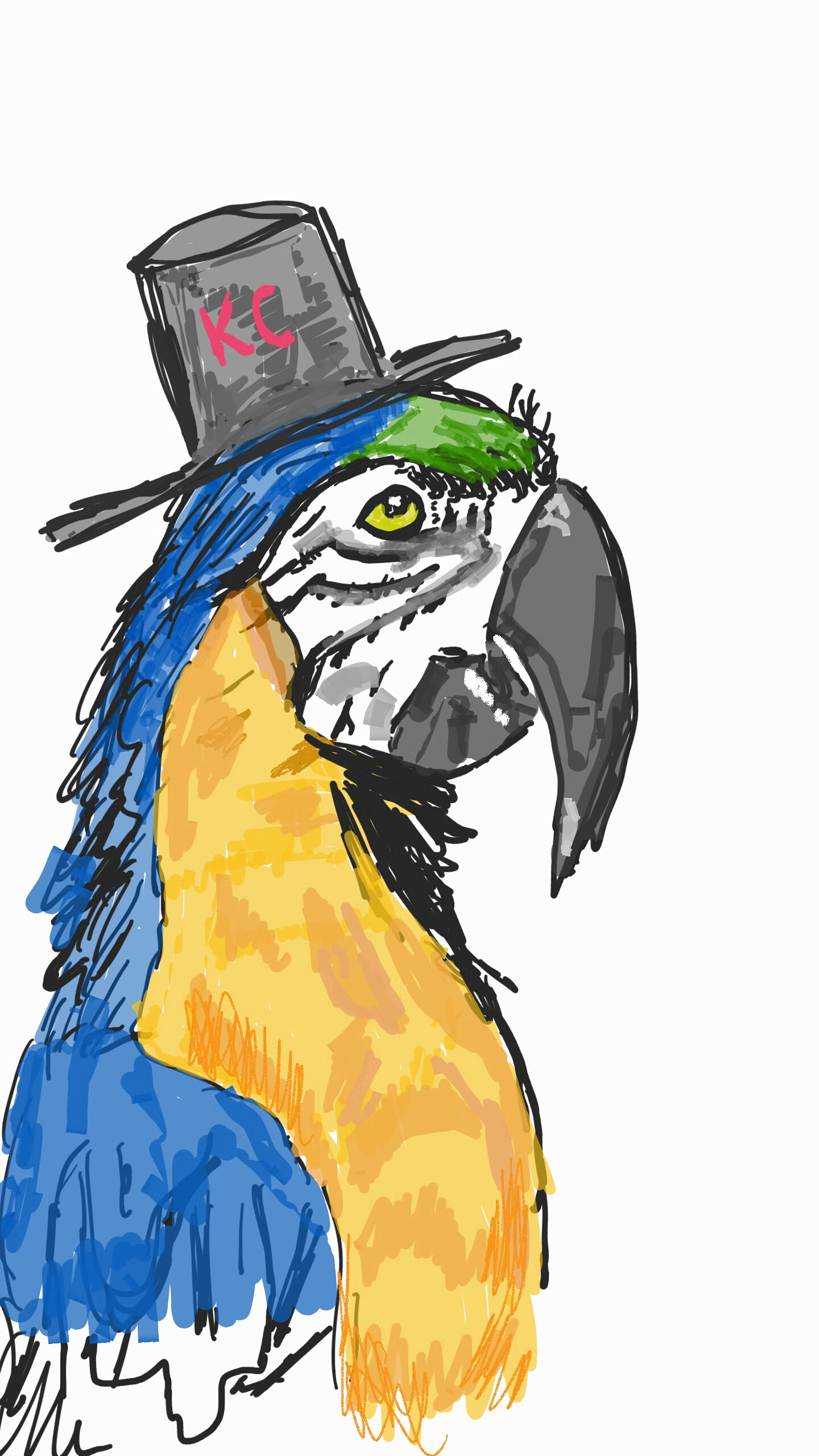
Macaw Redux–In the Style of Charlie the Doodlewasher–Only Better
Because of the Kansas City tophat, you see. That’s why “better.”
See Charlie’s quite exceptional original here.

 conversation is an engine