

Decentered. As in “not the crux of all things.”
A place for everything and everything in its place
I’ve put a recurring early-morning block on my calendar titled “Decenter.” The block or early morning quiet and focus has actually been on my calendar for decades, but I’ve recently retitled it based on a cue from Merold Westphal, a philosopher who teaches at Fordham University.
Westphal, writing in The Phenomenology of Prayer (NY: Fordham University Press, 2005), introduces prayer as a “decentering” activity. As a conversation, prayer takes me out of the center of my universe. Like the prayers of the old poet-king or the prayers of the inveterate letter-writer, these are conversations that recognize some other as the center of everything. Those two saw God as the center—I’m with them on that.

There is mystery beyond our convenient placeholders.
Of course, “de-centering” is not the way we could describe many of the prayers we pray. We send up endless lists to some imagined order-taking god, with caveats about when (“Now works for me. How about now?”) and where and how. And especially how much. But listen to Westphal:
…prayer is a deep, quite possibly the deepest decentering of the self, deep enough to begin dismantling or, if you like, deconstructing that burning preoccupation with myself. (Prayer as the Posture of the Decentered Self, 18)
Again and again I find myself at the center of all existence. Maybe you do too. We’re sorta set up for that, given eyes and ears that operate from a central pivot, constantly swiveling about to take in all we possibly can.
It seems natural enough to think everything revolves around us.
The truth is we need help to back away from this “burning preoccupation.”
###
Dumb sketch: Kirk Livingston
NOLA: Same words. Entirely different experiences.
Your Interpretation May Vary
Maybe you’ve seen a version of these New Orleans tourism spots. What is remarkable is how the same voiceover is used in all, but each depicts an entirely different experience. Tim Nudd has some smart comments on the three at Adfreak.
I watch these and cannot help but think about how we interpret any text, And how each understanding of a text is different because of the intentions we bring to a text and the experience/baggage we also bring to our reading. That’s why we talk through how we read things—your interpretation gives a fuller perspective to mine. And, I hope, vice versa.
These three ads tell that interpretation story well.
###
Via Adfreak
The Case for Desire
Hint: your smartphone is symptom not cause
Advertisers bank on it. Ascetics deny it. Libertines fan it while most of us try to tame it. Desire always drives behavior. The question is training ourselves to desire the best things, which are often not the immediate things. Habit can work for or against us in training desire. But it is desire—that glowing reactor in my mind/heart/instinct—that pushes me toward some object that has just now become irresistible.

Beautiful things can grow from years of tending
But when desire fails—what then? That sounds perfect, right? Always in control.
Not so much: In talking with my depressed friend, desire seems suppressed and/or forgotten and nothing matters. Nothing is interesting. Tiredness, life-weariness, stress, maybe age—all of these seem to affect desire. Without desire, curiosity vanishes. Without curiosity, life’s luster languishes.
How to rekindle desire—and especially desire for things/people/relationships that will prove generative after five, ten, or 70 years?
My hunch is that my smartphone is not the secret to rekindling the right desire. Whatever is being sold there is likely not the direction that will sustain over the long haul. Gratitude seems a potential route to rekindled desire—on this point, both my atheist friend and the poet-king agree. A good conversation with a person full of life may rekindle desire.
Connection may rekindle desire. If your smartphone helps make connections with real humans, that’s good.
If not, focus.
Elsewhere.
###
Image credit: Kirk Livingston
I completely disagree. Are we still friends?
How a small group helps you listen better
Say you are in a small group. Maybe you are part of a knitting guild. Maybe a book club. Maybe you meet every two weeks to study ancient texts together.
Your group comes together for some specific purpose, but along the way you make friends with these people. Sometimes these people agree with your opinion. Sometimes they disagree. But you listen to them anyway—even when you disagree. They listen/you listen because of friendship.

Tell me: how do you see it?
A few days back I wrote about a group we are part of where membership is shrinking. The take-away was that it only takes one or two people to have a conversation that is stimulating and even eye-opening, and possibly life-changing (if only incrementally). This has to do with the mechanism of hearing opinions and insights that are different from mine and stopping to consider them—because of friendship. Hearing from others is a beginning step away from the echo chambers we increasingly build for ourselves with media that says only what we want to hear.
Making friends who think and believe differently seems like a good idea. And engaging them in conversation about stuff that matters—that seems like a really good idea.
I wish we had a will to do more of that.
###
Image credit: Kirk Livingston
So. We all agree.
What does collaboration look like to you?
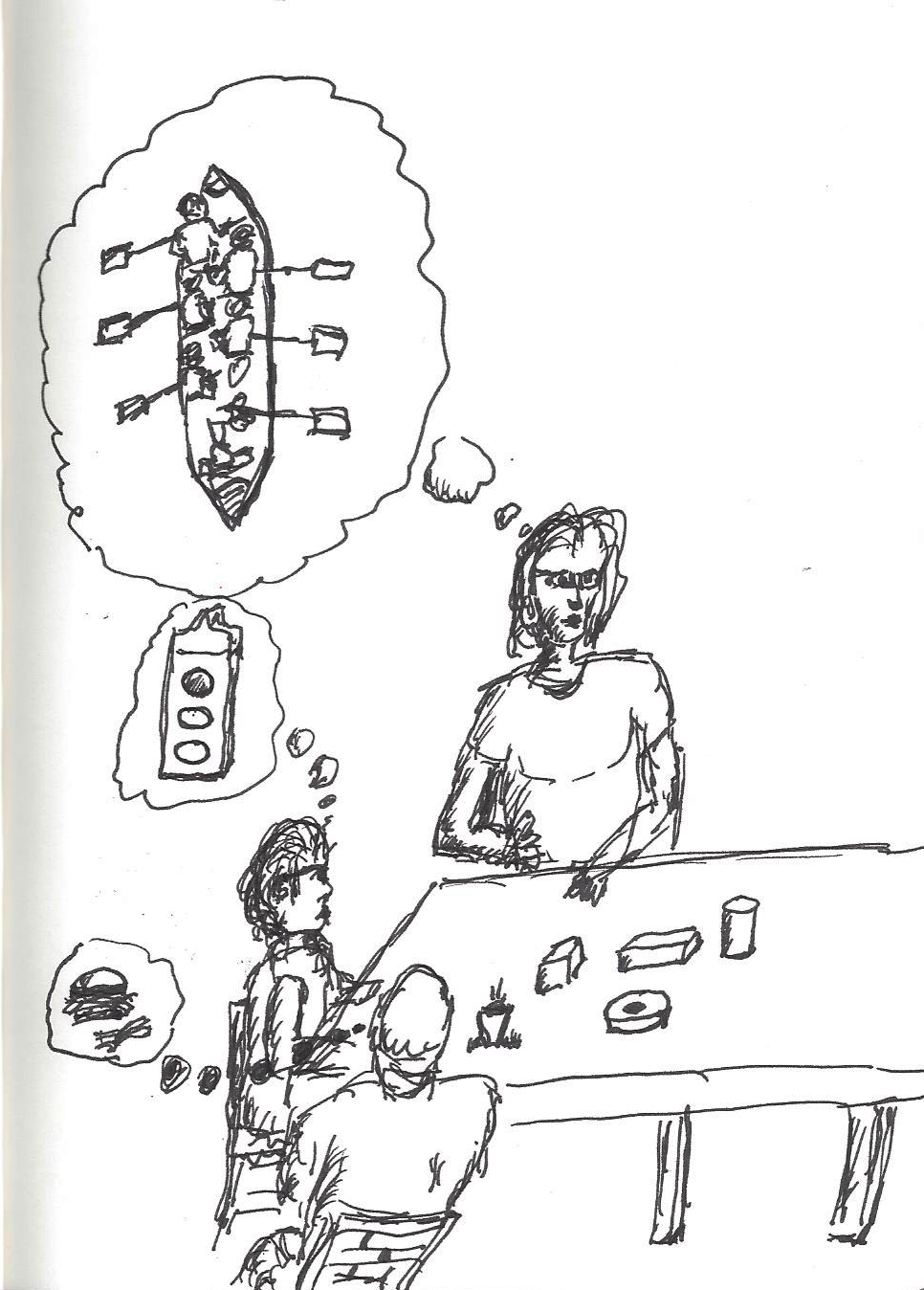
We’re having the same thought, yes?
###
Dumb Sketch: Kirk Livingston
Casket Arts: The Artist’s Palette
High in the Casket Arts Building

The artists in the Casket Arts Building are readying their spaces for Art-A-Whirl, next weekend.
###
Image Credit: Kirk Livingston
Extreme Listening: 4 Motivations
If one motivation doesn’t fit you right now, check that you have a pulse
We’re not great listeners. There’s so much we want to say and we are generally desperate to be heard. And in these highly partisan times, we simply shout at and past each other and call it a conversation.

Don’t let listening go unused.
But there are natural times when each of us actually does stop to listen. I count at least four:
- I Need Something. The most interested college students I teach are the ones who realize they need something. They are motivated to listen and stay engaged in class because they see themselves using the skill/knowledge we are talking about. I listen intently to the old guy at the hardware store because I truly have no clue why this plumbing connection will not seal. I listen because I need whatever it is the person is saying.
- I Want to Understand. It’s why a lot of us read fiction and non-fiction alike: we want to understand this topic and we’re willing to pay attention to this author as she or he spins out the story or argument. Wanting to understand is the motivation behind a story’s tension—it’s the hook that keeps us on the pages. We listen to our kids when they explain why they did this or that (when it seems perfectly counterintuitive to me). We sometimes listen to our own explanations and obfuscations as we try to distance ourselves from some thing we’ve done.
- I Want to be Close to You. “Listen, sweetheart, tell me everything about you.” The early days of romance give way over time to the growing realization that there is much we don’t know about our spouse—even after 30 years of marriage. We listen because we want to hear the perspective of our beloved.
- I Want to Serve. “Serve” sounds so menial, doesn’t it? And yet finding yourself in a position to help another is a primary motivation for work—at least I’ve found it so. Wanting to help beats working only for money. Wanting to help beats working to amass power every time. And wanting to serve is a sort of gift that keeps on giving. The desire to serve means listening to someone to see what he or she needs and wants. You cannot serve without listening.
If you have a listener in your life—someone who lets you spin out your argument or story and remains engaged—count yourself fortunate. I believe there’s actually quite a lot of healing in those listening encounters.
If you want to be an extreme listener tap into one of these motivations and apply it to your current situation.
Can you think of other motivations for listening?
###
Image credit: Kirk Livingston
Drunken Prophecy: The Tribe Who Didn’t Selfie
Boy 1: “Look at this old drunk guy”
Boy 2: “He’s not drunk. People call this guy a prophet—he’s just sleeping. Watch this.”
Pokes sleeping man with a stick.
Man wakes.
Boy 2: “Prophecy, Old Man!”

Man:
And there arose a tribe in the land of Commerce.
And these took not the selfies.
And they tended not their personal brand.
Neither did they Facebook.
And they came to be known as “Old.”
And the young did then flock to the Old
To hear stories of living without the desire for fame.
Boy 1: “Cool. But what a whack prophecy.”
Boy 2: “Crouch there. Let’s get a shot of us with this guy.”
Holds up phone.
###
Image Credit: Kirk Livingston

 conversation is an engine