A Beautiful Bit of Honesty: Butte’s Berkeley Pit

The Berkeley Pit is an open pit mine on the edge of Butte that had gobbled up neighborhood after neighborhood for years. In 1982 the mine ceased operation and began filling with water. But not just filling with clean swimming pool water. The water in the pit is highly acidic and so full of minerals that today it (yes, the water itself) is “mined” for copper. It may be a myth that migrating birds die instantly if they land in the water, but vigorous hazing activities include a houseboat that moves around the lake to get birds off the water and to collect those appearing to suffer ill effects (they dump the birds in an on-board five-gallon barrel of fresh water and release them from fresh-water).

Enjoy the view.
Standing on the viewing platform, the scale of the pit is amazing. And the chamber of commerce runs a brave Orwellian soundtrack complete with patriotic, upbeat music that describes all that is going on to clean up the mess and how nobody needs to worry about the toxins seeping into the ground water for a variety of reasons. So just enjoy the view. [Addendum: The level of the water in the pit is carefully monitored so the toxic mess does not seep into the groundwater. The number of people and groups watching the pit is quite amazing. ]
The beautiful bit of honesty came from a resident I spoke with. What was her impression of the Berkeley pit and what did other residents think of it?
“We know we live next to a lake of battery acid.”
No spin. No soundtrack or patriotic music. Just winsome honesty. And let’s get on with life.
###
Do a Dumb Sketch Today
Magnetize Eyeballs with Your Dumb Sketch
 As a copywriter, I’ve always prefaced my art or design-related comments with, “I’m no designer, but….” I read a number of design blogs because the discipline fascinates me and I hope for a happy marriage between my words and their graphical setting as they set off into the world.
But artists and designers don’t own art. And I’m starting to wonder why I accede such authority to experts. Mind you, I’m no expert, but just like in the best, most engaged conversations, something sorta magical happens in a dumb sketch. Sometimes words shivering alone on a white page just don’t cut it. Especially when they gang up in dozens and scores and crowd onto a PowerPoint slide in an attempt to muscle their way into a client’s or colleague’s consciousness. Sometimes my words lack immediacy. Sometimes they don’t punch people in the gut like I want them to.
A dumb sketch can do what words cannot.
I’ve come to enjoy sketching lately. Not because I’m a good artist (I’m not). Not because I have a knack for capturing things on paper. I don’t. I like sketching for two reasons:
- Drawing a sketch uses an entirely different part of my brain. Or so it seems. The blank page with a pencil and an idea of a drawing is very different from a blank page and an idea soon to be fitted with a set of words. Sketching seems inherently more fun than writing (remember, I write for a living, so I’m completely in love with words, too). Sketching feels like playing. That sense of play has a way of working itself out—even for as bad an artist as I am. It’s that sense of play that brings along the second reason to sketch.
- Sketches are unparalleled communication tools. It’s true. Talking about a picture with someone is far more interesting than sitting and watching someone read a sentence. Which is boring. Even a very bad sketch, presented to a table of colleagues or clients, can make people laugh and so serve to lighten the mood. Even the worst sketches carry an emotional tinge. People love to see sketches. Even obstinate, ornery colleagues are drawn into the intent of the sketch, so much so that their minds begin filling in the blanks (without them realizing!) and so are drawn into what was supposed to happen with the drawing. The mind cannot help but fill in the blanks.
The best part of a dumb sketch is what happens when it is shown to a group. In a recent client meeting I pulled out my dumb sketches to make a particular point about how this product should be positioned in the market. I could not quite hear it, but I had the sense of a collective sigh around the conference table as they saw pictures rather than yet another wordy PowerPoint slide. In fact, contrary to the forced attention a wordy PowerPoint slide demands, my sketch pulled people in with a magnetism. Even though ugly, it still pulled. Amazing.
###
Quiet Leadership by David Rock. How to Help Someone Have an “Aha!” (Review)
Talk your friend into the answer she already knows
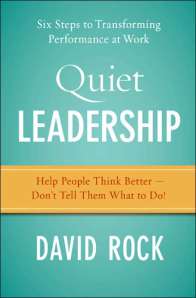 How do you help people connect the dots in their work lives…and in the rest of their lives? Turns out there is a lot we can do. And our primary tool is conversation. In Quiet Leadership, David Rock gives an overview of (relatively) recent neurological findings to show how our brains remain plastic, that is, moldable and changeable, long after childhood. It was once thought that at some point in late childhood our brains stopped—well, it’s not that they stopped growing, but seemed to create new neural pathways with less frequency. That thinking was all wrong. The truth is our brains are capable of growing new neural pathways all the time—new mental “wiring.” And by calling it “wiring,” Rock hints at the mechanics of how we help each other connect previously unconnected thoughts and motivations. He works at changing our mental wiring using questions about our thinking. Helping people find their own answers is light years more effective than telling someone what to do.
Like most books written for the business market, Rock presents a tidy set of steps to follow. Quiet Leadership has six steps. Each step has a chapter or section attached, so there is a lot of very practical, very interesting information for each. I outline these steps below because after reading the book and getting a sense of the potential, I’m curious to remember and try them:
- Think about thinking (focusing on how your conversation partner is thinking about the issue troubling them)
- Listen for potential (listening with a belief your conversation partner already has the tools for success)
- Speak with intent (Be succinct. Be specific. Be generous.)
- Dance toward insight (Conversation really is a kind of dance)
- Permission
- Placement
- Questioning
- Clarifying
- CREATE new thinking by exploring:
- Current Reality
- Explore Alternatives
- Tap Energy
- Follow up (Renewing and restoring the motivational connections by checking in later)
You may be skeptical of tidy steps. You may think “dance toward insight” is too over-the-top. I agree. And yet there is something in what Rock says that speaks to the reality of any conversation. Conversations routinely take off in crazy directions. Conversations often start with a need and we immediately feel helpless to meet the need: we don’t know all the details. Even if we did, we don’t know how our conversation partner is really thinking about the issue.
Rock provides a way to probe thinking (I like how he asks permission to probe) to not only help a person find solutions, but also to help a person be motivated to act on the solution.
I’ll use this book as I teach, with clients, and in general conversation. I highly recommend it.
###
Try this: Be Ionic, Iconic and Ironic
Disturb Someone Today
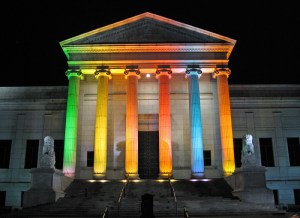
The Minneapolis Institute of Arts manages to be ionic (columns), iconic (yes, the columns again) and ironic (colors on columns–really?)
It’s all in the mix. Start with an ancient form: a note, a letter. A poem. An email? Get the form just right and let it carry all it was meant to carry. Then bring it into today with an element that steps outside that form. The MIA does it with colored lights on the ionic pillars with are also iconic. Is the result beautiful? Not exactly. Several of us have thought a lot about whether those lights are right or wrong. We decided they are ironic.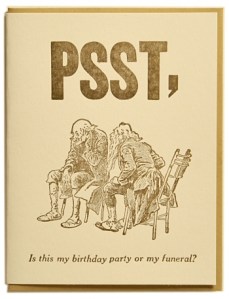
That’s why I’m so fond of the cards turned out by Zeichen press. Old form. Old cold type. I’ve worked with quoins and frames and rollers that spread ink across a platen. Everything about the process shouts “old.” But the messages are anything but old. Their cards disturb even as they console or encourage.
How can you disturb someone’s attention by mixing up an old form with something of today?
###
Dummy’s Guide to Conversation #9: Say it Out Loud To Get It
 A pastor friend once wondered why the congregation didn’t know this certain fact he had mentioned in a sermon. My friend was under the notion that people listen closely to every word of a sermon. I am convinced people do listen—just not to every word.
I know this because I have taught college students and mistakenly thought that the wide-open eyes and direct eye contact meant they were listening. It took me until my first test to realize how mistaken I was. Direct eye contact is as much an act as appearing to type notes while facebooking friends. Students and all of us easily adopt the outward behaviors that allow us to escape miles away to play on the beach while the person in front persists in boring monologue.
But a conversation is a different environment than a lecture or sermon. Don’t let your conversation partner bore you with abstractions. Challenge them. Question. Ask. This is the very nature of conversation and it fits with how we understand anything: we need to try an idea on for size to sort out whether it fits us or the situation.
Trying an idea on for size looks like talking.
We must turn something over verbally to begin to understand it. It’s just how the will is connected to the brain—through the voicebox. Not exclusively, sometimes we get it without saying it or asking. And sometimes writing a note helps in understanding (that’s often how it works for me). But make peace that people need to respond in one way or another to truly begin to understand something.
This is part of the reason lectures can be so ineffective.
###
Image Credit: BLU (street artist from Bologna Italy) via 2headedsnake
It Turns Out Time Is Not So Flexible
My Wife Demonstrates Use of a “Clock”
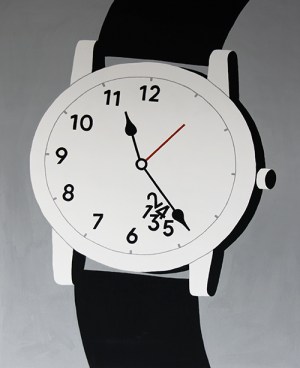 I’ve always joked that I live in a time warp. Time actually moves backwards as I drive to my next meeting (which is not a confession of speeding, please understand).
I am of the tribe who refuses to leave what I’m doing to get to the next thing. In my mind—as I remain at my keyboard—myriad mental time and distance calculations convince me that of course I have plenty of time to get to that meeting. My watch is set ten minutes ahead so I am only five minutes late to things. (That’s a reasonable margin, right?) Of course there will be green lights. Certainly there will be no traffic—I count on it. Naturally I can shower/shave in five minutes and be ready. Absolutely.
As it turns out, my wife is able to use a clock. And she timed my five-minute shower. And then she asked me if I could take a shower and eat breakfast in five minutes.
“Yes,” I said. “Of course.”
“Twenty minutes,” she said.
“What’s that?”
“Yes.”
So, here’s my new deal with the universe: I’ll give myself thirty minutes to shower and eat breakfast. And not just because my wife has had something to say about this for 27+ years. Perhaps peace with Mrs. Kirkistan—in this area—would be useful.
Yes.
I’ll get started right away.
Just let me finish this thought.
###
Image Credit: Ryan Todd via thisisnthappiness
The Republic of Kirkistan is On the Move
Over the next few days, Conversation is an Engine will revisit a few old posts
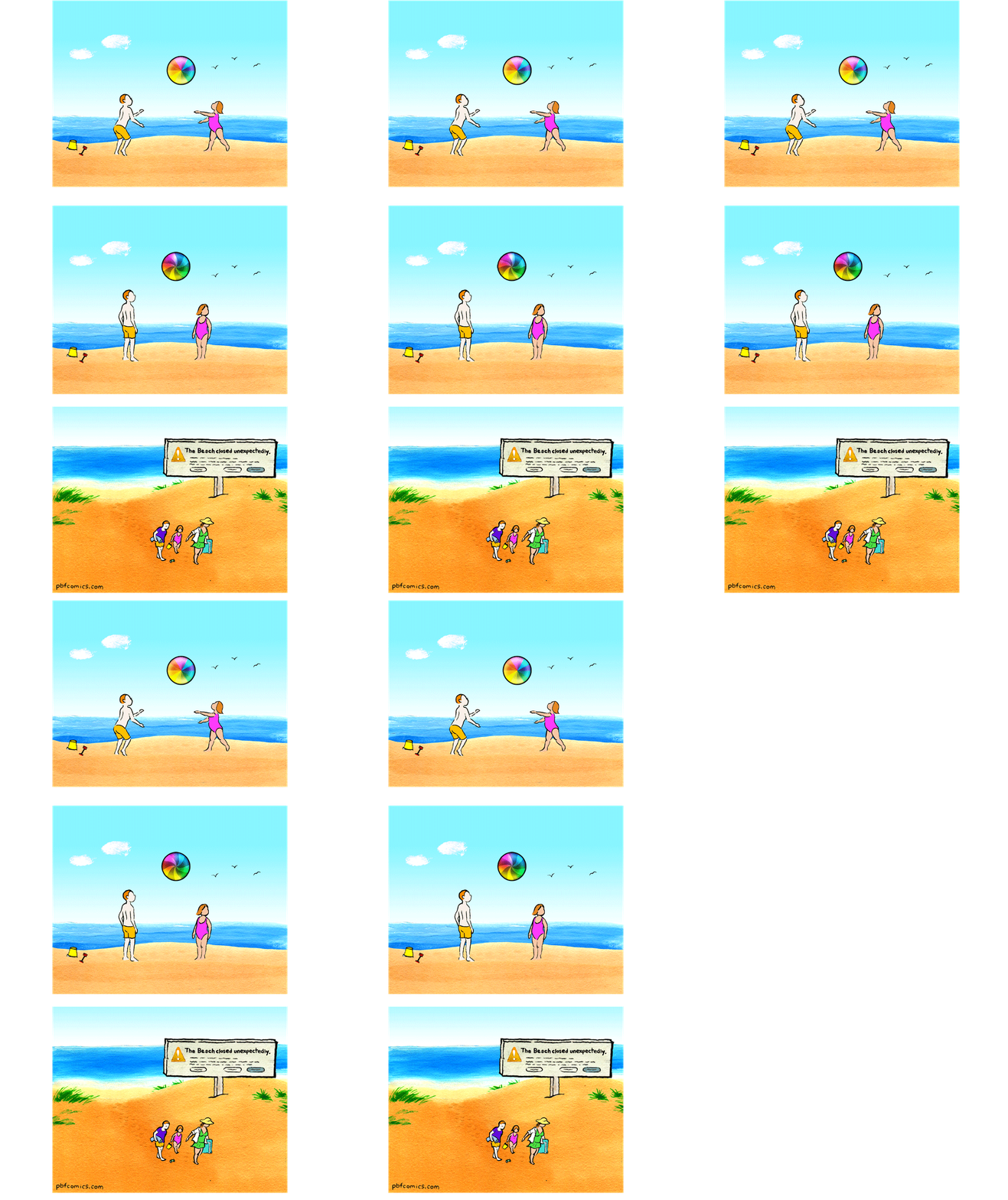 It’s time to play hooky from work.
###
Image Credit: PBF via thisisn’thappiness
18 HBR Finalists on Redistributing Power
It Is Written: The M-Prize and You
 For some time I’ve wondered what leadership will look like when the power of monologue is finally revealed as the empty shell it always was.
I’m not alone with that question.
It seems the folks running the Harvard Business Review have teamed with McKinsey to incent people to rethink “the work of leadership, redistributing power, and unleashing 21st century leadership skills.” The result is a series of case studies that should prove interesting—and not just to folks in the leadership industry.
I’ve not read any of these 18 articles but I plan on reading them all. I’m interested because the more we learn about how to build conversations that free our best thinking, the more likely we are to innovate. And the more likely we are to find ourselves living out our vocation. And the more that happens, the more better everything gets.
Yesterday I stumbled on an ancient text that presented an insight on the very kind of leader the M-Prize hopes to unearth. The text talked about a very unusual leadership skill set: This leader is equally at home encouraging the worker in pain as he is furthering the cause of justice. This leader can fan the dying embers of a person’s passion even as she moves earth’s largest causes forward. No trampling on others in an upward climb for this leader.
If you stop by Conversation is an Engine with any regularity, you know that a theology of conversation exerts a powerful gravity around here. We have this hunch that people were made to be in conversation and that we become fully human as we engage in conversation. And more: conversation may be a part of any knowledge we lay claim to.
Naturally, there’s a lot more to say about this.
But the leader who understands the power of conversation and works at interactive collaboration rather than straight-line order delivery is the leader poised to succeed.
It is written.
So—Kudos to the HBR/McKinsey folks for their vision.
###
Image credit: actegratuit via 2headedsnake
Mark Hartman: When a photographer asks questions
Photography answers look different than, say, a writer’s answers

I’ve long thought the answers we get depend on the questions we ask. But those answers also depend on the tools we use to unearth the answers. Writing is my primary tool. I reach for a sentence or two as I approach any question. It’s why I’m rarely without a pen/paper/smartphone/computer in any life situation. It’s just how I process life.
Some people carry pen and paper everywhere they go.
Some people carry a Hassleblad camera where ever they go.
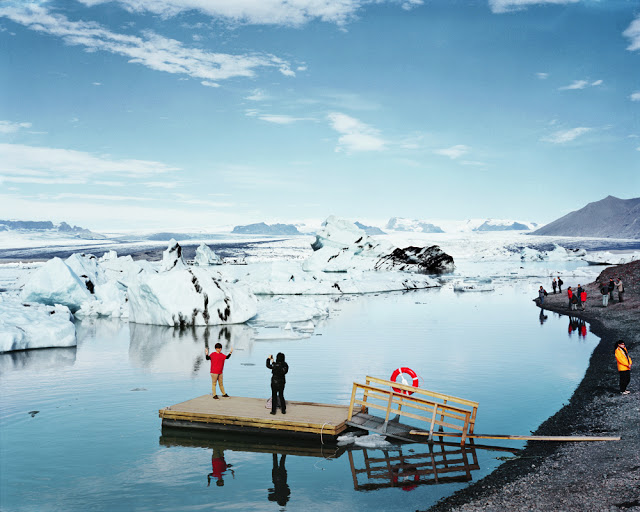
Like Mark Hartman who spent a month in an isolated, northern region of Iceland. He wanted to explore “how we as humans occupy, exist and relate to our earth and environments.” He also wondered about the “echoes of human presence [that] linger long after we leave it.”
Mr. Hartman’s answers are bright, clear and full of wonder.
See for yourself.
###
Via Lenscratch

 conversation is an engine