“What Will I Be When I Grow Up?”
Start Your Process Early to Answer Life’s Recurring Question
This question will not go unanswered.
As a kid you quickly volunteer answers: firefighter, ballerina, basketball player, scientist, pilot. It’s right that action-jobs attract kids. You may defer answering it as a college senior. You may say, “I’m not sure. We’ll see what comes up.” You find yourself saying it in your first job, hinting that “This is OK, but it’s not quite the right fit.” In fact, you may think it through a career.
I’ve had two different conversations recently with people suddenly seeing the horizon of retirement off in the distance. Both said some variation of “I’m not sure what I want to be when I grow up.”

The question is tricky because it sounds like an all or nothing deal: you do this or you do that. Binary. One or the other. But the truth is more like life is filled with all sorts of opportunities that are concurrent. You must pick. You must choose. If you don’t pick and choose, chances are good you’ll simply slide into being entertained. That’s not bad, it’s just that being entertained generally pacifies the urge to create.
And yes, I am talking about creating. Because one assumption behind the “What will I be?” question is “How will I take action in the world?” I argue that the sooner we find ways to address that question, the better off we’ll be at every stage of life. One old model of retirement was that you put in your time for 30-40 years (at something you hate or just tolerate), and then head to the golf course in Florida or Arizona to be entertained until you tip over into the grave. Today people approaching retirement are looking for ways to keep making a difference. The lucky ones have both their health and some sense of the art or craft or service they simply cannot live without doing.
I’m thinking about this today because one central piece to my social media marketing class asks students to pursue their passion publicly using every social media avenue open to them. This is a difficult question and commitment for these students to make. I like the exercise because it forces them toward the larger life question. I like the exercise because it initiates a process that, if they follow it, will begin to answer that question.
Locating that thing we are passionate about involves experimentation, of course. And if your work does not leave any time for locating your art/craft/serve/tribe, is it possible that in 30 years you might still be asking, “What will I be when I grow up?”
I hope not.
###
Image credit: Kirk Livingston
What is Engagement, Anyway?
Are Likes Helpful or Corrosive?
The college where I teach is something of a bride-and-groom factory. This [largely unstated] expectation of finding your soul-mate by the time you graduate lurks in the halls and hovers over tables in the cafeteria.
At least that’s what students tell me.
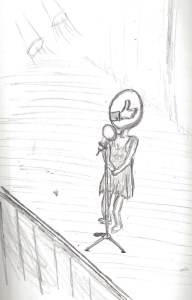
“You like me. You really like me.”
I’m sympathetic: there are few times like college for being surrounded by attractive folks of similar age who are also poised to make big life decisions. And, true, that’s where I ran into the beautiful young woman who a few years later became Mrs Kirkistan (lo these 30 years and counting).
In this particular college social construct, if you ask someone for a date, well, that’s kind of like a proposal. If you actually date, well, you might as well be married. To be fair, I’m not close enough to say if it this is entirely accurate. But my few talks with students make me kind of sad that relationships would be so, well. binary.
So it’s not surprising that these folks have an interesting skew on engagement. These are people who grew up with likes and short texts and public Facebook conversations. The quick word carries a lot of weight. For some, the quickness with which a like comes back speaks volumes to their self-esteem. It seems like engagement is an all or nothing deal and social media has the power to amplify that.
This social construct plays into expectations in my class. What do we expect when we think of engaging with the audiences we pursue? Are likes what we seek? Page views? Actual comments? Someone stopping you in the hallway? How does anyone determine if someone else is interested in what they say? Social media experts have all sorts of answers for this and all sorts of complicated metrics, some of which even make sense.
One thing is certain: grooming your personality and language for likes is dangerous. Just as it always has been. Of course we all do this to some extent. Who doesn’t want to be seen as attractive and groovy?
My hope for my class—and for anyone with courage to create anything—is that they create from an interiority that remains integrated and intact. That is: write and create from what drives your passion. Likes and page views are OK, but they should never substitute for your own sense of chasing the thing you simply must say. Yes, you’ll need to sort out how to get attention, but it is even more important to exercise your creativity along the lines you were made for.
In the end, likes may not be all that helpful.
###
Dumb Sketch: Kirk Livingston
Gary is So Money SuperMarket
Epic Dance Moves
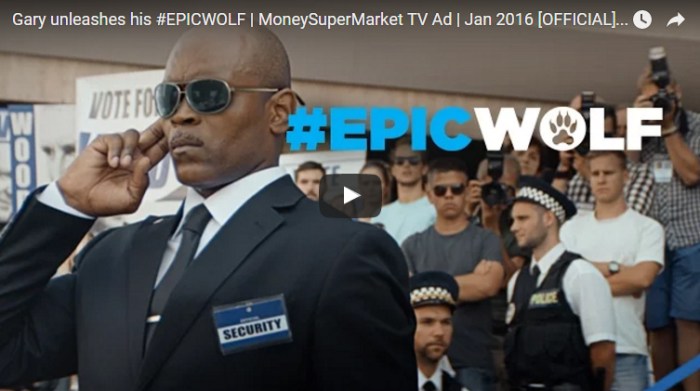
Unfortunately, it is not available for viewing in the US.
Still, if you click on that image, or perhaps here, you might be able to see it.
You never know.
###
John Cleese and Writing Funny
The writing must bring the reader along.
John Cleese is nearly always funny. And he has a lot to say about writing funny. In the “John Cleese Interview” that follows, he says that Basil Fawlty (from Cleese’s Fawlty Towers) was never angry at the beginning of the show. The funny bit was showing how he got there and showing it in a way the viewer could relate to. He goes on to describe the difficulty he had finding a branch to give his auto a good thrashing.
###
Via Adweek
Stuck and Reframe
Just How Real is Our Imagined Beginning?
I’m stuck on a client project. Late in 2015 I devised a social media communication strategy that calls for weekly themes. But one of my weekly themes provides very little fodder for producing content. And so I’ve been spinning my wheels and getting exactly nowhere.

Maybe it’s a good time to be stuck, because this is the season of reframing. Old things ended as 2015 shuffled out and new things began with the calendar change. Everything outside my window looks the same, but we’ve all group-thinked (group-thunk?) ourselves into what we call a new year. Is it an imagined new beginning? Of course. But that doesn’t make it any less real. Somehow that calendar change gives a bit of courage to consider releasing the strategies that don’t work.
Reframing—trying to see a problem or need differently—is a way out of stuckness. My tools for building a new frame around a client need or personal problem include words on pages and dumb sketches and mind-maps and fartleks and conversations. You already know that conversations hold quite a bit of promise: telling someone else about your stuckness has the effect of bringing to light a problem and beginning to find your way through it.
If you are of the tribe that makes resolutions, you also know that telling your resolution to someone can have a positive effect on keeping those resolutions. And you may even have someone who holds you accountable.
I’m stuck on a client project.
I’m going to talk with my client.
Staying stuck is not an option
###
Image credit: Kirk Livingston
Marcia Brady and ListenTalk and Learning in 2015
Even the Gray and White Outside Points In
 Surely you notice all the 2015 retrospectives: photography, music, film, advertising. Every industry has some writer summing the year into the ten best. These waning days lend themselves to a bit of reflection.
2015 was a year for trying things. Today I’ll produce my 365th dumb sketch—a sketch a day since January 1, 2015. Did I produce art? Not a single time. But I did learn to see shadow and light and the crazy, limitless variation in the people around me. 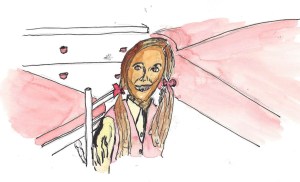 I did learn that very few lines exist out in the physical world and that Marcia Brady can look like the Joker when drawn spectacularly wrong.
From publishing ListenTalk: Is Conversation an Act of God? I learned that I need to simplify my argument for listening to each other. In fact, the mystery and promise of conversation has taken hold of me so that I am listening to conversations in a new way. I continue  to wonder what might happen if people at work listened to each other more closely. I continue to hope my nation can learn to listen to people outside our tribe rather than label and dismiss them. I suspect conversation is an engine will continue to sketch out the parameters of useful conversation in 2016.
Outside my window are variations on gray and white. Gray sky. White snow. Dark gray 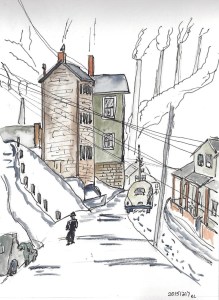 branches thrusting up toward blue-gray clouds. Lighter gray shadow on snowy edges. It’s the perfect climate for asking about the fruit of a year’s worth of effort.
How about you? What’s got your attention as 2015 melts into the gray?
###
Dumb sketches: Kirk Livingston

When Hoax-Busters Give Up
And so we descend into irrationality
Our Bright Shining Future
The end of the Washington Post’s “What was Fake” column had the writer quoting academic Walter Quattrociocchi, head of the Laboratory of Computational Social Science at IMT Lucca in Italy:
Essentially, he explained, institutional distrust is so high right now, and cognitive bias so strong always, that the people who fall for hoax news stories are frequently only interested in consuming information that conforms with their views — even when it’s demonstrably fake.
The entire last article is worth reading: What was fake on the Internet this week: Why this is the final column.
To sum up this moment: we read what agrees with our viewpoint, we talk with people in our tribe who agree with us, we label those who disagree with us and we generally see facts as “facts.”
This moment does not represent the future I hoped for.
###
Image credit: Kirk Livingston
And Before You Were Born
What was life like then?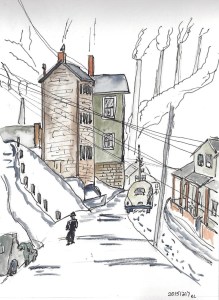
Before Instagram. Before Twitter. Before games on screens.
Back where your people came from.
Will you run into anyone who can answer that in the next week?
###
Dumb Sketch: Kirk Livingston

 conversation is an engine