Posts Tagged ‘dialogue’
Counterintuitive: Listening Beats Talking?
Persuader Vs. The Persuaded

The Russian polymath Mikhail Bakhtin—one of the titanic minds of the twentieth century, though too neglected now—believed that in a dialogue the position of primacy is with the person who listens rather than the one who first speaks. After all, he said, we do not speak unless we anticipate a response; and we shape what we say in light of possible reactions.
–Alan Jacobs, The Pleasures of Reading in an Age of Distraction (NY: Oxford University Press, 2011) 55
Without some listener—you see—there would be no words launched.
###
Image credit: Kirk Livingston
DBT: When Does Talk Become Therapy? (Shop Talk #9)
Can a conversation save your life?
I recently met a therapist who practices dialectical behavior therapy (DBT). She and her team work with clients who may struggle with a number of issues including borderline personality disorders and thoughts of suicide, among other things. As we talked it seemed to me that her practice was very much focused on, well, talking. Her practice of therapeutic talk has a pretty good track record of helping people find ways through each scary personal wilderness.
In Doing Dialectical Behavior Therapy: A Practical Guide (NY: The Guilford Press, 2012), Kelly Koerner describes some pieces of how this therapy works:
Emotion dysregulation is the inability, despite one’s best efforts, to change or regulate emotional cues, experiences, actions, verbal responses, and/or nonverbal expression under normative conditions.
Gaining control is a matter of recognizing biologically-based contributing characteristics, focused regular therapeutic conversations, skills training, self-monitoring and a host of other strategies and tactics.

As a non-therapist outsider, I am simply curious as to how far conversation can go to help people become well again. And I am very curious as to what a therapeutic conversation looks like. While we may or may not suffer the particular illnesses that Koerner notes, I am reasonably certain anyone reading this can testify to the clarifying power of a conversation with a good friend and the long-term impact conversations have on keeping us…sane.
In ListenTalk: Is conversation an Act of God? I try to show what happens in our simple and ordinary conversations. I found a few philosophers to talk with some ancient texts (pre-order ListenTalk here), and what they ended up saying together continues to surprise me. It’s a book that will be interesting to people of faith, but the big idea is that since people matter, our talk together matters. And more than that, we actually come alive in tiny ways when in conversation.
I’ve begun tracing the different paths where conversation is truly an engine for some particular outcome. I’ve noted the product place of conversation in many business settings. I’ve wondered about the role of conversation in connecting any/all of us to God. And now here is another example of using the ordinary tool of talk to uncover and possibly address deep-seated need.
Talk. It’s a marvel.
Other Shop Talks you may find interesting:
- Writing with Sheet Metal (Shop Talk #2)
- Is Your Job Fulfilling? (Shop Talk #3)
- Power Distance Vs. Skunkworks (Shop Talk #8)
###
Image credit: Kirk Livingston
I completely disagree. Are we still friends?
How a small group helps you listen better
Say you are in a small group. Maybe you are part of a knitting guild. Maybe a book club. Maybe you meet every two weeks to study ancient texts together.
Your group comes together for some specific purpose, but along the way you make friends with these people. Sometimes these people agree with your opinion. Sometimes they disagree. But you listen to them anyway—even when you disagree. They listen/you listen because of friendship.

Tell me: how do you see it?
A few days back I wrote about a group we are part of where membership is shrinking. The take-away was that it only takes one or two people to have a conversation that is stimulating and even eye-opening, and possibly life-changing (if only incrementally). This has to do with the mechanism of hearing opinions and insights that are different from mine and stopping to consider them—because of friendship. Hearing from others is a beginning step away from the echo chambers we increasingly build for ourselves with media that says only what we want to hear.
Making friends who think and believe differently seems like a good idea. And engaging them in conversation about stuff that matters—that seems like a really good idea.
I wish we had a will to do more of that.
###
Image credit: Kirk Livingston
If you say a dumb sketch, will others pay attention?
Engineers aren’t the only ones who love to correct you
I’ve been repeating myself recently to different people and groups within my client’s shop.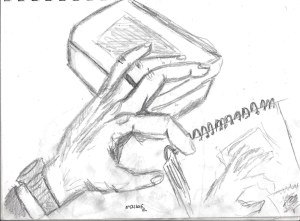
I’ve been saying aloud the oral version of a dumb sketch. I’ve been telling and retelling the story of how I thought one thing but then in conversation with different experts, came to see what I thought was really not so at all, but something different. I know this is terribly abstract and I apologize: We’re working on a new proprietary idea at the moment, so I cannot be too specific.
I thought X was like Y. But it turns out that X is very like Z. And when I tell that story—of trying and failing and trying—my listeners get it. They learn something. They jump to Z and each gets pretty excited about Z—they had not seen Z before. But now that Z is named and out there, Z may just change everything (and not in a breathless marketing-hype way, but really change how people move forward in this particular industry) (Which I cannot name.) (Sorry.) Each mini-audience put the pieces together and then leaps forward in a way my didactic, linear, word-driven paragraphs did not succeed at.
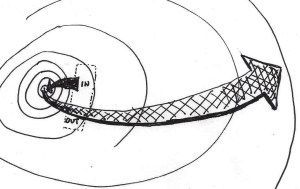 The point of a dumb sketch is to be not-finished. A sketch is the opposite of the heavily produced diagram or slide. The “unfinishedness” of a sketch is the very crux of usefulness as a communication tool. By being unfinished, the sketch invites collaboration and improvement. And people seem to not be able to turn away—at least from the oral version. Failure is built right into my story, and who can resist gawking at a car wreck?
Maybe this is an engine behind John Stepper’s notion of “working out loud.” Maybe this is a key to how we collaborate with each other. We already do this with friends and family, but what if we extend our try-fail-try circle to include many others?
###
Dumb sketches: Kirk Livingston
We’re not good with multiple voices
But if top-down communication isn’t working,

People find their voice.
###
Image Credit: Kirk Livingston
What about those hard conversations? (DGtC #27)
Are explosive words better from an authority or friend?
I am convinced that where people gather: a classroom, a department, a congregation, discussion is a more effective use of time than all of us listening to monologue. Many teachers explore the flipped classroom, where their time together is in discussion and the preachy monologues and lectures slide to a different time, place and pace. In general I am attracted to collaboration and many voices speaking. I keep hoping coherence will show up.
We may want to collaborate, but obstacles arise. We may want to be walking catalysts, but something stands in the way. Unsaid obstacles can block collaboration. And sometimes we need to have hard conversations, the kind where we not only disagree, but our different positions are emotionally charged. To assert my position will cut at my conversation partner’s position and vice versa. There may be anger. There may be tears. There may be power-plays. This conversation could be explosive.
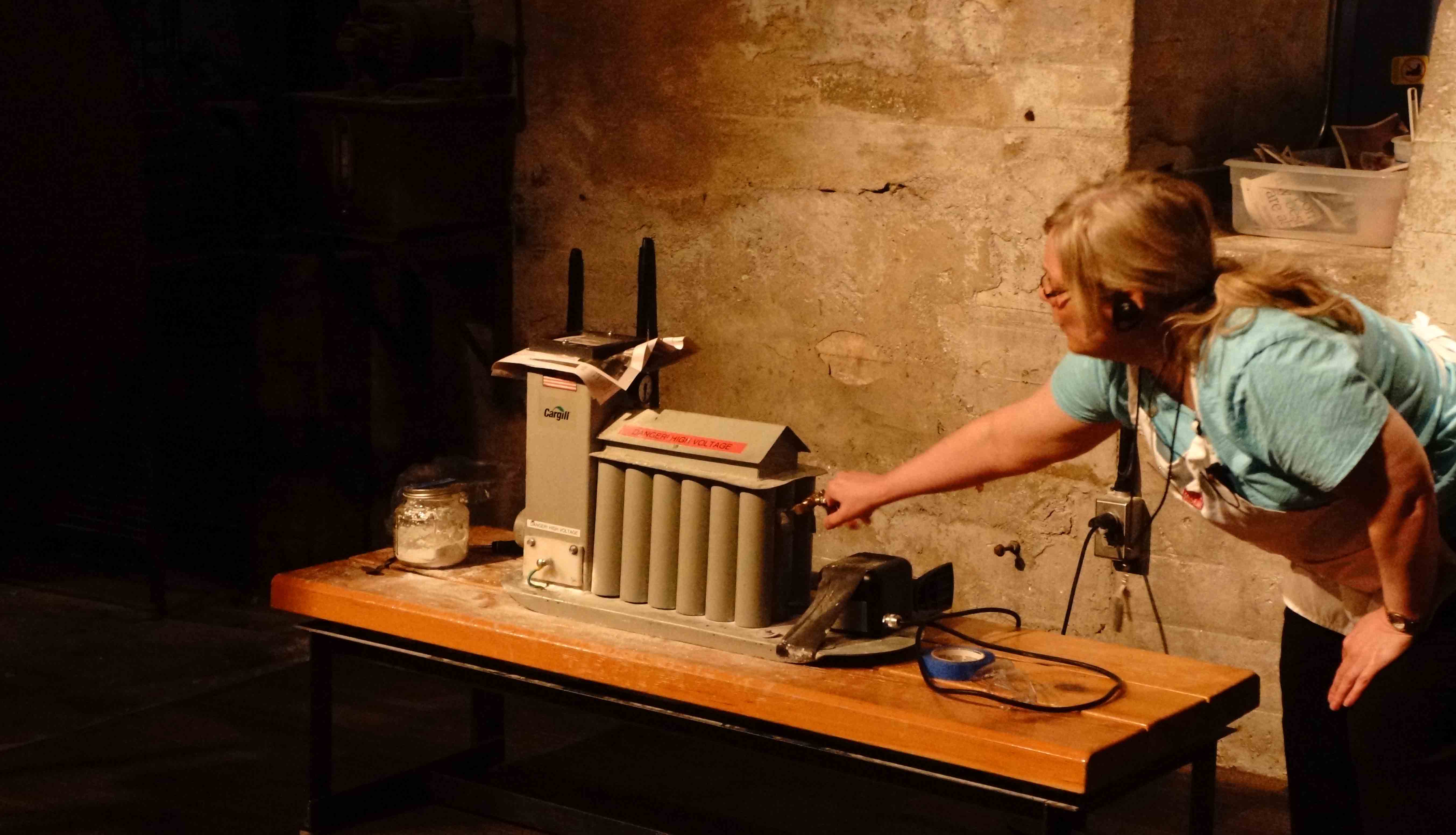
Demonstrating the explosive past for Minneapolis flour mills.
The late Wayne Booth advocated a kind of listening-rhetoric: listen intently enough to your conversation partner to faithfully tell their position (without denigration) while still holding to your own. This would not be the place for win-rhetoric, where your goal is to beat your message into someone else. Emmanuel Levinas might say we have an obligation to watch out for the person before us—this conversation partner. In fact, he might advocate that this person before us is our first priority. Martin Buber might say we continue to hold that person in high regard as a person, inviting them to consider this different perspective rather than trying to force our viewpoint. Even Jesus modified the law with love and compassion (he actually said love was the fulfillment of the law).
So…
- Say we take the listening seriously as we approach the hard conversation.
- Say we take seriously our commitment to the growth and personhood of this conversation partner (stay with me here). And we recognize this person as a person (versus an employee or student or lesser-being).
Given a kind of love for the person before us, we say the hard thing. And the explosion happens. No guarantees, but that blow up can be a worthwhile communication event. Good things can come from that, hard as they are.
Personally, I shy away from these explosive conversations.
But is shying away from a potentially explosive conversation doing a disservice to the thing that needs to happen between us?
###
Image credit: Kirk Livingston
Catalyze This! (Dummy’s Guide to Conversation #26)
What to do: Engage colleagues or just put up with them?
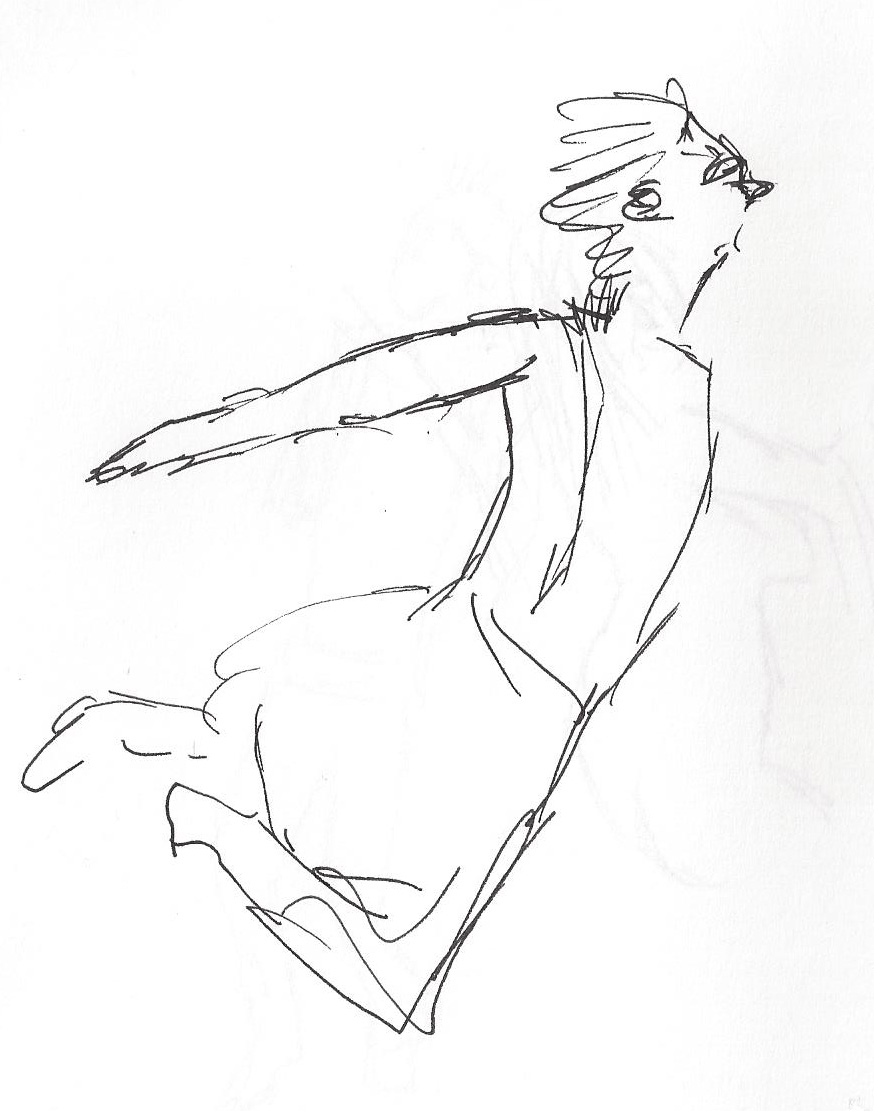 Between David Rock and David Bohm there is a lot of good advice about helping people have productive conversations. Rock’s “Quiet Leadership” is all about helping your friend find the answer she already knows, which is particularly useful for folks with leadership responsibilities. Bohm, on the other hand, was an omni-thinking physicist with deep curiosity about ordinary life connections. Bohm (and Rock, for that matter) are two of my conversational heroes.
Here’s Bohm on how it is that something new gets created between two people (italics added):
Consider a dialogue. In such a dialogue, when one person says something, the other person does not in general respond with exactly the same meaning as that seen by the first person. Rather, the meanings are only similar and not identical. Thus, when the second person replies, the first person sees a difference between what he meant to say and what the other person understood. On considering the difference, he may then be able to see something new, which is relevant both to his own views and to those of the other person. And so it can go back and forth, with the continual emergence of a new content. That is common to both participants. Thus, in a dialogue, each person does not attempt to make common certain ideas or items of information that are already known to him. Rather, it may be said that the two people are making something in common, i.e., creating something new together.
–David Bohm, On Dialogue (New York: Routledge, 1996)
Every day affords some catalyzing opportunity, often hidden in a very ordinary exchange.
How will you leap in to catalyze today?
###
Dumb Sketch/Timed Gesture: Kirk Livingston
Words Build Stuff Between Us
Words destroy stuff we’ve built
We all know this, don’t we? It’s perfectly obvious.
If words were money (words are definitely not money), we would be aware of our spending to inform or persuade or entertain. And just like people who make a hobby of “going shopping,” spending our word budget every day would be just another normal piece of everyday life for a U.S. citizen (or “consumer,” as business has renamed humans).
And that is actually how words work: We spend them.
With words we buy influence. We give some bit of knowledge or direction to someone else and win something in return. Some bit of psychic collateral. With words we buy context: we proclaim this or that in response to a situation at home or at work. Sometimes those around us agree with our context-setting assessment. Sometimes they don’t. Hint: if you want more people to agree with you, become the boss. Authority has a way of bringing believability with it, whether or not it is earned.
How we spend our words is worth thinking about. For many of us conversation seems instinctual. We say this in response to that. We inform, persuade, entertain with a joke. We do most of this without making conscious choices about our wordly-intentions.
But what if we did think of how we spend our words? What if we invested our words to accomplish some end? What if we invested our words with meaning—which is to say, what if we said things that were pulled from the well of what is important to us? That would make us vulnerable, of course. It would also be a platform for growth. Because when we say what is important, we learn something about ourselves and often a meaningful conversation can follow. The kind of conversation that has a chance of touching us deeply.

If you’ve not read Mistakes Were Made (But Not by Me), now is a good time. Tavris and Aronson have been referred to frequently as the Rolling Stone article on rape at the University of Virginia and news reader Brian Williams were found to have amped up their stories beyond anything resembling truth. Tavris and Aronson talk about cognitive dissonance and how we have such a hard time living with ourselves when our inconsistencies and personal malpractices appear—so we just change the story to coddle our precious psyches. The authors also demonstrate how memory gets built and rebuilt as we change stories:
Memories create our stories, but our stories also create our memories. Once we have a narrative, we shape our memories to fit into it.
–Carol Tavris and Elliot Aronson, Mistakes Were Made (But Not by Me), (Orlando: Harcourt, Inc, 2007) 77
I am advocating for conscious use of words, and for filling those words with stuff that is important to us—scary as that is. I see this as the opposite of small talk. I do, however, acknowledge that small talk is the precursor to big talk.
In my dream world, we use words to constantly build stuff between us rather than destroying relationships by purposely misunderstanding and showing we are better/righter/fitter/stronger/groovier.
###
Image credit: Kirk Livingston
The World Needs You—Ms./Mr. Verbal Processor—Annoying As You Are
Silence can be nice sometimes, too
I know a few people who process life verbally. I’m not naming names, but to be with them is to sit before an open window through which you hear internal debates, sharp intakes of breath in response to a new stimulus, and general narration about turning left or standing up or “I think I’ll eat a jelly bean.”
People process life in all sorts of ways, of course. I don’t know what I think until I write it down. Others might sketch a response to a life event. Others process a life event over the course of a three-hour bicycle ride. James Thurber could hold 1000 words in his head as his eyesight failed, processing and editing in his brain-pan and seeming to spit out a fully-formed essay or story.
And some talk it out: declaring boldly and then backing up to change direction. And then boldly declaring the opposite. They settle on a position over time (often). Sometimes it’s fun to engage in their internal debate. Sometimes it is maddening to witness the ebb and flow.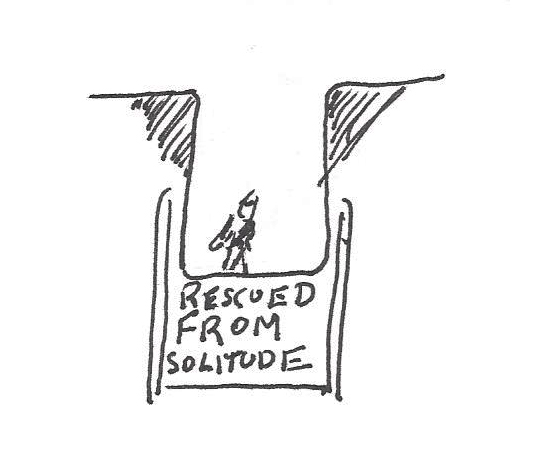
The ways we process life are not mutually exclusive, we might each do all of the above to figure out what is going on. It may take many conversations and many bike rides and many sketches to, say, process a larger than expected tax refund (ha), or a job loss. Or a death.
But the verbal processor plays a unique role among us. They are the ones who quickly spout a response to a question. They tend to be more comfortable in a group, or , perhaps this: for the groups they are comfortable in, they are even more verbal. The things they say become a sort of conversational/processing rudder against which we agree or disagree. But it is something nearly tangible (as tangible as words ever get) we can react to. The verbal processor does everyone a service by putting something out there for the rest of us to respond to. Their initial, fast response is a word that can rescue us from our solitude. Their quick work can help us avoid sitting passively while inside we are furiously yelling to get our heads around some new situation.
Kudos to the verbal processor.
Their out-flowing attempts to sort things pull the rest of us in as well.
###
Dumb sketch: Kirk Livingston
God-Talk and Other BS
Do Communication and Spirituality Connect?
I say “Yes.”
And I say it manifests in the ordinary conversations of everyday life.
Let me prove it: deep down in your brain-pan, where you instantly recoil from people who snap at you; back down there where your inner child says snarky, politically incorrect, frankly obscene, stuff that your adult, outer-self edits and translates to “Hmm. I see….”
Deep down there in the hidden recesses—that’s part of the connection.
Your immediate responses to the stuff of everyday life can tip you off that things are not right—deep down in the soul. Yes—I’m talking about weird stuff. But you have an inner life, right? A place where no one visits but you.

If that inner place is full of doubt, while your outer self—the adult self in tie and loafers, who edits and translates the inner child’s voice so the rest of the world remains unaware what a low-life that kid is—if that outer self proclaims stable faith in God and corporation and the upright institutions (ha ha) that surround us—that’s where the cognitive dissonance starts. That’s the precise locus of hypocrisy.
Mind you: I’m big on doubt. Questions are good. Questioning institutions and the quick answers to life’s hard questions—I’m all for that. Talking unbelief to God makes perfect sense to me (Just read Job, my patron saint of doubt honestly-processed).
It’s the saying one thing while believing another I’m not for. It is that very place where God-talk becomes BS. And I believe most of us have sixth-sense/BS detector that goes off when outer words don’t match inner life—even if we cannot put our finger on exactly why. I am most certainly talking to myself here as well.
We need to process our bouts of cognitive dissonance together to keep our God-talk from becoming BS—rudderless words without the ballast of belief and action a life-lived.
If you don’t have a friend to be honest with, find one.
This is important.
Today is Good Friday—a day when the Christian Church celebrates (is that even the right word?) Jesus’ death. Three days later we celebrate that this dead guy is dead no longer.
I appreciate this time of year for processing doubts together with others. Quite often we come away rejoicing. And somehow more whole.
###
Image credit: Kirk Livingston
By the way: I’ve written ListenTalk: Is Conversation an Act of God? to explore this connection. Pre-order here.

 conversation is an engine