Posts Tagged ‘dialogue’
Loose Lips Link Scripts
Open(ish) access for tight-lipped companies
Technical people can learn something from advertising people.
My creative director friend presented advertising concepts by first showing how his agency team came up with the idea. His presentations took a bit more time, but along the way he restated the problem, showed visuals of how competitors attempted to solve the problem and then revealed stumps of ideas that never really worked. Then he got to the solutions he hoped the client would pay for.
My friend’s process placed his solution in a context that helped those around the conference table understand why the solution made sense. As he spun out his process, he verbally brought these people with him so they were nodding “Yes” long before they signed off on the solution.

The boardwalk protects fragile land while providing access.
Many of my clients guard their proprietary information with fierce protections. And rightly so: their processes keep things running and bring in the coin that satisfies employees, stakeholders and shareholders. But in a search and share economy where like-minded people find each other more and more often, is a firewall surrounding all information really the best way forward?
The right information presented at the right time (that is, just when someone needs it, which typically coincides with a search for that information) affects buying decisions and brand loyalty. Interestingly, your technical people are right now busy working through the context that, if properly presented, would draw others to your product.
People are searching for your information.
If only they could find you.
My more innovative clients are finding ways to help their problem-definers and solution-makers talk more publicly. And as these discussions move outside the corporate walls, they best ones are finding ways to combat the PR department temptation to suck meaning from the words. Because sharing useful information happens person-to-person. And useful information will always have something of an unfiltered quality to it.
How is your organization preparing to share details with those who can help you move forward?
###
Image credit: Kirk Livingston
Neville Brody: Making Space on a Page to Think
In the advertising business, it’s not in the interest of advertisers for people to think about what they’re presented with. It’s in the interest of advertisers that people choose to think in the way the advertisers intend them to. It’s a formulaic thing, where there’s only one possible outcome in advertising. That creates a space where the “right to thought” is taken away from people.
I’ve always tried to approach my work as being open-ended and with a degree of abstraction or ambiguity. This prevents it from being a monologue, because it is a dialogue. The work is only completed when a viewer has looked at it and made his or her own decision as to the full meaning of the piece.
From Debbie Millman’s, How To Think like a Great Graphic Designer (NY: Allworth Press, 2007) 72-3
Today I’m Listening
What can you hear between the lines—and where will it take you?
I’ll start by listening to a set of phone conversations my medical device client fields constantly. I want to hear the questions. I want to hear the responses. But I especially want to hear the tone of the questions. I’m listening for urgency and for actual language used. I’ll write down the words and note the flow and capture quotes. These notes and my listening will guide the communication that takes place next.

Listening goes places.
I’ll spend the balance of the day listening between the lines for another client. But this time I’ll be listening to the text I am creating for them. And I’ll listen to the process they use to serve their customers. Listening and revising and re-jiggering and re-listening.
Listening is required to know where to go next
What—or who—are you listening to today?
###
Image credit: Kirk Livingston
Think “Plant” Not “Preach” (Dummy’s Guide to Conversation #18)
Monologue is dead. Long live dialogue.
You’ll be much more effective if you give up telling people what to do and instead invite them into an idea.

It’s more work on your part, of course.
Inviting your conversation partner into an idea has the advantage of letting the notion grow in their native cerebral soil versus boxing them about the ears and head with your command.
Planting seeds can also change the shape of your internal discourse. And that can become a fresh, personal beginning point.
Check out the other 17 tips from the Dummy’s Guide to Conversation.
###
Image Credit: Kirk Livingston
Try “Yes, and…” Today
Let there be a Science of Deep Collaboration
When I hand out a group project in my writing class I hear audible groans.
It’s because we’re trained to work at things on our own—that’s how scholarship and schoolwork and academics have worked for a long time. The groans come from all the extra work of communicating and all the expectations around not knowing if others in the group will keep their end of the group-work bargain. The groans come from the anxieties that hover around roles and responsibilities and knowing you’ll have to sell your ideas.
I am eager for new and deeper research into collaboration. Let’s call it a Science of Collaboration. Maybe it is a social science. People like Keith Sawyer and Edgar Schein are moving this science forward—along with many others. I am fond of the work Patricia Ryan Madson has done around Improv, which seems the perfect gateway for anyone to learn the fun of collaboration. And Keith Johnstone seems to have spawned many thinkers along these lines.
 I’d like for this science to do (at least) two things:
- Invite people in who have been working alone for forever. But gently, and independent of the introvert/extrovert divide. I want the invitation to show the fun of the process. I want that invitation to promise more aha moments and then to quickly deliver on that promise.
- Show next steps to working together. What can an ad hoc team do to quickly get grounded enough to toss ideas that build on each other? There are techniques out there, certainly, but I’d like this to be second nature, part of our emotional intelligence, something we come to expect. Something we’ve grown up with.
“Yes, and…” seems a perfect place to start. This is the old improv notion of building directly on what the last person just said. And quickly, without lots of deliberation. It requires a certain fearlessness.
What if “Yes, and…” was built into our educational DNA from grade school up?
###
Image credit: Kirk Livingston
Custom Answers to Personal Perplexities
What does a good conversation look like?

###
Image Credit: Kirk Livingston
Collaborate is the New Black
Listening looks good on you
Work often looks like a flavor-of-the-month shop. Depending on which consultants get the ear of those with a budget for adjusting corporate culture, we could be talking about mindfulness, or total quality commitment or getting the right people on the bus—there is no end to the analogies and training seminars and tightly-packed sessions to buy.
Always these programs promise change. Sometimes they deliver.

Here’s why you should care.
But the constant impetus behind these attempts is employee engagement. The days of just showing up to stand on an assembly line or sit in a cubicle are long gone. Putting in hours is not enough—was it ever enough?
Engagement is tricky, of course. Employees work with BS filters set on high, which is why suggestion boxes rarely worked. Everyone knew putting a well-reasoned argument on a slip of paper and dropping it in a box went exactly nowhere.
No—the will to listen, which is near the heart of collaboration—must come from within rather than without. There must be a kernel of mission that speaks to listening to the good people you’ve brought in. The trick is to find that kernel. Engaged employees have done that work, usually on their own time.
I’m excited about a particular client of mine with a compelling, collaborative mission. They’ve invested millions in a particular process that is doing something brand new in the world. My client is lining up eager collaborators from industry and from academia. They are just now setting up systems to deepen their collaboration with researchers across the globe.
But how far are they willing to go with collaboration?
Working and learning together is the stated center of their mission—and this organization lives it out in countless ways. But are they willing to make messages that reach out and pull people in—even with ongoing research? Are they willing to set themselves apart as leaders willing to share knowledge in endlessly accessible research bites that are media and social media ready? After all, my client is partnering with an industry known for its secrecy, so what will collaboration and the inevitable transparency look like with these steely customers?
All that remains to be seen.
But one thing is certain: the will and gifts and curiosity of engaged, collaborative partners and employees is the only thing that will help this move forward.
###
Image Credit: Kirk Livingston
Audiences Read an Actor’s Use of Space
Keith Johnstone: Impro

May Day Parade, South Minneapolis, 2013
When I was commissioned to write my first play I’d hardly been inside a theatre, so I watched rehearsals to get the feel of it. I was struck by the way space flowed around the actors like a fluid. As the actors moved I could feel imaginary iron filings marking out the force fields. This feeling of space was strongest when the stage was uncluttered, and during the coffee breaks, or when they were discussing some difficulty. When they weren’t acting, the bodies of the actors continually readjusted. As one changed position so all the others altered their postures. Something seemed to flow between them. When they were ‘acting’ each actor would pretend to relate to the others, but his movements would stem from himself. They seemed ‘encapsulated’. In my view it’s only when the actor’s movements are related to the space he’s in, and to the other actors, that the audience feel ‘at one’ with the play. The very best actors pump space out and suck it in, or at least that’s what it feels like. When the movements are not spontaneous but ‘intellectual’ the production may be admired, but you don’t see the whole audience responding in empathy with the movements of the actors.
–Keith Johnstone, Impro: Improvisation and the Theatre (NY: Theatre Arts Books, 1979) 57
Actors act on something the rest of us respond to without knowing why.
###
Image Credit: Kirk Livingston
Dialogue 2.0: Can a Marketer Game a Conversation?
Yes. But maybe no?
Lots of us try to figure how to turn a conversation to our advantage.
Marketers increasingly slip us information just when we want it, like Google giving directions to the donut place on the way to my next meeting.
Bad Google.

Carefully observe, one must.
Carl Griffith, writing over at ClickZ, wants marketing websites to recognize and reengage with returning customers via their behind the scenes content management system. He wants websites to engage in dialogue like people do: no need for reintroductions. We know you—you know us—where did we leave off last time? Cookies help this happen, of course. Amazon is an example of picking up where you left off and adding suggestions for more purchasing joy. That is likely where all web properties are headed.
Mr. Griffith goes further: what if we programmed into our content management systems a way to pick up on non-verbals? He means those signals that pass between animate conversation partners (I wrote human first and then remembered how much non-verbal information dogs pick up): the open or closed hands, the orientation of shoulders or head toward or away from the speaker, the eye contact (or lack thereof)—all these bring depth and context to our conversations. That depth and context adds to the words exchanged or belies the words exchanged. Listen to Mr. Griffith:
You will be familiar with the throw-away lines in everyday conversations around the importance of non-verbal communication and what we have now in the world of digital are ways of understanding the more silent and less obvious conversations and dialogue we now have with our consumers driven by context and the insights we should derive from the sum of interaction and engagement.
As a consumer—or for anyone increasingly wary of how our own national security apparatus listens in at will—it’s easy to read sinister overtones into these marketing improvements. Marketers will want to be wary of any resemblance to the NSA, although all the players are starting to look like classmates from the same surveillance school.
But in a human conversation, we start to get the sense of when our partner is yanking our chain—or outright manipulating facts and/or lying. And we back away. Quickly. Perhaps the computer programs that touch our web conversations will go the way of 30 second TV spots—a chance for us to cognitively check-out because we know we’re being sold something.
Mr. Griffith’ vision of dialogue 2.0 is starting to sound like a return to monologue, only in shorter bits and micro-fitted and shoehorned into seemingly ordinary conversations.
Caveat emptor.
###
Image credit: Kirk Livingston (Weekly Photo Challenge: Street Life)
Edward Hopper: How to Talk to Yourself
Can a conversation result in art?
The answer can only be “Yes!”
Not every conversation, mind you. But some will.
Last weekend Mrs. Kirkistan and I (plus our art-student daughter) wended our way through the sketches and drawings by Edward Hopper currently on display at the Walker. As a nation we’re quite familiar with Mr. Hopper’s drawings and paintings—today they seem perfectly obvious explanations of life in America. But I was intrigued by how he got there. What was his process for producing such enduring images? How did he see what he saw?
His sketches look like conversations with himself. Look how he developed the frame for his (well-beloved, much parodied) Nighthawks at the Diner. His sketches add layer to nuance to layer. It’s almost as if he were explaining something to himself with one approximation and then another and then another. Sort of like conversations with our best friend where we allow each other to say it wrong even as we pursue saying it right.
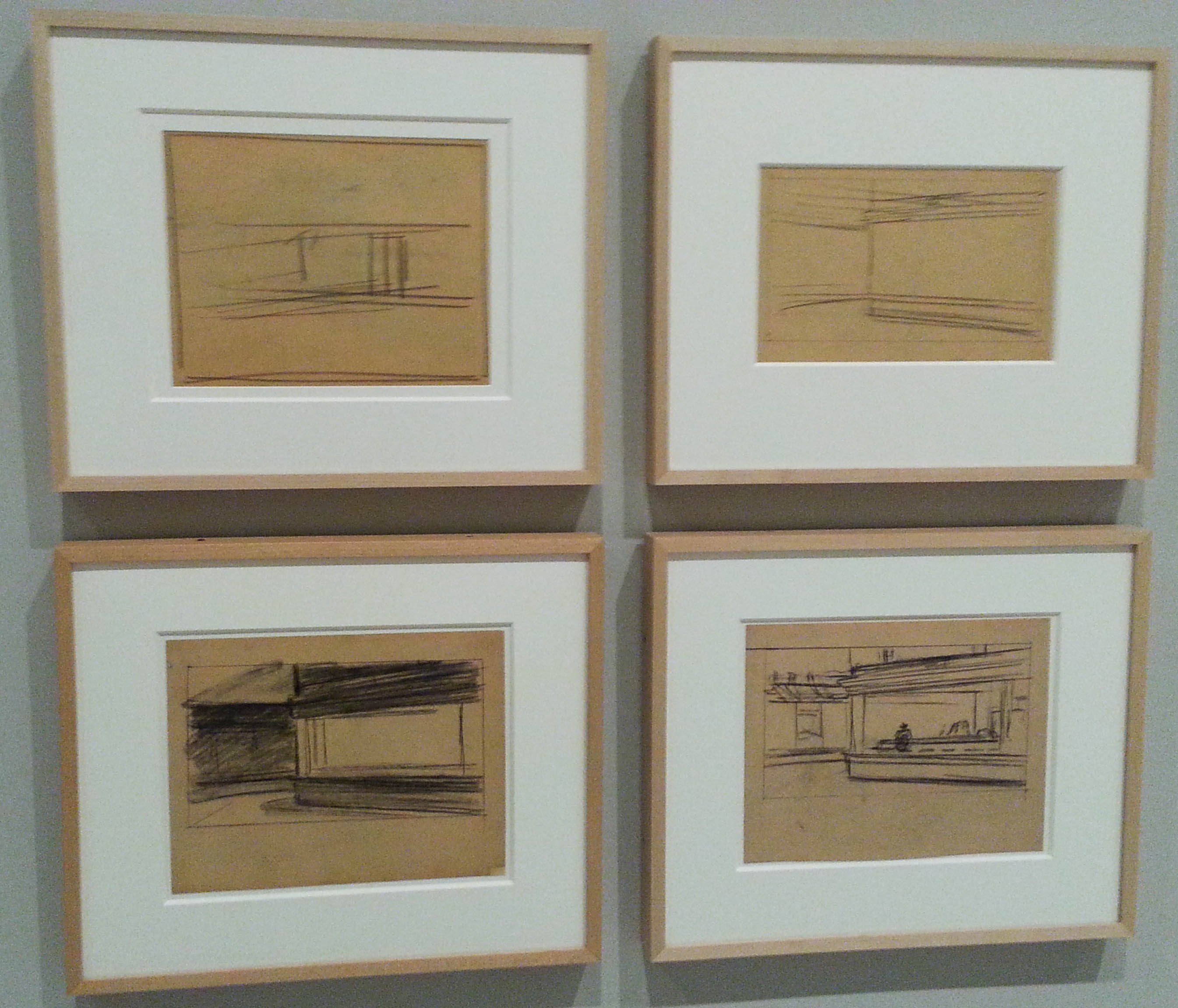
Hopper was a man given to observation and keen on interpreting detail. With quick strokes he captured form and mood and motion. And there’s no question he had an eye for the ladies:
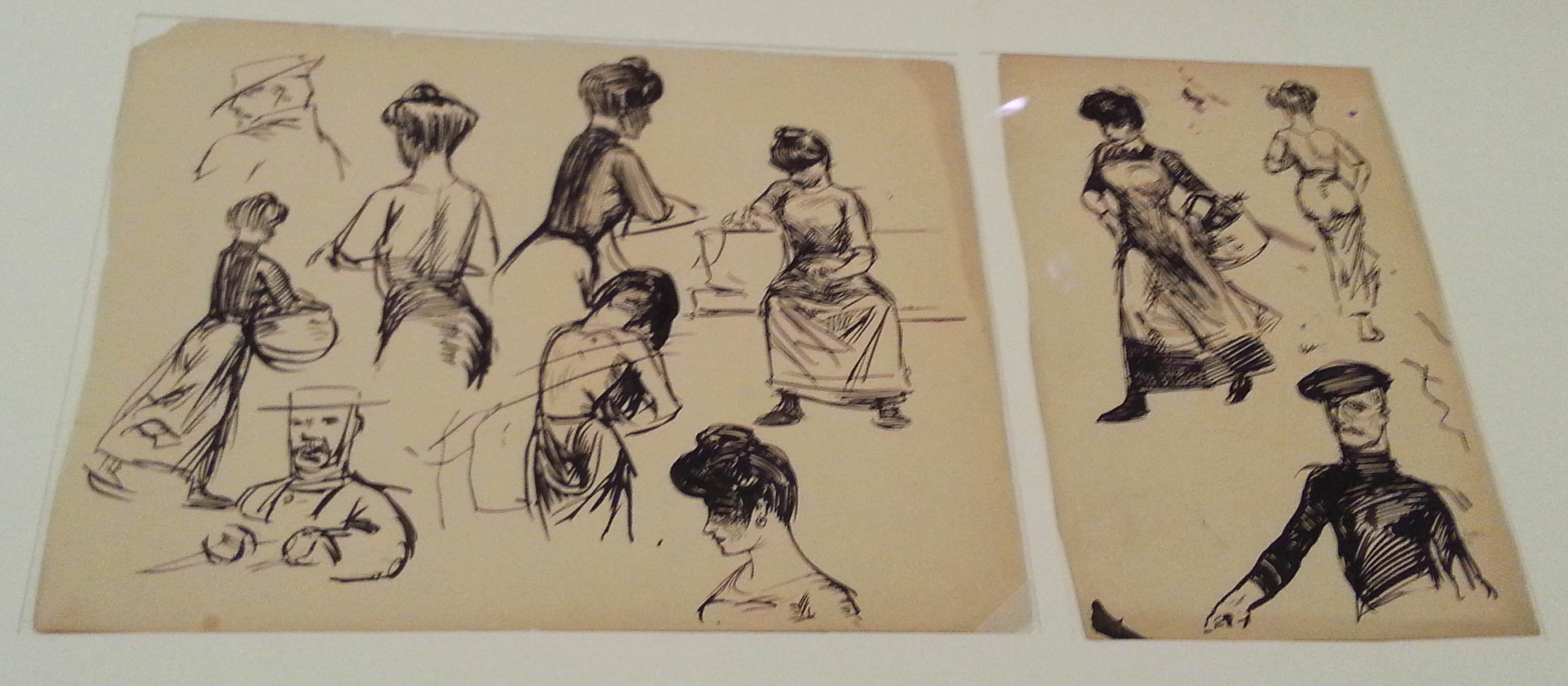
Hopper seemed to never stop observing and capturing. Again and again and again. He spent hours sitting at favorite locations and sketching and perhaps waiting. This quote from Mr. Hopper hints at his process:
My aim in painting is always, using nature as the medium, to try to project upon canvas my most intimate reaction to the subject as it appears when I like it most….
I’ve been a fan of sketches for some time because they give a behind-the-scenes picture into how someone’s mind works. The Hopper exhibit at the Walker does not disappoint. And I cannot help but think how sketches provide such a rich analog to our collaborative conversations.
###
Image credit: Kirk Livingston photos taken at Edward Hopper exhibit, Walker Art Center

 conversation is an engine
