Posts Tagged ‘work’
We’re All In Construction
We build every day with actions and words
Sometimes our work is purposeful.

Sometimes we build walls with ice.
Sometimes we joke that our habits and actions and speech patterns amount to nothing. But that is false: if nothing else, what we do and say affects us. And there is no telling the power of example and well-placed words in the circles we travel.
Don’t think for a second you are not building.
Something.

###
Image credits: Kirk Livingston
Write Alone And Send To Collect. (Copywriting Tip #11)
Except for Bill Holm

Bill Holm, by Brian Peterson, Star Tribune
The late poet and writer Bill Holm spent his days teaching at Southwest Minnesota State University. In the context of daily teaching, he was too busy to write his own works. But when class finished for the semester, he wrote his poems and stories and memoirs long-hand on the back of the memos he received at school. Interestingly, he was a gregarious soul who often welcomed people into his house but continued to write at the kitchen table even as he engaged in discussions with visitors.
But for many of us, writing is a solitary activity. Oh, sure: ideas pop in conversation. Careful, committed writers take note of the idea on whatever scrap they have handy. And that scrap becomes useful when the writer is, yet again, sitting before blank screen or page.
Unless you are/were Bill Holm, it is the typical writer’s fate to sit alone.
This is not to say writers must be loners or introverts. Those are not necessary conditions, although they do often fit together.
But creating is only one part of writing. Yes, it seems like the biggest part of writing, doesn’t it? Creating and the aura around creating are certainly the most celebrated bits of writing.
But another part of writing is reading. Specifically, getting read. And that requires publishing, in one form or another. At its essence publishing is getting read by someone else. And for all the (quite true) advice about “just sitting down and writing” and “writing = butt-time-in-chair,” it seems to me there is still a missing piece: the reader at the other end of the writing. Written words need to find and land on their audience.

Here is a place where writers might learn something from copywriters. Copywriters have deadlines. They have people who expect copy at a certain time and quite often that copy is delivered verbally—often read aloud by the copywriter to the client.
Something happens when writing is read aloud to an audience. The text itself tends to shape and reshape and the writer hears it differently because of the people listening. The writer cannot help but see things differently when another person is also hearing the copy.
Many will say that some of their best writing happens during revising. I agree. Especially after having read something aloud to someone else and seen their reaction. It can be thrilling. Or depressing.
Butt-in-chair time is essential for writing. But sending your writing out—scary though it might be—is equally essential to hear how the ideas land and to revise with creativity and gusto and possibly increased motivation.
###
Image credit: Kirk Livingston, Brian Peterson/StarTribune

FastCompany: The Beguiling Dangers of Insider Language
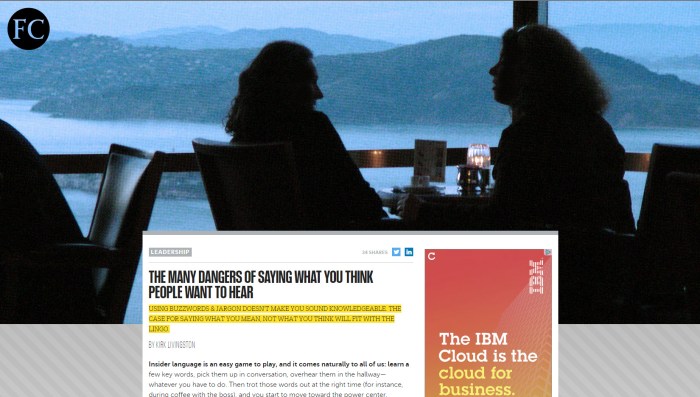
Check out my article in today’s FastCompany: The Many Dangers of Saying What You Think People Want To Hear
 ###
###
Image Credit: FastCompany
What Freelance Knows that You Don’t
For starters: Work is permanent while jobs come and go.
When I first considered life as a freelance copywriter, a friend said,
Welcome to the wonderful world of floating icebergs.
And it was so: projects fall off (the glacier of corporate planning) and float off to sea (so to speak, to the market) and you stand on them for a time, work on them, even as they melt under you. And then you step to the next iceberg. Or you tread water while another iceberg comes into view.
It’s a refreshing cycle—in a painful, polar-dip, take-this-horrid-medicine-it’s-good-for-you—kind of way.

Ice sheet, not iceberg. Don’t step on it.
I like to tell my copywriting students that the freelancer goes into it knowing this is how the game works. Then I tell them this knowing is in sharp contrast to nine-to-fiver’s who instinctually trust their jobs will remain, and are too often deeply surprised to find themselves waiting for the bus one day at 11am holding a cardboard box containing their office posters and mug.
But students typically have no mortgage or kids to feed or insurance to buy. So I’m pretty sure the comment doesn’t register until five years later, when all those conditions are true.
Recognizing the impermanence of today’s job is a great benefit, because it means one must always—always—be thinking about what’s next. The freelancer understands this in her bones. The smart nine-to-fiver rehearses this bit of knowledge every time she crosses the corporate threshold and enters the air-locked doors.
One thing that happens while I tread water is I make contact with dozens of old colleagues. I am no longer surprised by how often people change jobs, get laid off, start their own business or agency. Not to sound like an old guy, but way back when, people expected to stay at a single company for an entire career. Today I could count on one hand the number friends who have done that.
Friends often ask about work. I typically say, I’m busy and I’m looking. Always looking. In fact, this way of working has two benefits I cherish:
- Vision is no esoteric word for me. It is a hard-edge guide to what’s next. And I can never not pursue it. If I neglect to think ahead, those icebergs will float by without me ever noticing.
- The work itself become the focus. I get to burrow down into communication and copy and the telling of stories. The craft itself is a never-ending wonderland that shape-shifts as it leaps between clients and industries. The work, and the process toward the work, become the marathoner’s stroke for swimming toward the next iceberg.
In fact, faith, hope, and love remain as essential ingredients to this way of working. There is no space for taking-for-granted.
###
Image credit: Kirk Livingston
Dormant Versus a Bias Toward Action
The Shroud of Tuesday
What if your work stopped—on purpose?
We celebrate and expect constant productivity gains in our culture. Wall Street rewards those gains as they decrease the expense line of any business. We congratulate those people in constant motion who have momentum and trajectory.
But is constant forward motion sustainable?

Sure: looking back over the arc of our life we can cobble together a story about how we were always moving toward this invention or position or conclusion or achievement. That bit of personal cinema we learned from the biographer’s art.
In the moment, however, there are dormant times: work goes south, dries up, gets boring. There are times when it is not at all clear what to do next, which way to go, or even if this work will succeed at all. Doubts interfere. Even if you have a boss telling you what to do, there can be internal fallow times where you silently rethink your commitment to this job or that project or that leader.
We hate those times when work goes dormant.
We love movement and purpose, followed by lots more movement.
But dormant is not the same as death, despite how being laid-off feels like a mini-death. And when a work-stoppage happens it is hard to believe the rejuvenating effects of a release from movement. And yet, most of us do make it out the other side. And typically we have a new grasp of where we need to go and what we need to do.
I’ve always wondered how any living thing survives the bitter cold of the northern United States. Every winter I am amazed that cars start and water flows and life continues at 20 degrees below zero (F). Then March and April bring thaws and by May that dead-looking Maple blooms all over again.
Every year.
Maybe the cycles outside my window are a better analogy for work: there are ebbs and flows. And maybe it is worth building up a bit of patience with slower times, and even to embrace them and allow them to do their hidden work.
Even on a Tuesday.
###
Image credit: Kirk Livingston
Worthwhile work is hard: A visual meditation
All day long.

It is difficult to unearth the material we need to move forward.

Which is why we pray. And hope.
“The work will teach you how to do it.”
–Estonian proverb
Images of Pipestone National Monument
###
Image credits: Kirk Livingston
Tune-up the Voices Talking Inside Your (Corporate) Head
Pitch the preachy. Scrap the sing-song. And definitely lose the lingo.
Sometimes a certain tone will flip a switch for me. And all the person says next is covered in darkness because the tone pointed me elsewhere—so I miss the message entirely:
- The VP standing before the group launches into a sermon and 93% of the audience tunes out before she takes her first breath
- The newsletter from internal communications plays out cheery, one-sided copy that feels as manufactured and questionable as a tuna sandwich from the vending machine
- A poetry recitation where the sing-song voice seems to have come from a different century
- The prayer that sounds like a sermon. The sermon that sounds like a lecture. The lecture that shows no interest in connecting with an eager audience.
Each communication event is an opportunity to pass information, true. But each event is also an opportunity to deepen relationship and build trust—both of which may be more valuable than the information in transit. To squander those communication events on vacuous, preachy or condescending fare seems a waste of time, money and consciousness.
Perhaps certain situations activate your autopilot and you slip into a particular communication mode. The status meeting, the Sunday sermon, talking to an employee. Talking to a child. Maybe we even have a special voice reserved for praying with other people. We may not even realize that we adopt a slow-meter pacing, using parlor words we pull from our big-bag-of-sacred-stuff.
Our autopilot mode can learn from the practice of that old poet-king. That old poet-king had a special voice for prayer too, but it wasn’t from the big-bag-of-sacred-stuff. Instead, it was the voice of desperation, of falling and not being able to get back up, of righteous anger on the dudes who done him wrong. The poet-king’s voice was a real voice, based on real bad stuff that seemed to be happening.
The lesson from the poet-king is this: keep it real.
Employees appreciate hearing what’s really happening, not some vetted-party-line version. Use your real human voice as often as possible. Real voices—the ones that we believe—find a way around buzzwords and corporate lingo.
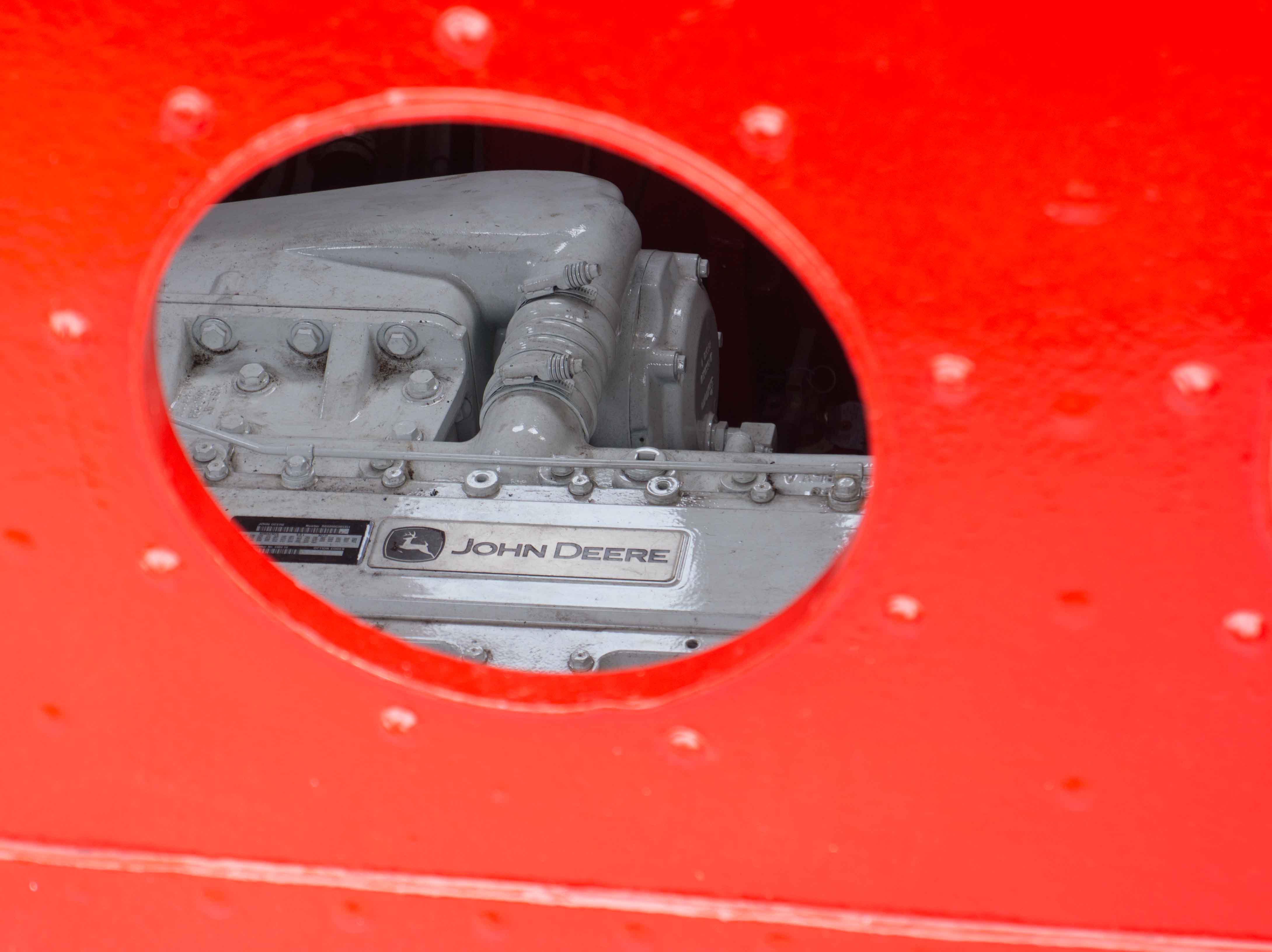
Real conversation with real voices is the engine moving all of us forward.
###
Image credit: Kirk Livingston
Policy is the Gulag of Good Ideas
Good Ideas Sour and Stink When Enshrined as Law
“We’ll do it this way going forward.”
If you could do a quick, very honest poll of employees listening to their boss say those words, how many would silently be saying, “No. We won’t do it that way.”
- 50 percent?
- 99 percent?
- 100 percent?
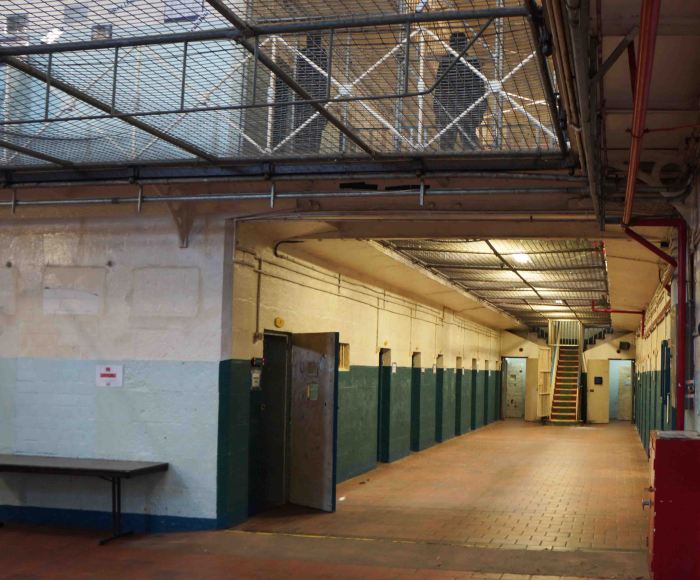
HM Prison Geelong
It is possible the very nature of the hierarchical or “push” corporation lends itself to sapping motivation from good ideas. When ideas come from above as pre-packaged laws-of-this-workplace, a piece of humanity goes dormant in the otherwise engaged employee. Enough of those pre-packaged laws-of-this-workplace and work becomes full of half-functioning automatons.
A room full of automatons working only for the weekend or the money or to keep a job or to avoid the boss’s wrath may have succeeded 50 years ago, or even 25 years ago. But smart corporations and organizations will study how to turn their hired automatons into full-fledged, interactive humans while at work, not just after work.
Inevitably, that involves hearing from employees. It must be about hearing from more than the boss or those favored few. And know this: engaged people talk and discuss. That is the way of owning a process. Automatons cannot own a process. But engaged people can own a process, no matter where they fit in the organization.
Once upon a time, the lovely Mrs. Kirkistan and I spent a few years at a volunteer organization that had a compelling mission. But that mission was hindered by a hierarchical leadership approach that treated volunteers as cogs in an unyielding machine. There was no room to engage, revise, add-to or direct from within the roles we played. Only a few key leadership voices could do that. We eventually walked, as did other talented people in a variety of roles.
Coming generations of working stiffs will expect their voices to be heard. Or they will walk.
We can all grow in listening for engaged voices with solid ideas.
###
Image credit: Kirk Livingston
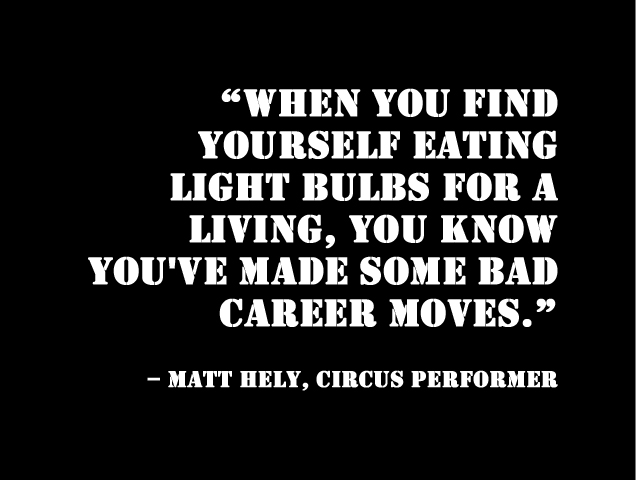
Bad Career Moves: Eating Light Bulbs
Always sound advice: Stop and notice which parts of your work you enjoy.
###
Quote Via Star Tribune News of the Weird, 5/24/2001, p. E5

 conversation is an engine