Archive for the ‘Brand Promise’ Category
Rob Moses & the People of Calgary
“Have you ever ridden a horse?”
If you’ve had the pleasure of going to Calgary you’ll know it is truly a western city. Situated not far from Banff and Jasper National Parks, it is also quite spectacular. And rich, fueled by oil and gas money flowing into the city.
Rob Moses is a photographer based in Calgary. I follow his blog because of the extraordinary portraits he takes of complete strangers. His method is to approach someone, have a conversation, and shoot the photo. The endearing thing about this process is the conversation he has. He records it verbatim —or so it seems. His written text includes nervous laughter, indecision, and ricocheting answers. His recorded conversations sound like real conversations to my ear.

Stopping complete strangers is not easy in the best of situations. Asking to take their picture sounds like a scam, but Mr. Moses pulls it off with what seems to be a fair bit of joy. And he always asks if his subject has ridden a horse—critical information for Calgarians, evidently.
The optimism of sharing his talent with photography is not lost on me here. It’s kind of an amazing way to self-promote and, well, bless people. And for those lucky enough to find their way into his lens, they come away with a phenomenal view of themselves. Scroll through his blog and be amazed at the composition, lighting and the ease written on the faces of his subjects. If you’ve ever asked to take someone’s photo, you know it typically ends badly. Unless you are Rob Moses.
May there be more of his talented tribe.
###
Image Credit: Rob Moses
“Viral” is Fool’s Gold
People often have legs and feet. So do collaborative ideas.
Years ago we noticed the threshold to globalization falling to the point where anyone could step over it. Back then advertisers talked about music or images that could transcend language with television and radio. And it was true: cloak your message with a mainstream song and off your product flew to sell among lands and languages previously unknown.

Today we routinely interact with people across the globe. Tweets and Tumblrs and blog posts and comments can and do come from anywhere at any time (because it’s always 17:01 somewhere). It’s mostly asynchronous. But not always—my WordPress friend in Hong Kong responds to my morning posts (his evening) and I respond to his evening posts (my morning) and it feels like real time.
Marketers and advertisers want to promise a viral result from the work they do for clients. But the bar for viral gets higher every day: interweb participants stand amazed at less and less.
More realistic: go back to the old way of focus on the important people. In this we make sure our message can be carried in a style to which our target audience is accustomed. Making sure our messages are sticky for the primary and secondary audiences we care most about is better than shooting for viral. And the first step toward sticky ideas is to simplify (not the same as dumbing-down) so the idea is quickly grasped and possibly even elegantly presented.

This simplifying process is a natural result of collaboration. Just explaining an idea in the course of a normal conversation is a step away from Teflon toward sticky. That simple act of saying it aloud helps you realize what works and what doesn’t: it’s all written in the face of the person you are explaining it to.
Start with a simple collaborative conversation to begin to move toward sticky.
###
Image credit: Kirk Livingston
Zumba: Create Your Own [Alternative Dance] World
Learning from “Let it move you”
Advertising’s great advantage is making images that dismiss the real baggage real people carry into the real world. And that’s why we buy the product: we want to be that person so in the zone we don’t realize we’ve been dancing on the conference table in the middle of a budget meeting.
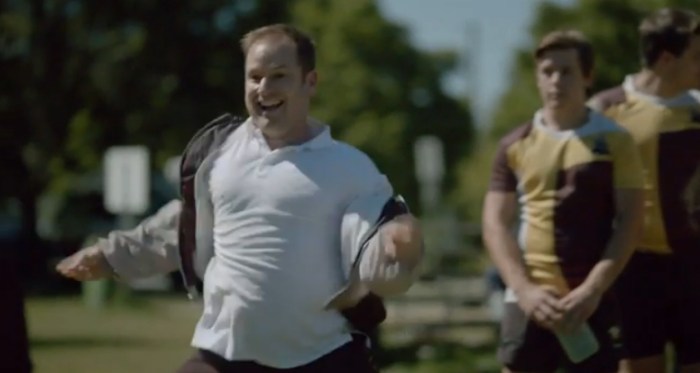
[Click to play at Creativity]
But is “dismissing real baggage real people carry into the real world” really so far-fetched? I’m starting to think not. We’re all marching toward some image of life that we’ve created or someone has created for us.
What are you marching toward?
What could you be dancing toward?
###
Via Creativity
Italian Telecom Wind: Engage + Remind – Shill
Still selling, of course. But they pulled me in.
Lots of great “dad” moments in here.
What about those decades-long conversations we have with the people in our lives?
###
Where does loyalty come from?
Gift Economy and Loyalty Programs
This is a tale about where loyalty comes from. It involves making a garbage man very sad.
The second home we purchased was left with all sorts of furniture by the previous owners. We called them and put the furniture in the yard. But they never returned and their furniture sat in our new yard for too long. Rain and sun and more rain—these people never came.

But Ace Solid Waste came. And they took it all for free. And they won our loyalty. Is this a commercial for Ace Solid Waste? Maybe, although I am not employed or directed or in any communication with Ace Solid Waste. In fact, I pay them. On time (mostly).
Their gift of removal (you might say Ace blessed us with the absence of a soggy couch and other wet furniture), is easily and quickly remembered by Mrs. Kirkistan and I, still, to this day.
In The Gift (NY: Vintage Books, 1983), Lewis Hyde described how a gift economy works: people give gifts to each other as a sort of payment. But not in the transactional way most of us expect today. One gift was not given in exchange for another gift. No, Hyde described how gifts move on. Or, you might say, moved forward. The gift you gave me, I gave to someone else, and so on in an endless cycle of giving. In the gift economies Hyde cited, trade was greased by gifts.
Of course, gifts carry with them an obligation: a sort of unwritten sense that I must pay this back, or “I owe you one.” Gifts also carry a sense of relationship. We give gifts to friends or relatives. It is a way of saying, “Hey buddy!” or “I’m thinking about you.”
One long-time strategy for business is to give gifts to woo loyalty. I buy plumbing supplies at Beisswengers because they are patient with my simplistic plumbing questions. They provide answers along with the new drain. The answers are even more valuable than the drain. All sorts of free apps become so indispensable we finally buy them. We frequent the vendor who gives away their knowledge.
A competing garbage gentleman stopped at our door with an offer of savings. When I said I wasn’t interested, he probed:
Why?
I told him my story of the furniture that wouldn’t go away and how Ace helped us out.
Will you be in debt to Ace for the rest of your life?
And here is the surprise: as I listened to my own words, I wondered at the strength of the feeling and the depth of loyalty for this good deed done to us—and the longevity. Maybe our retelling of our furniture story kept giving fresh reasons to continue.
Maybe.
And so the man of seeming excellent garbage-manship walked away sadly.
So that’s one way to build loyalty: help someone with a need. And as you help, try not to see the gift as a transaction.
###
Image credit: Kirk Livingston
Martin Weigel: Go to give. Don’t go to take.
Even advertising people are human.
In the spirit of “What is remarkable?” I offer Slide #43 from adman Martin Weigel’s excellent Slideshare on how brands fool themselves into thinking they matter in the grand scheme of real life.
They don’t.
Not when it comes to real human interaction.
No sir.
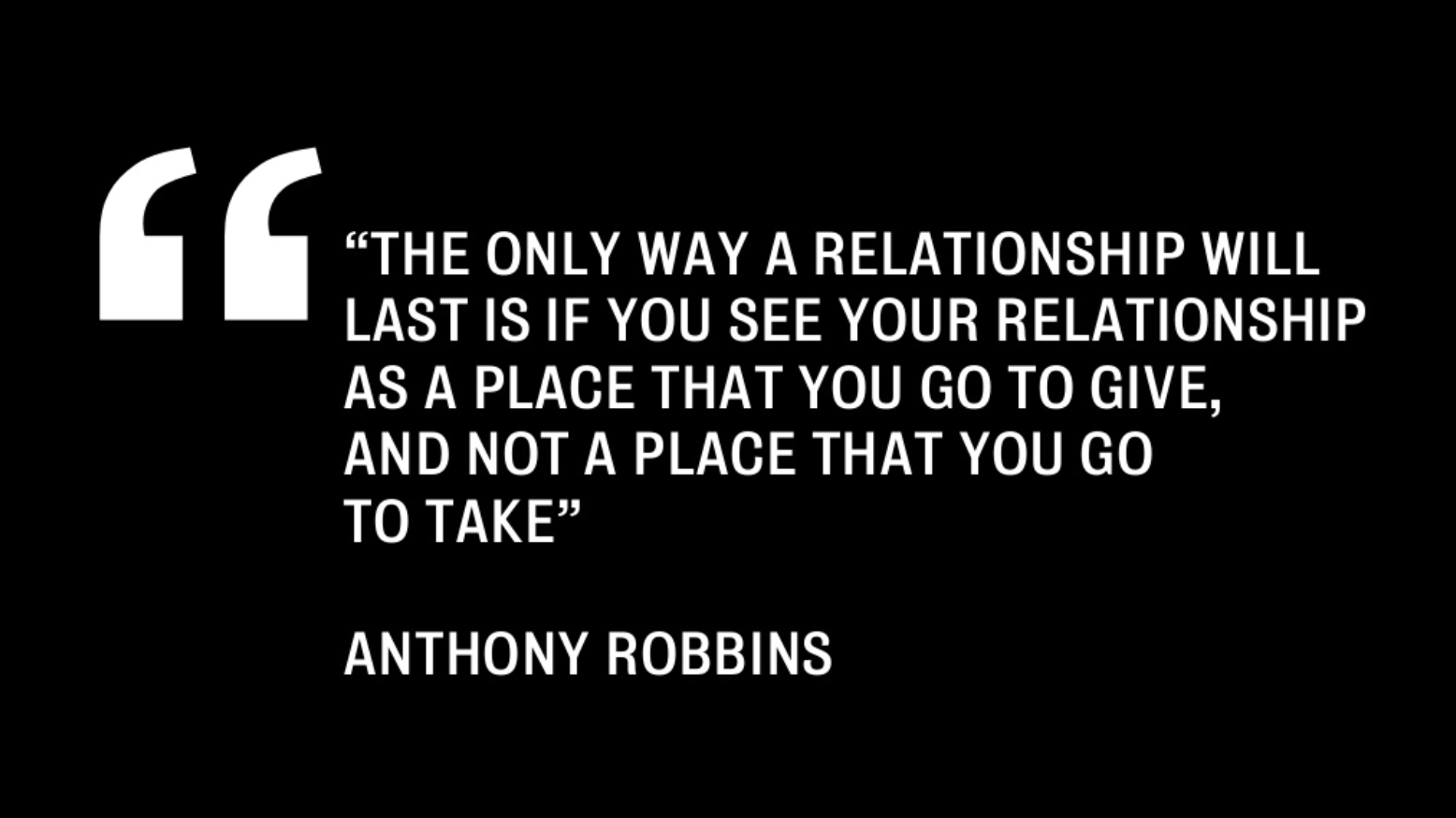
Can a brand serve? Yes. And I will argue that is the profitable space to explore.
I’m not generally an Anthony Robbins fan, but this quote has been stuck in my brainpan since I first reposted these slides. And that is remarkable.
###
Can we finally reject being defined as “Consumers?”
How about “citizens” or “persons”? Maybe not “fleshists.”
Must everything in U.S. life be about ingesting?
Eating. Watching TV. Shopping. Listening to music. Watching movies. Amassing tablets and apps that allow us to consume more and faster and on-the-go. Talking about what we are eating/watching/buying. These are our pastimes. These are the things that define us. None are bad, many are necessary, but should they be at or near the core of our essence?
Is this why we landed on the planet?
I like all these things as much as anyone, if not more. But I wonder if my rush to consume has blinded me to other definition-inducing activities? Consuming is good for brand managers because they can play on this emotive, definitional piece of life and squeeze money from our attempts to be a certain kind of person. We buy this car or those dungarees or those shoes (or watch that show) because of certain aspirational desires. If we own that property, then we become that person. Yes?
In Cognitive Surplus, Clay Shirky makes the cogent point that watching TV is very like a full-time job for many of us. It consumes our hours outside of work like nothing else. I understand why: many of us are so busy at work, spending so many hours, stressed about so much that all we can muster—all we can look forward to—are those blessed, mind-numbing moments on the couch before the screen.
I’m right there. That’s me, too.
Shirky’s book goes on to point out example after example of people banding together in groups small and very, very large to accomplish things that would not otherwise exist. Wikipedia comes to mind, along with open-source software. As social media allows us to connect, I wonder if our collaborative selves will beckon us from the couch more and more often. It’s not some new magic of social media I’m talking about, it’s the very old and known quantity of human connection. Relationship stuff has always motivated our species.
But we’ll need to step away from constant movement and blessed numbness to get back to seeing ourselves as co-creators and collaborators. Relationship-builders rather than consumers.
###
Image credit: Kirk Livingston
Brands: Still (Always?) Incidental to Life
Bit of truth from Martin Weigel, Wieden+Kennedy, Amsterdam
We all know this, of course.
###
Via the Sell! Sell! Blog

 conversation is an engine