Archive for the ‘Collaborate’ Category
4 Ways to Bring Creativity to Work
Hint: Creativity is not easily contained
I’ve been reworking priorities for the social media marketing and copywriting classes I start teach again in January. If these are like previous classes (I’ve not yet looked at the rosters), there will be quite a few English majors, juniors and seniors, many of which will be excellent writers. I teach the class in a sort of writing-forward way: we use writing as our primary tool for sorting client brand problems and opportunities. But over the last few years, the copywriting class has morphed from a focus on “copywriter” to “idea writer,” which is a book by Teressa Iezzi that I’ve become very attached to. We use The Idea Writers as a text to help grow our understanding of our task.
My syllabus is mostly intact from last time I taught, but this time it I see four areas where additional emphases are needed. These four areas make it difficult for a student to jump from writing papers for an English professor to writing copy in the world of commerce: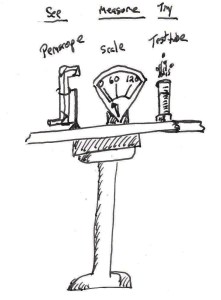
- See: this has to do with trying to get out of your own brain-pan and jumping into someone else’s life situation. Read more: How to Go Out of Your Mind
- Try: social media, in particular, rewards those who jump in and try stuff—all sorts of stuff. Trying stuff is a way of learning what your audience will listen to, and will respond to, along with understanding the limits of their attention. Yes there are some best practices and some favored tools, but social media is in constant motion.
- Measure: The goal really is to move the needle, that is, to get a response. Hits, page views—so many of these numbers are really only incidental to engagement. Real engagement looks like a comment or a share or some other solid action in the world. This is debatable, of course, and varies by audience and objective. But social media opens a window to see just what effect our words and ideas can have. Which can also be terribly discouraging for a writer with a message to deliver.
- Passion: This is the surprise for students, that they can channel a passion about a topic or tool or process into a project for a client. Many think passion and inspiration are ingredients only safely stirred into their own poetry or short stories. It turns out the more you run on inspiration, the more you run with inspiration.

“Inspiration” by Richard Bledsoe
Richard Bledsoe’s interpretation of “Inspiration” is completely right: there is often a point where the idea carries the writer forward, eyes bulging, wishing only to stop.
###
Dumb Sketch: Kirk Livingston
Image credit: “Inspiration” by Richard Bledsoe, used with permission
How to Go Out of Your Mind
Hint: It’s a crazy idea that just might work
Can you ever see from someone else’s point of view?
“No,” some say. We are entirely bound by our own way of seeing. All the world lays before us—all the friends and enemies and acquaintances and mobs, the institutions, the physical world, all the influences, everything that is, was and ever will be (amen)—all of which we perceive from our own vantage point. We fill our brain pan using our eyes, our ears, our sense of touch, our taste buds, our sense of smell.
It’s always me looking out at you.
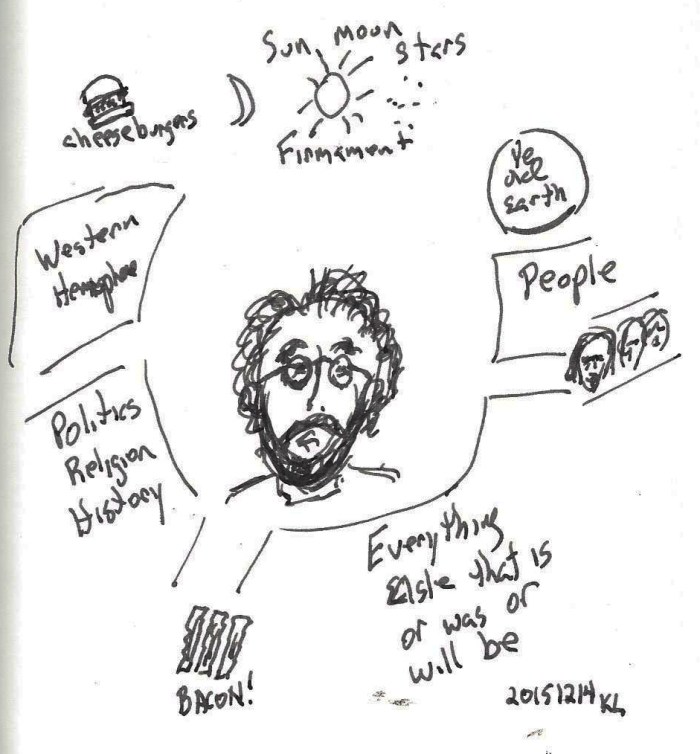
There are manufactured instances, though. Huge numbers have already bought Star Wars: The Force Awakens tickets for the very experience of looking out at a favorite world through JJ Abram’s eyes, who happens to be channeling George Lucas’ story-brain. We reread Harry Potter or Tom Sawyer for the joy of seeing from someone else’s perspective.
Stories get us close to seeing from someone else’s eyes.
A primary challenge in teaching copywriting to English students is asking them to see from someone else’s perspective. It’s an invitation to awaken the force (as it were) of caring about someone else’s issues and feeling the weight they feel. And though we see and feel imperfectly, it is enough to begin to engage our imagination. And it is precisely the imagination-engaged that produces satisfying, potentially useful copy that has a chance of meeting some human need.
I want to think that as we age, we become better able to see from someone else’s perspective. But my experience says otherwise: it is all too easy to let my world close in to include only what impacts me directly.
Hard work, it is, to begin to see from someone else’s perspective.
And good work.
###
Dumb Sketch: Kirk Livingston
The State of Conversation is Strong
Despite the stupid stuff we keep saying
My fellow humans, the state of our conversation is strong—though “strong” may not the first word that comes to mind.

I’ve spent the last few weeks in a funk. Given Trump’s call for banning Muslim entry into the U.S, and Franklin Graham’s approval of that plan (never mind that Graham’s inherited salvation-industry hinges on reaching out to the very people he wants to ban, which is bad for his business model); and given Jerry Falwell Jr.’s call to arm his student body; and given what seems to be tacit agreement with these lunacies by a too-large percentage of my nation’s population, it seems the voices calling us to act on fear are winning.
But here are two hopeful signs:
- A poll out today suggests that the majority of Americans do not agree with Trump’s fear-mongering.
- An open letter from Wheaton College students to Jerry Falwell Jr. rejecting his strange twist on Christianity and reminding him that the religion he espouses has little in common with the hostility he voices.
Beyond those signs, the inflammatory rhetoric flying about can at times serve to stimulate solid conversation. For me those conversations have come out of a pit of despair, but they can still be productive. Just saying aloud what we really think can be like draining the pus from a wound: ugly but necessary. Maybe our conversations can start a long-term suturing that can help us heal. But we’ll need to listen to each other and not respond out of our instinctual fear.
All this fear-rhetoric is pivoting me away from the rabid voices and back toward seeking conversations with people who are different. At our best we welcome people even as we trust. We start by engaging in conversation.
Fie on the fear-mongerers.
###
Image credit: Kirk Livingston
Tag:
From “You Suck” to “Say More”
Advance Your Conversations by Providing Wee Bits of Pivot

My client has a big agenda for her healthcare organization: she wants her colleagues to reconsider how they purchase their millions of dollars of medical equipment every year. As we talked we realized there are a set of steps her colleagues take to see things differently. Every conversation can be a step, bringing in information, yes, but more importantly, bringing in emotional connection, along with wee bits of pivot. She needed to provide the right information at the right time at the proper emotional setting.
That’s because we use rational thought to change our minds. But changing our minds is also an emotional activity. Reason and emotion together help us see and do things differently.
If you are convinced you are right about something—and most of us are dogmatic by default on dozens of topics—then you state your opinion flat out and your conversation partner is forced into a binary response:
- “Yes—I agree. You and I, we are brothers.” or,
- “No. You suck and now I hate you forever.”
But if we dial dogmatic back a notch and consider that another opinion may help us, we are poised to deliver words with wiggle, words that help us move forward in a conversation. What we say next allows us to bring more information along with our own emotional force. And even if we don’t persuade someone of our opinion, we’ve had a conversation where we’ve learned something.
And that is significant.
We need a lot of wee bits of pivot just now. Conversations about race, about policing, about religion, about politics—all of these are ripe areas for letting go of the dogmatism that leads to binary thinking.
Can’t we all just have better conversations?
###
Image credit: Kirk Livingston
Cemetery Graffiti
That’s just not right.
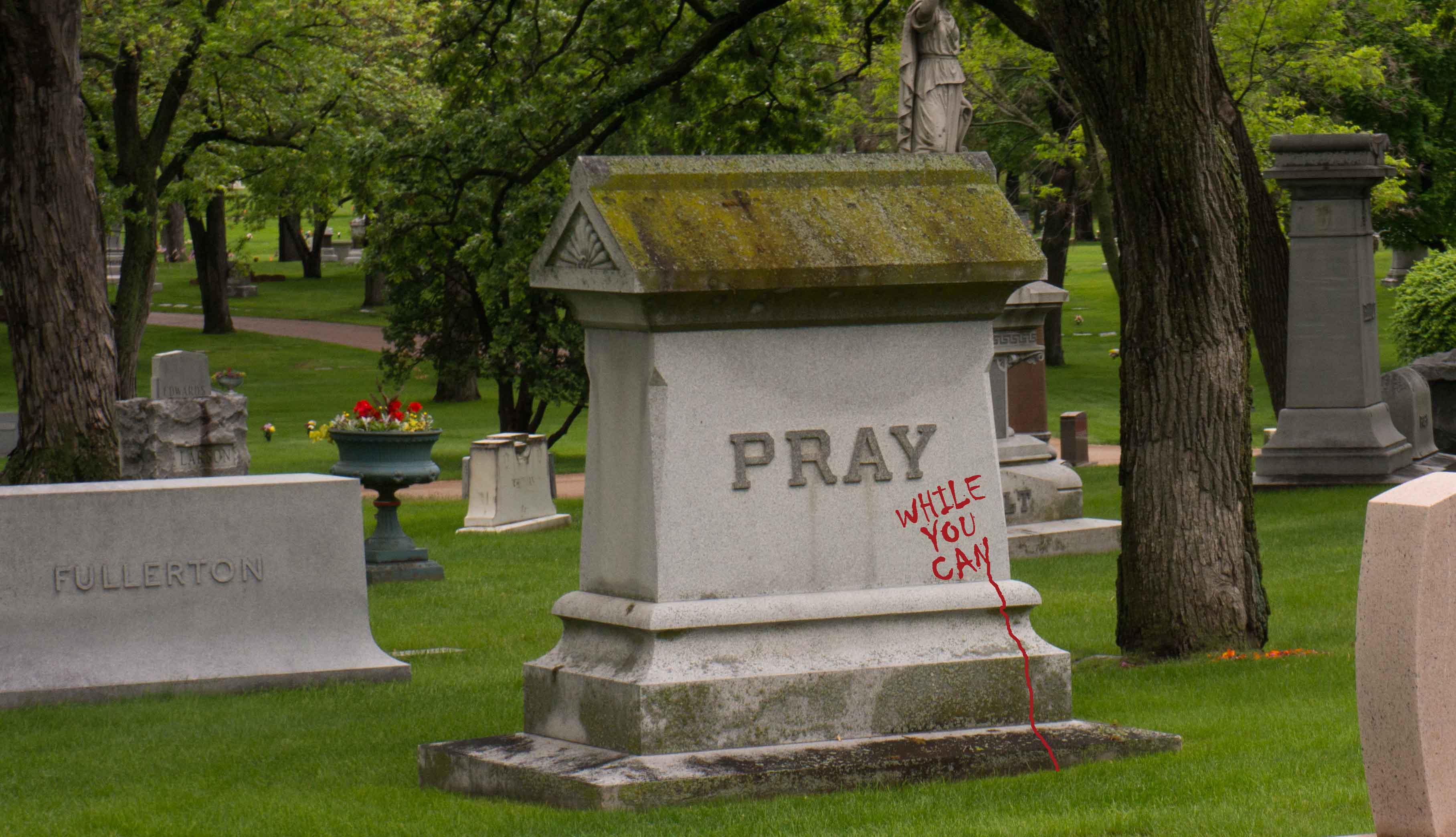
Or is it?
###
Image Credit: Kirk Livingston
DBT: When Does Talk Become Therapy? (Shop Talk #9)
Can a conversation save your life?
I recently met a therapist who practices dialectical behavior therapy (DBT). She and her team work with clients who may struggle with a number of issues including borderline personality disorders and thoughts of suicide, among other things. As we talked it seemed to me that her practice was very much focused on, well, talking. Her practice of therapeutic talk has a pretty good track record of helping people find ways through each scary personal wilderness.
In Doing Dialectical Behavior Therapy: A Practical Guide (NY: The Guilford Press, 2012), Kelly Koerner describes some pieces of how this therapy works:
Emotion dysregulation is the inability, despite one’s best efforts, to change or regulate emotional cues, experiences, actions, verbal responses, and/or nonverbal expression under normative conditions.
Gaining control is a matter of recognizing biologically-based contributing characteristics, focused regular therapeutic conversations, skills training, self-monitoring and a host of other strategies and tactics.

As a non-therapist outsider, I am simply curious as to how far conversation can go to help people become well again. And I am very curious as to what a therapeutic conversation looks like. While we may or may not suffer the particular illnesses that Koerner notes, I am reasonably certain anyone reading this can testify to the clarifying power of a conversation with a good friend and the long-term impact conversations have on keeping us…sane.
In ListenTalk: Is conversation an Act of God? I try to show what happens in our simple and ordinary conversations. I found a few philosophers to talk with some ancient texts (pre-order ListenTalk here), and what they ended up saying together continues to surprise me. It’s a book that will be interesting to people of faith, but the big idea is that since people matter, our talk together matters. And more than that, we actually come alive in tiny ways when in conversation.
I’ve begun tracing the different paths where conversation is truly an engine for some particular outcome. I’ve noted the product place of conversation in many business settings. I’ve wondered about the role of conversation in connecting any/all of us to God. And now here is another example of using the ordinary tool of talk to uncover and possibly address deep-seated need.
Talk. It’s a marvel.
Other Shop Talks you may find interesting:
- Writing with Sheet Metal (Shop Talk #2)
- Is Your Job Fulfilling? (Shop Talk #3)
- Power Distance Vs. Skunkworks (Shop Talk #8)
###
Image credit: Kirk Livingston
I completely disagree. Are we still friends?
How a small group helps you listen better
Say you are in a small group. Maybe you are part of a knitting guild. Maybe a book club. Maybe you meet every two weeks to study ancient texts together.
Your group comes together for some specific purpose, but along the way you make friends with these people. Sometimes these people agree with your opinion. Sometimes they disagree. But you listen to them anyway—even when you disagree. They listen/you listen because of friendship.

Tell me: how do you see it?
A few days back I wrote about a group we are part of where membership is shrinking. The take-away was that it only takes one or two people to have a conversation that is stimulating and even eye-opening, and possibly life-changing (if only incrementally). This has to do with the mechanism of hearing opinions and insights that are different from mine and stopping to consider them—because of friendship. Hearing from others is a beginning step away from the echo chambers we increasingly build for ourselves with media that says only what we want to hear.
Making friends who think and believe differently seems like a good idea. And engaging them in conversation about stuff that matters—that seems like a really good idea.
I wish we had a will to do more of that.
###
Image credit: Kirk Livingston
So. We all agree.
What does collaboration look like to you?
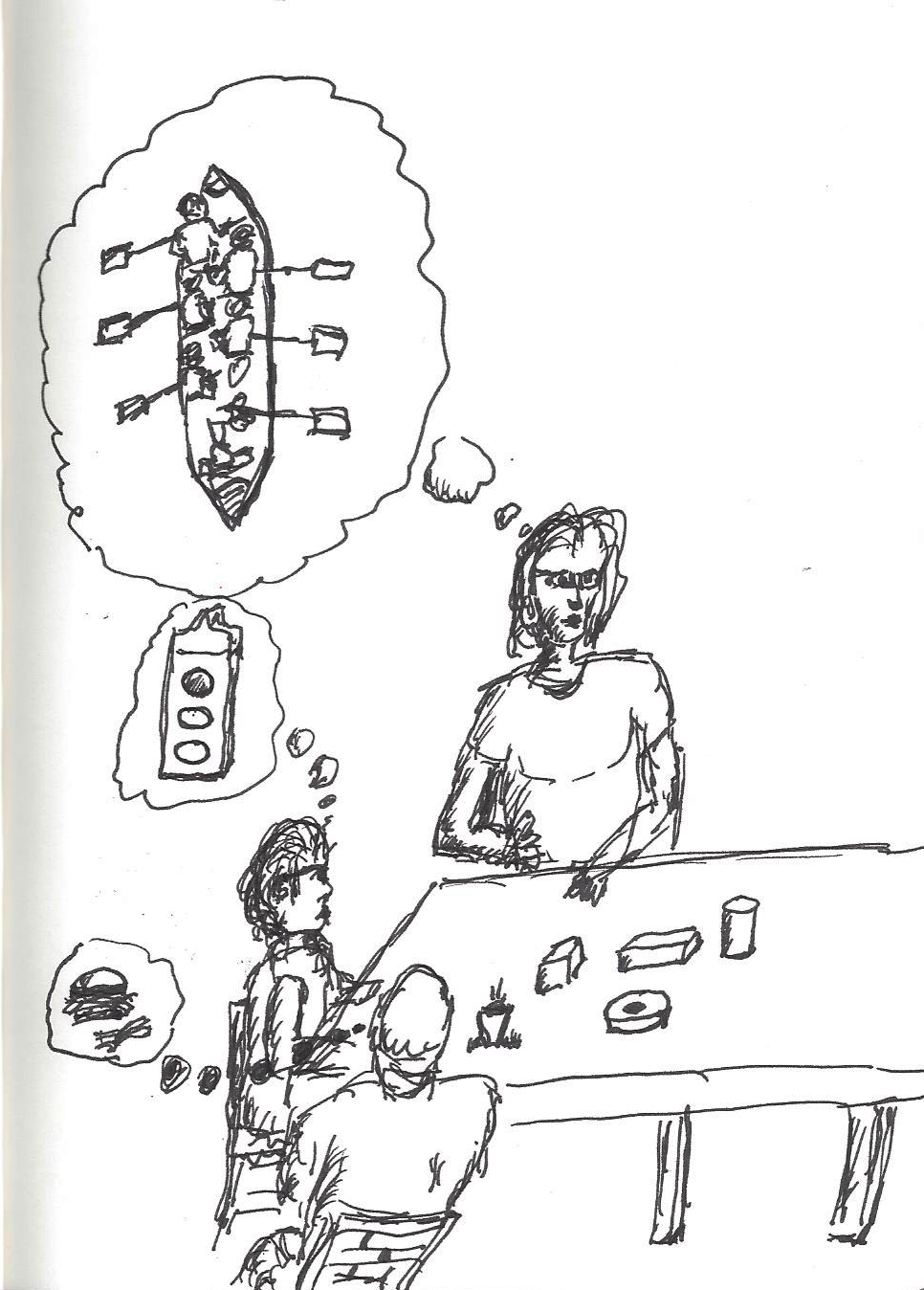
We’re having the same thought, yes?
###
Dumb Sketch: Kirk Livingston
Jargon: Just Say No. (DGtC #28)
Make a human happy—speak to be understood
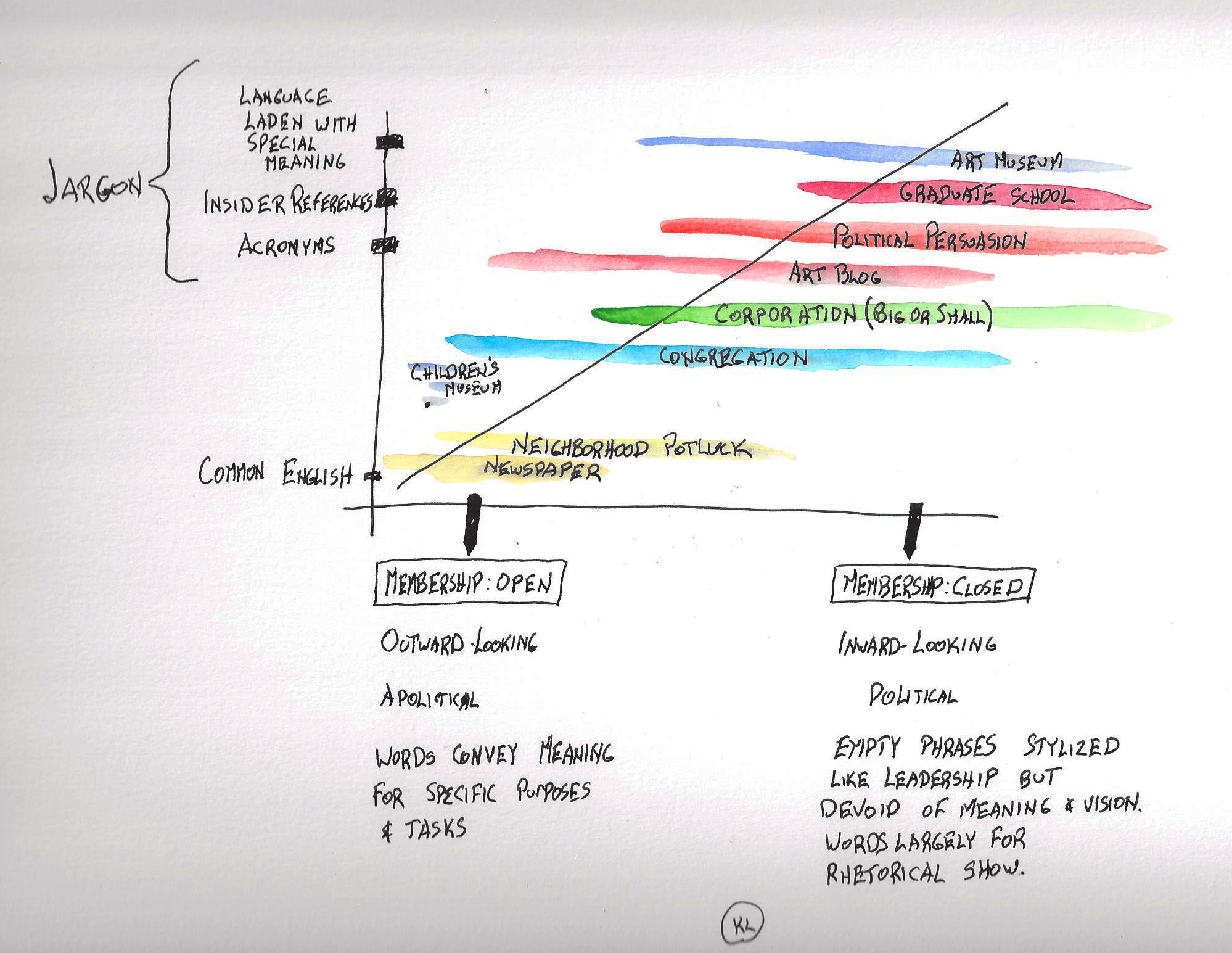
No matter what organization you are in, there are choices to be made about how you talk with the people around you. No matter what gathering you attend, you speak to communicate or you speak to impress.
We’re never rid of rhetorical flourish and persuasive intent, but can we at least work at speaking to be understood?
You don’t have to be obscure, you know—choose your own space on the continuum.
###
Dumb Sketch: Kirk Livingston
If you say a dumb sketch, will others pay attention?
Engineers aren’t the only ones who love to correct you
I’ve been repeating myself recently to different people and groups within my client’s shop.
I’ve been saying aloud the oral version of a dumb sketch. I’ve been telling and retelling the story of how I thought one thing but then in conversation with different experts, came to see what I thought was really not so at all, but something different. I know this is terribly abstract and I apologize: We’re working on a new proprietary idea at the moment, so I cannot be too specific.
I thought X was like Y. But it turns out that X is very like Z. And when I tell that story—of trying and failing and trying—my listeners get it. They learn something. They jump to Z and each gets pretty excited about Z—they had not seen Z before. But now that Z is named and out there, Z may just change everything (and not in a breathless marketing-hype way, but really change how people move forward in this particular industry) (Which I cannot name.) (Sorry.) Each mini-audience put the pieces together and then leaps forward in a way my didactic, linear, word-driven paragraphs did not succeed at.
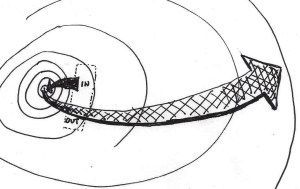 The point of a dumb sketch is to be not-finished. A sketch is the opposite of the heavily produced diagram or slide. The “unfinishedness” of a sketch is the very crux of usefulness as a communication tool. By being unfinished, the sketch invites collaboration and improvement. And people seem to not be able to turn away—at least from the oral version. Failure is built right into my story, and who can resist gawking at a car wreck?
Maybe this is an engine behind John Stepper’s notion of “working out loud.” Maybe this is a key to how we collaborate with each other. We already do this with friends and family, but what if we extend our try-fail-try circle to include many others?
###
Dumb sketches: Kirk Livingston

 conversation is an engine