Archive for the ‘Communication is about relationship’ Category
What is Engagement, Anyway?
Are Likes Helpful or Corrosive?
The college where I teach is something of a bride-and-groom factory. This [largely unstated] expectation of finding your soul-mate by the time you graduate lurks in the halls and hovers over tables in the cafeteria.
At least that’s what students tell me.
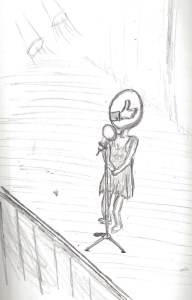
“You like me. You really like me.”
I’m sympathetic: there are few times like college for being surrounded by attractive folks of similar age who are also poised to make big life decisions. And, true, that’s where I ran into the beautiful young woman who a few years later became Mrs Kirkistan (lo these 30 years and counting).
In this particular college social construct, if you ask someone for a date, well, that’s kind of like a proposal. If you actually date, well, you might as well be married. To be fair, I’m not close enough to say if it this is entirely accurate. But my few talks with students make me kind of sad that relationships would be so, well. binary.
So it’s not surprising that these folks have an interesting skew on engagement. These are people who grew up with likes and short texts and public Facebook conversations. The quick word carries a lot of weight. For some, the quickness with which a like comes back speaks volumes to their self-esteem. It seems like engagement is an all or nothing deal and social media has the power to amplify that.
This social construct plays into expectations in my class. What do we expect when we think of engaging with the audiences we pursue? Are likes what we seek? Page views? Actual comments? Someone stopping you in the hallway? How does anyone determine if someone else is interested in what they say? Social media experts have all sorts of answers for this and all sorts of complicated metrics, some of which even make sense.
One thing is certain: grooming your personality and language for likes is dangerous. Just as it always has been. Of course we all do this to some extent. Who doesn’t want to be seen as attractive and groovy?
My hope for my class—and for anyone with courage to create anything—is that they create from an interiority that remains integrated and intact. That is: write and create from what drives your passion. Likes and page views are OK, but they should never substitute for your own sense of chasing the thing you simply must say. Yes, you’ll need to sort out how to get attention, but it is even more important to exercise your creativity along the lines you were made for.
In the end, likes may not be all that helpful.
###
Dumb Sketch: Kirk Livingston
Stuck and Reframe
Just How Real is Our Imagined Beginning?
I’m stuck on a client project. Late in 2015 I devised a social media communication strategy that calls for weekly themes. But one of my weekly themes provides very little fodder for producing content. And so I’ve been spinning my wheels and getting exactly nowhere.

Maybe it’s a good time to be stuck, because this is the season of reframing. Old things ended as 2015 shuffled out and new things began with the calendar change. Everything outside my window looks the same, but we’ve all group-thinked (group-thunk?) ourselves into what we call a new year. Is it an imagined new beginning? Of course. But that doesn’t make it any less real. Somehow that calendar change gives a bit of courage to consider releasing the strategies that don’t work.
Reframing—trying to see a problem or need differently—is a way out of stuckness. My tools for building a new frame around a client need or personal problem include words on pages and dumb sketches and mind-maps and fartleks and conversations. You already know that conversations hold quite a bit of promise: telling someone else about your stuckness has the effect of bringing to light a problem and beginning to find your way through it.
If you are of the tribe that makes resolutions, you also know that telling your resolution to someone can have a positive effect on keeping those resolutions. And you may even have someone who holds you accountable.
I’m stuck on a client project.
I’m going to talk with my client.
Staying stuck is not an option
###
Image credit: Kirk Livingston
Marcia Brady and ListenTalk and Learning in 2015
Even the Gray and White Outside Points In
 Surely you notice all the 2015 retrospectives: photography, music, film, advertising. Every industry has some writer summing the year into the ten best. These waning days lend themselves to a bit of reflection.
2015 was a year for trying things. Today I’ll produce my 365th dumb sketch—a sketch a day since January 1, 2015. Did I produce art? Not a single time. But I did learn to see shadow and light and the crazy, limitless variation in the people around me.  I did learn that very few lines exist out in the physical world and that Marcia Brady can look like the Joker when drawn spectacularly wrong.
From publishing ListenTalk: Is Conversation an Act of God? I learned that I need to simplify my argument for listening to each other. In fact, the mystery and promise of conversation has taken hold of me so that I am listening to conversations in a new way. I continue  to wonder what might happen if people at work listened to each other more closely. I continue to hope my nation can learn to listen to people outside our tribe rather than label and dismiss them. I suspect conversation is an engine will continue to sketch out the parameters of useful conversation in 2016.
Outside my window are variations on gray and white. Gray sky. White snow. Dark gray  branches thrusting up toward blue-gray clouds. Lighter gray shadow on snowy edges. It’s the perfect climate for asking about the fruit of a year’s worth of effort.
How about you? What’s got your attention as 2015 melts into the gray?
###
Dumb sketches: Kirk Livingston
When Hoax-Busters Give Up
And so we descend into irrationality
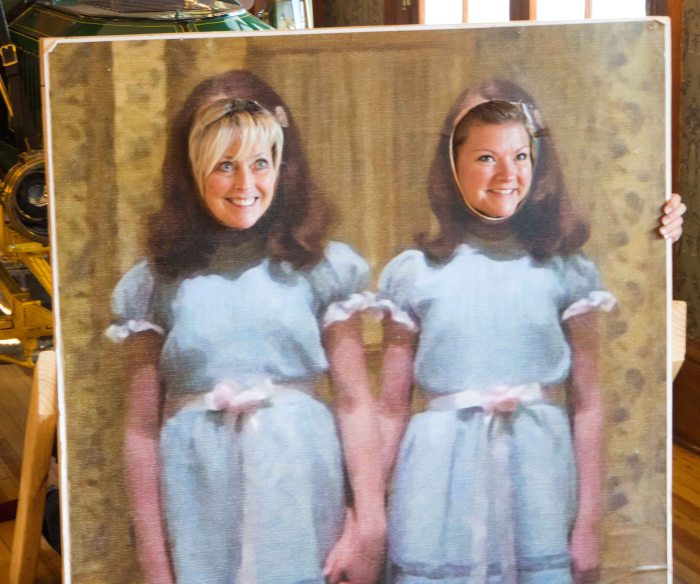
Our Bright Shining Future
The end of the Washington Post’s “What was Fake” column had the writer quoting academic Walter Quattrociocchi, head of the Laboratory of Computational Social Science at IMT Lucca in Italy:
Essentially, he explained, institutional distrust is so high right now, and cognitive bias so strong always, that the people who fall for hoax news stories are frequently only interested in consuming information that conforms with their views — even when it’s demonstrably fake.
The entire last article is worth reading: What was fake on the Internet this week: Why this is the final column.
To sum up this moment: we read what agrees with our viewpoint, we talk with people in our tribe who agree with us, we label those who disagree with us and we generally see facts as “facts.”
This moment does not represent the future I hoped for.
###
Image credit: Kirk Livingston
4 Ways to Bring Creativity to Work
Hint: Creativity is not easily contained
I’ve been reworking priorities for the social media marketing and copywriting classes I start teach again in January. If these are like previous classes (I’ve not yet looked at the rosters), there will be quite a few English majors, juniors and seniors, many of which will be excellent writers. I teach the class in a sort of writing-forward way: we use writing as our primary tool for sorting client brand problems and opportunities. But over the last few years, the copywriting class has morphed from a focus on “copywriter” to “idea writer,” which is a book by Teressa Iezzi that I’ve become very attached to. We use The Idea Writers as a text to help grow our understanding of our task.
My syllabus is mostly intact from last time I taught, but this time it I see four areas where additional emphases are needed. These four areas make it difficult for a student to jump from writing papers for an English professor to writing copy in the world of commerce:
- See: this has to do with trying to get out of your own brain-pan and jumping into someone else’s life situation. Read more: How to Go Out of Your Mind
- Try: social media, in particular, rewards those who jump in and try stuff—all sorts of stuff. Trying stuff is a way of learning what your audience will listen to, and will respond to, along with understanding the limits of their attention. Yes there are some best practices and some favored tools, but social media is in constant motion.
- Measure: The goal really is to move the needle, that is, to get a response. Hits, page views—so many of these numbers are really only incidental to engagement. Real engagement looks like a comment or a share or some other solid action in the world. This is debatable, of course, and varies by audience and objective. But social media opens a window to see just what effect our words and ideas can have. Which can also be terribly discouraging for a writer with a message to deliver.
- Passion: This is the surprise for students, that they can channel a passion about a topic or tool or process into a project for a client. Many think passion and inspiration are ingredients only safely stirred into their own poetry or short stories. It turns out the more you run on inspiration, the more you run with inspiration.

“Inspiration” by Richard Bledsoe
Richard Bledsoe’s interpretation of “Inspiration” is completely right: there is often a point where the idea carries the writer forward, eyes bulging, wishing only to stop.
###
Dumb Sketch: Kirk Livingston
Image credit: “Inspiration” by Richard Bledsoe, used with permission
How to Go Out of Your Mind
Hint: It’s a crazy idea that just might work
Can you ever see from someone else’s point of view?
“No,” some say. We are entirely bound by our own way of seeing. All the world lays before us—all the friends and enemies and acquaintances and mobs, the institutions, the physical world, all the influences, everything that is, was and ever will be (amen)—all of which we perceive from our own vantage point. We fill our brain pan using our eyes, our ears, our sense of touch, our taste buds, our sense of smell.
It’s always me looking out at you.
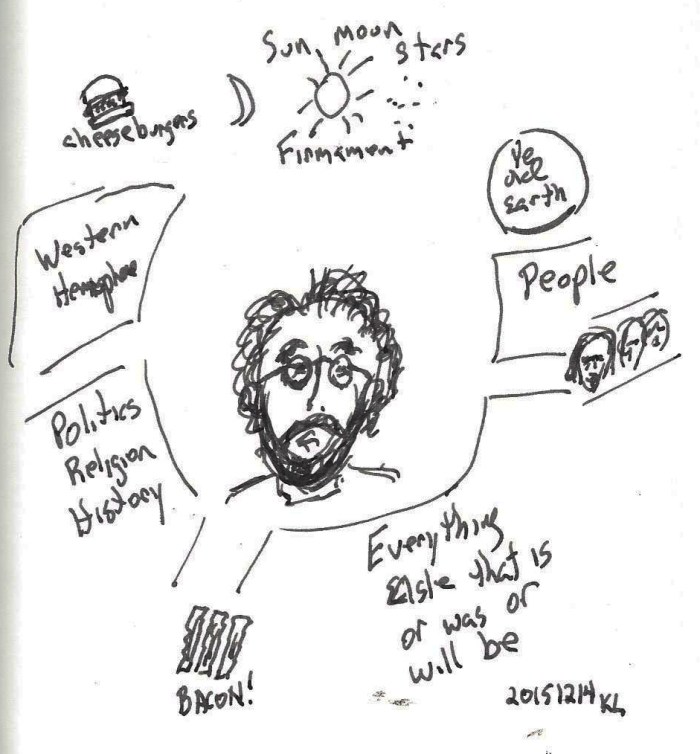
There are manufactured instances, though. Huge numbers have already bought Star Wars: The Force Awakens tickets for the very experience of looking out at a favorite world through JJ Abram’s eyes, who happens to be channeling George Lucas’ story-brain. We reread Harry Potter or Tom Sawyer for the joy of seeing from someone else’s perspective.
Stories get us close to seeing from someone else’s eyes.
A primary challenge in teaching copywriting to English students is asking them to see from someone else’s perspective. It’s an invitation to awaken the force (as it were) of caring about someone else’s issues and feeling the weight they feel. And though we see and feel imperfectly, it is enough to begin to engage our imagination. And it is precisely the imagination-engaged that produces satisfying, potentially useful copy that has a chance of meeting some human need.
I want to think that as we age, we become better able to see from someone else’s perspective. But my experience says otherwise: it is all too easy to let my world close in to include only what impacts me directly.
Hard work, it is, to begin to see from someone else’s perspective.
And good work.
###
Dumb Sketch: Kirk Livingston
The State of Conversation is Strong
Despite the stupid stuff we keep saying
My fellow humans, the state of our conversation is strong—though “strong” may not the first word that comes to mind.

I’ve spent the last few weeks in a funk. Given Trump’s call for banning Muslim entry into the U.S, and Franklin Graham’s approval of that plan (never mind that Graham’s inherited salvation-industry hinges on reaching out to the very people he wants to ban, which is bad for his business model); and given Jerry Falwell Jr.’s call to arm his student body; and given what seems to be tacit agreement with these lunacies by a too-large percentage of my nation’s population, it seems the voices calling us to act on fear are winning.
But here are two hopeful signs:
- A poll out today suggests that the majority of Americans do not agree with Trump’s fear-mongering.
- An open letter from Wheaton College students to Jerry Falwell Jr. rejecting his strange twist on Christianity and reminding him that the religion he espouses has little in common with the hostility he voices.
Beyond those signs, the inflammatory rhetoric flying about can at times serve to stimulate solid conversation. For me those conversations have come out of a pit of despair, but they can still be productive. Just saying aloud what we really think can be like draining the pus from a wound: ugly but necessary. Maybe our conversations can start a long-term suturing that can help us heal. But we’ll need to listen to each other and not respond out of our instinctual fear.
All this fear-rhetoric is pivoting me away from the rabid voices and back toward seeking conversations with people who are different. At our best we welcome people even as we trust. We start by engaging in conversation.
Fie on the fear-mongerers.
###
Image credit: Kirk Livingston
Tag:
From “You Suck” to “Say More”
Advance Your Conversations by Providing Wee Bits of Pivot

My client has a big agenda for her healthcare organization: she wants her colleagues to reconsider how they purchase their millions of dollars of medical equipment every year. As we talked we realized there are a set of steps her colleagues take to see things differently. Every conversation can be a step, bringing in information, yes, but more importantly, bringing in emotional connection, along with wee bits of pivot. She needed to provide the right information at the right time at the proper emotional setting.
That’s because we use rational thought to change our minds. But changing our minds is also an emotional activity. Reason and emotion together help us see and do things differently.
If you are convinced you are right about something—and most of us are dogmatic by default on dozens of topics—then you state your opinion flat out and your conversation partner is forced into a binary response:
- “Yes—I agree. You and I, we are brothers.” or,
- “No. You suck and now I hate you forever.”
But if we dial dogmatic back a notch and consider that another opinion may help us, we are poised to deliver words with wiggle, words that help us move forward in a conversation. What we say next allows us to bring more information along with our own emotional force. And even if we don’t persuade someone of our opinion, we’ve had a conversation where we’ve learned something.
And that is significant.
We need a lot of wee bits of pivot just now. Conversations about race, about policing, about religion, about politics—all of these are ripe areas for letting go of the dogmatism that leads to binary thinking.
Can’t we all just have better conversations?
###
Image credit: Kirk Livingston
Does Faith Make You Stupid?
Given current national examples, one wonders.
I want to say “No.”
As a person of faith, I want to think that trust in God does not make a person stupid. My own experience is that faith in God opens a world of possibility for thoughtful responses to life. Faith can be a platform for reading and testing and trying and understanding. Though more often faith is portrayed as a ridiculous intellectual straight-jacket; that half-truth is not the whole truth. I’m no historian, but I think I could find examples through history of people motivated by faith who moved us forward.

I get that lots of Christian churches don’t make a place for questions. I get that lots of people of faith don’t want to apply logic and reason to their scriptures and their faith, though logic and reason remain our primary tools for dealing with life on this planet.
I am also comfortable with the leaps of faith that defy logic—especially when we recognize when we are leaping. Still. Our leaps of faith must be informed by and grappling with and in tension with logic and reason. It cannot be otherwise and we cannot turn off one part of our brains and still expect to move forward. Knee-jerk, automatic responses, especially those that cater to our national fears, they simply don’t have a place in a thoughtful life. Automatic responses don’t help with seeking truth. Maybe it is the automatic responses and pat answers that make people of faith look stupid.
I resonate with Lynnell Mickelsen’s recent commentary about rigid, calcified thinking that stands as a barrier to forward movement. Mickelsen wrote of her fundamentalist upbringing and brought her experience to bear on current education hurdles. She was able to note that progress halts when we hold to a party line rather than continue to seek truth.
But…does faith make you stupid? Again: No. Some of the smartest people I know have a deep faith commitment. Accomplished people: physicians and professors and philosophers and writers and engineers and builders and mechanics and teachers and makers and organizers—all sorts of people. Smart, aware people. People who seek truth and have their listening-antennae raised quite high indeed.
Does faith make you stupid?
Not necessarily: but don’t look to the media (and especially the presidential race) for counter-examples.
###
Image credit: Kirk Livingston
Happily Ever After
Escape the orbit of your status quo stories
AnaLouise Keating names “status quo stories” as a chief culprit in reinforcing the same old binary direction choices we fall into day after day. In her book Teaching Transformation (NY: Palgrave Macmillan, 2007), she details the ways she helps students identify and reflect on all sorts of status quo stories—stories from racial identity to sexuality to our cherished pull-yourself-up-by-your- bootstraps, I-did-it-my-way tales. The stories we tell ourselves have a way of constructing the world we inhabit:
In various ways and to various degrees, we co-create the world we inhabit.
–AnaLouise Keating

These very stories serve as guiding lights for much of our lives because they signal the direction we should take. But over time the stories can also serve as a sort of tomb, if they go unexamined. Part of that has to do with the custom nature of humanity: we’re not all the same (it turns out) and so we’re not all going in the same direction. And by the way, mass-marketing is heaving its last gasps. So there is good reason to stop and examine the stories that drive us.
Under a microscope, some stories hold up and even blossom with new suggestions that point in solid directions. Others of those stories start to smell like the dead mouse under the stove: rank and yukko. For myself, when I reread Luke’s account of what Jesus actually said, it is full of life (precisely because he points at death, strangely). And then I wonder how faith-stories in the United States have wandered so far into power-hungry, money-hungry, empire-building waters.
Many faith stories from the last several decades stink to high heaven.
Once you start to identify status quo stories, you see them all over the place. And that’s a good thing, because each needs to be examined and given a green light or a red light. As I prepare for teaching writing students, I am on the lookout for new stories that will help them craft a useful writing life full of daily meaning-making.
###
Image credit: Kirk Livingston

 conversation is an engine