Archive for the ‘curiosities’ Category
When Hoax-Busters Give Up
And so we descend into irrationality
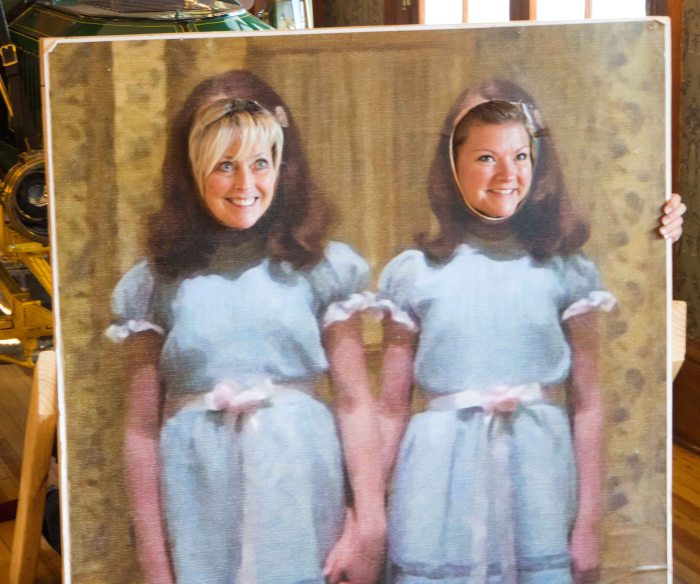
Our Bright Shining Future
The end of the Washington Post’s “What was Fake” column had the writer quoting academic Walter Quattrociocchi, head of the Laboratory of Computational Social Science at IMT Lucca in Italy:
Essentially, he explained, institutional distrust is so high right now, and cognitive bias so strong always, that the people who fall for hoax news stories are frequently only interested in consuming information that conforms with their views — even when it’s demonstrably fake.
The entire last article is worth reading: What was fake on the Internet this week: Why this is the final column.
To sum up this moment: we read what agrees with our viewpoint, we talk with people in our tribe who agree with us, we label those who disagree with us and we generally see facts as “facts.”
This moment does not represent the future I hoped for.
###
Image credit: Kirk Livingston
And Before You Were Born
What was life like then?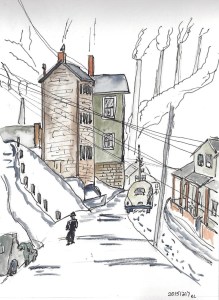
Before Instagram. Before Twitter. Before games on screens.
Back where your people came from.
Will you run into anyone who can answer that in the next week?
###
Dumb Sketch: Kirk Livingston
How to Go Out of Your Mind
Hint: It’s a crazy idea that just might work
Can you ever see from someone else’s point of view?
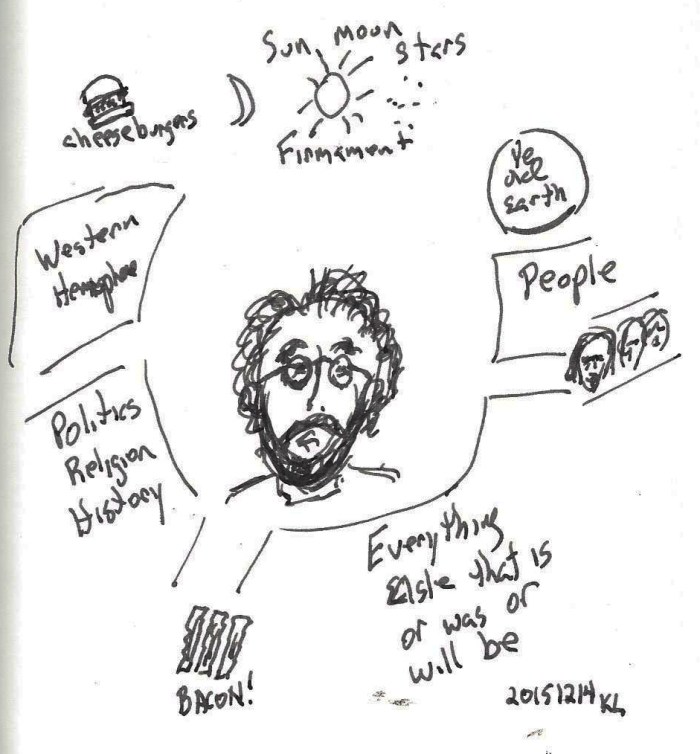
“No,” some say. We are entirely bound by our own way of seeing. All the world lays before us—all the friends and enemies and acquaintances and mobs, the institutions, the physical world, all the influences, everything that is, was and ever will be (amen)—all of which we perceive from our own vantage point. We fill our brain pan using our eyes, our ears, our sense of touch, our taste buds, our sense of smell.
It’s always me looking out at you.
There are manufactured instances, though. Huge numbers have already bought Star Wars: The Force Awakens tickets for the very experience of looking out at a favorite world through JJ Abram’s eyes, who happens to be channeling George Lucas’ story-brain. We reread Harry Potter or Tom Sawyer for the joy of seeing from someone else’s perspective.
Stories get us close to seeing from someone else’s eyes.
A primary challenge in teaching copywriting to English students is asking them to see from someone else’s perspective. It’s an invitation to awaken the force (as it were) of caring about someone else’s issues and feeling the weight they feel. And though we see and feel imperfectly, it is enough to begin to engage our imagination. And it is precisely the imagination-engaged that produces satisfying, potentially useful copy that has a chance of meeting some human need.
I want to think that as we age, we become better able to see from someone else’s perspective. But my experience says otherwise: it is all too easy to let my world close in to include only what impacts me directly.
Hard work, it is, to begin to see from someone else’s perspective.
And good work.
###
Dumb Sketch: Kirk Livingston
The Tiny Capital
Breaking from NaNoWriMo for four minutes because, well, you’ll see
###
Books are a uniquely portable magic
Kirkistan: What gives with your slow and sporadic posts?

Thanks for asking.
I’m thinking of my next book. It may be something related to the seven essential questions that shape our expectations about work and life. It may be something completely different. But I am consciously pulling back from daily posts so that I can invest a bit more time in these early stages of exploring what next. These explorations will likely look like blog posts.
Does that work for you?
###
Image credit: Kirk Livingston
Drill or Disperse?
Teachers Know: Why stop to tell what you are doing?
Researchers just want to research. Inborn curiosity drives that desire, though other incentives likely add to curiosity. The research is the key work and the satisfaction of curiosity is its own reward.
So why would anyone stop to tell about their research? Why not just keep at it? What reward is there in stopping? And if there is financial reward for research, there is even less reason to stop and talk about it.
I’m working on a few thought pieces with a client: small, pointed communication tools that paint a picture of a particular bit of knowledge they are expanding. These smart people have a particular niche and they want to let others know so they can move faster into collaboration with their customers and partners. But the people with the detailed smarts don’t want to stop to communicate because they are busy inventing and satisfying their curiosity. Plus, they are likely paid to invent, not to talk about their inventing.
In a smaller, less acute way, I feel the inventor’s pain. Writing ListenTalk opened new ground for me and answered questions I did not know enough to ask, even as it unearthed entirely new categories of questions. I’m not alone in this: writer friends and artist friends (and wood-working friends and welding friends and mechanic friends) just want to push forward with their projects. Why talk about it when you can do it? You may face this dilemma too: you don’t want to explain what you are doing. You just want to keep at it.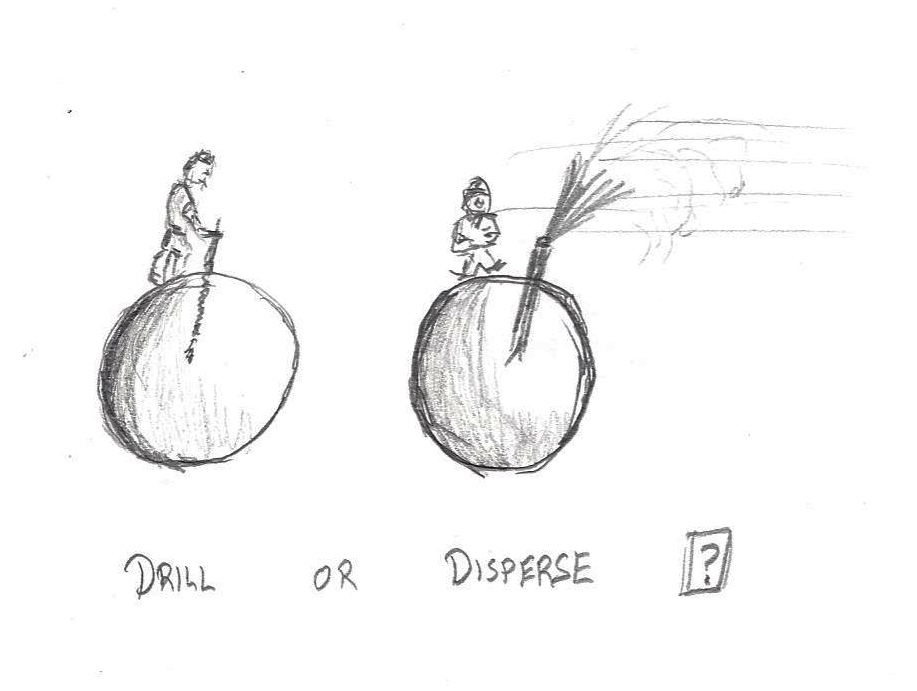
I get that.
But do we push forward in a slightly new way as we stop to tell others? I wonder. Teachers and professors understand this—especially those teachers and professors who are also practitioners of their art and craft. In stopping to explain, we suddenly realize some brand new thing. We realize something we would never have come up with on our own, sitting at our keyboard/bench/laboratory. It’s the interaction with another that stimulates that.
John Stepper gets this in his notion of Working Out Loud. Social media offers an opportunity for this. It turns out that customers and communities and friends and colleagues and collaborators—even academics—respond to sharing of insights.
What would happen today if you shared an insight or two with someone tuned in to that question? Not present. Not monologue. Not preach–just share it.
###
Image & Dumb Sketch credit: Kirk Livingston
That moment when you’ve realize you’ve been doing it wrong all these years
Father Jacob and Question #4: “Where Does My Ladder Lean?”
The blind old priest in rural Finland hired an ex-con to read his mail. Maybe she was a murderer. Maybe she was innocent. Whatever the case, she brought enough real-world cynicism to her reading job to sway the old man.
Letters came. People wanted help with this and that: Sickness. Poverty. Death Troubles with the law. More sickness. They wanted God-help and the priest’s duty or calling or reputation was that he prayed and stuff happened in the real world. So the ex-con read the letters and the priest prayed. Except the ex-con’s readings, which included critical questions for the priest, gradually exposed his shaky foundations.
What a fool I’ve been, all these years.
The Finnish film “Letters to Father Jacob” continues with a twist, but the question “How have I spent my life and what do I have to show for it?” is central to all that happens next.

What do you desire?
Seven critical questions help frame how we progress in our quest to balance work, art and economics in real life. One of those questions has to do with where we aim all our efforts: “Where does my ladder lean?” Common assumptions about work include the notion that you want the corner office and the big stock options that come with the high-octane positions. Of course you do: money and power are on everyone’s radar. Writers and artists want fame and money. Athletes want wins and fat contracts. Televangelists want souls with wallets. We all aim at something because that’s how we motivate ourselves.
It’s worth asking again and again what it is we are aiming at. At any point on the ladder it makes sense to stop and consider our end-goal. Especially because our work or art exacts a price from us. We’re used to the notion of the corporate executive who sacrifices family life and interpersonal relationships in his or her climb. But the craftsman or artist also pays a price: maybe relationships. But for certain the crafter or artist pays a price of looking at the world in a particular way. They move through the world with that bit of art or craft as a centerpiece—their own tool set for processing the world. Or perhaps the ladder is a ladder of faith and suddenly you wonder if it leans against, well, anything.
Anything at all.
This is not a rant against aggressive career movement. It is not a diatribe against capitalistic acquisition. It is a lament that there are not more Father Jacobs out there with an existential intelligence and a passion for listening and, well, seeking help for others. And maybe this is a plea for some to keep on seeking and to keep on waiting.
Perhaps there are unseen things worth desiring.
###
Image credit: Kirk Livingston

 conversation is an engine