Archive for the ‘Dumb Sketch’ Category
And Before You Were Born
What was life like then?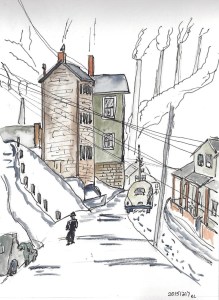
Before Instagram. Before Twitter. Before games on screens.
Back where your people came from.
Will you run into anyone who can answer that in the next week?
###
Dumb Sketch: Kirk Livingston
4 Ways to Bring Creativity to Work
Hint: Creativity is not easily contained
I’ve been reworking priorities for the social media marketing and copywriting classes I start teach again in January. If these are like previous classes (I’ve not yet looked at the rosters), there will be quite a few English majors, juniors and seniors, many of which will be excellent writers. I teach the class in a sort of writing-forward way: we use writing as our primary tool for sorting client brand problems and opportunities. But over the last few years, the copywriting class has morphed from a focus on “copywriter” to “idea writer,” which is a book by Teressa Iezzi that I’ve become very attached to. We use The Idea Writers as a text to help grow our understanding of our task.
My syllabus is mostly intact from last time I taught, but this time it I see four areas where additional emphases are needed. These four areas make it difficult for a student to jump from writing papers for an English professor to writing copy in the world of commerce: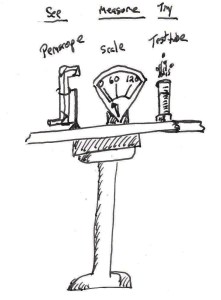
- See: this has to do with trying to get out of your own brain-pan and jumping into someone else’s life situation. Read more: How to Go Out of Your Mind
- Try: social media, in particular, rewards those who jump in and try stuff—all sorts of stuff. Trying stuff is a way of learning what your audience will listen to, and will respond to, along with understanding the limits of their attention. Yes there are some best practices and some favored tools, but social media is in constant motion.
- Measure: The goal really is to move the needle, that is, to get a response. Hits, page views—so many of these numbers are really only incidental to engagement. Real engagement looks like a comment or a share or some other solid action in the world. This is debatable, of course, and varies by audience and objective. But social media opens a window to see just what effect our words and ideas can have. Which can also be terribly discouraging for a writer with a message to deliver.
- Passion: This is the surprise for students, that they can channel a passion about a topic or tool or process into a project for a client. Many think passion and inspiration are ingredients only safely stirred into their own poetry or short stories. It turns out the more you run on inspiration, the more you run with inspiration.
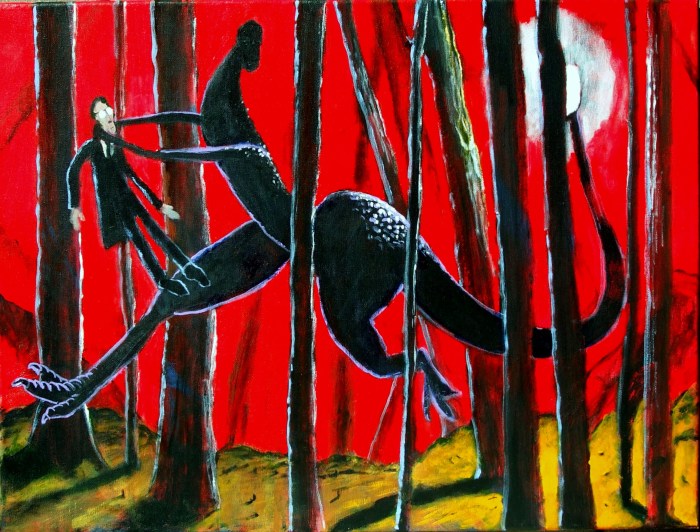
“Inspiration” by Richard Bledsoe
Richard Bledsoe’s interpretation of “Inspiration” is completely right: there is often a point where the idea carries the writer forward, eyes bulging, wishing only to stop.
###
Dumb Sketch: Kirk Livingston
Image credit: “Inspiration” by Richard Bledsoe, used with permission
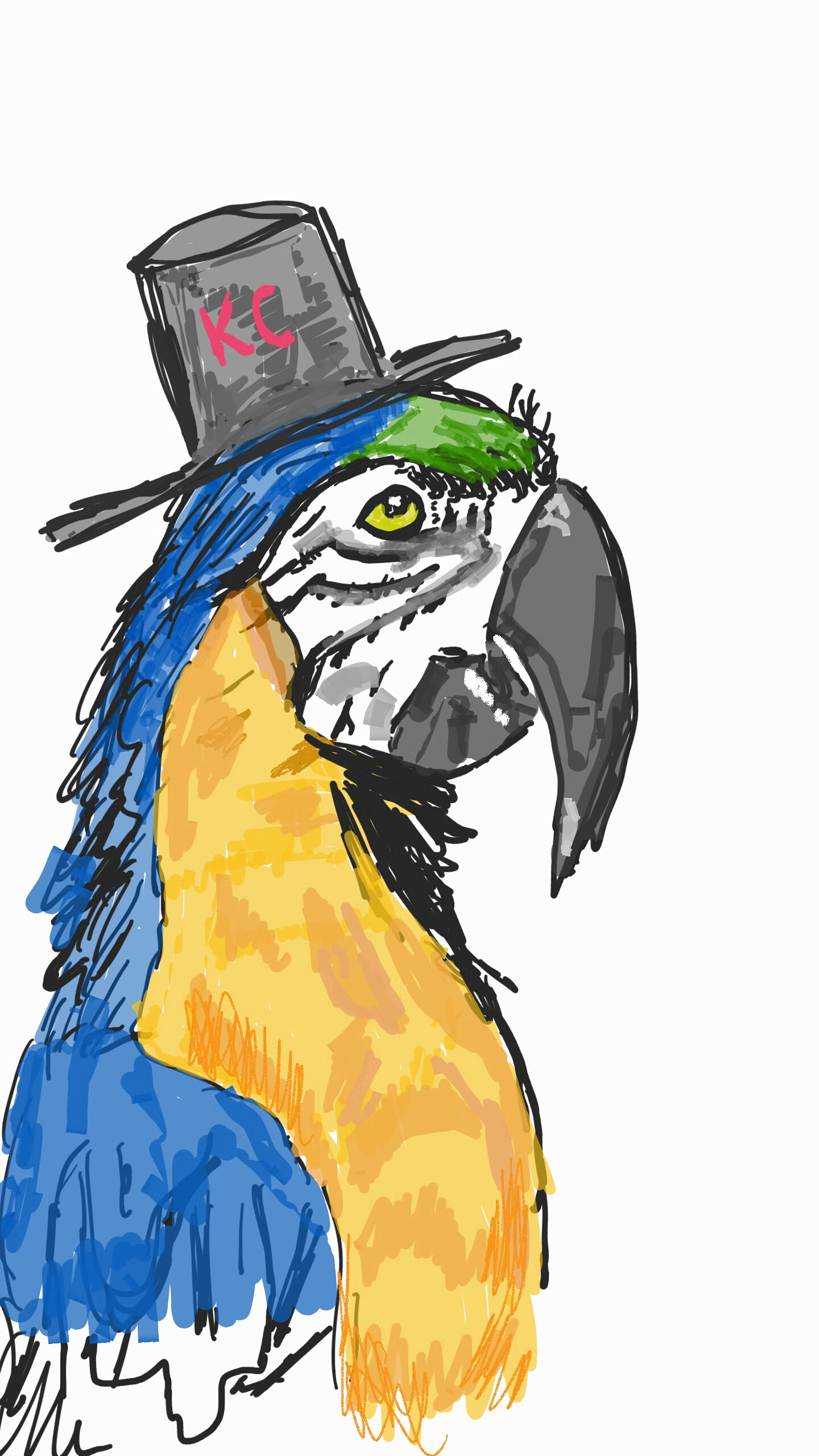
Macaw Redux–In the Style of Charlie the Doodlewasher–Only Better
Because of the Kansas City tophat, you see. That’s why “better.”
See Charlie’s quite exceptional original here.
Drill or Disperse?
Teachers Know: Why stop to tell what you are doing?
Researchers just want to research. Inborn curiosity drives that desire, though other incentives likely add to curiosity. The research is the key work and the satisfaction of curiosity is its own reward.

So why would anyone stop to tell about their research? Why not just keep at it? What reward is there in stopping? And if there is financial reward for research, there is even less reason to stop and talk about it.
I’m working on a few thought pieces with a client: small, pointed communication tools that paint a picture of a particular bit of knowledge they are expanding. These smart people have a particular niche and they want to let others know so they can move faster into collaboration with their customers and partners. But the people with the detailed smarts don’t want to stop to communicate because they are busy inventing and satisfying their curiosity. Plus, they are likely paid to invent, not to talk about their inventing.
In a smaller, less acute way, I feel the inventor’s pain. Writing ListenTalk opened new ground for me and answered questions I did not know enough to ask, even as it unearthed entirely new categories of questions. I’m not alone in this: writer friends and artist friends (and wood-working friends and welding friends and mechanic friends) just want to push forward with their projects. Why talk about it when you can do it? You may face this dilemma too: you don’t want to explain what you are doing. You just want to keep at it.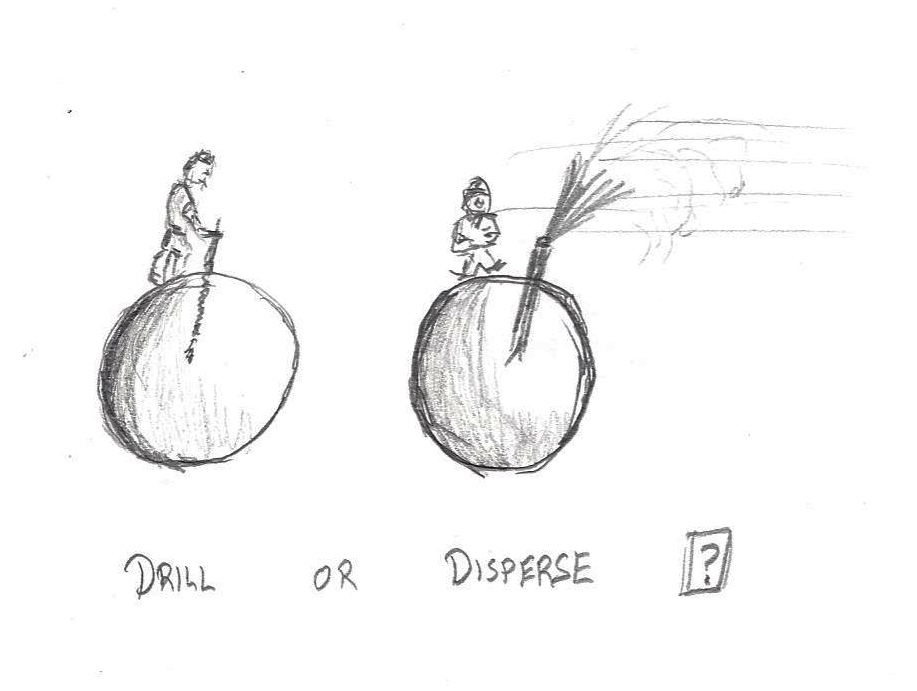
I get that.
But do we push forward in a slightly new way as we stop to tell others? I wonder. Teachers and professors understand this—especially those teachers and professors who are also practitioners of their art and craft. In stopping to explain, we suddenly realize some brand new thing. We realize something we would never have come up with on our own, sitting at our keyboard/bench/laboratory. It’s the interaction with another that stimulates that.
John Stepper gets this in his notion of Working Out Loud. Social media offers an opportunity for this. It turns out that customers and communities and friends and colleagues and collaborators—even academics—respond to sharing of insights.
What would happen today if you shared an insight or two with someone tuned in to that question? Not present. Not monologue. Not preach–just share it.
###
Image & Dumb Sketch credit: Kirk Livingston
7 Questions that Shape Your Art/Work Life
Please Write this Book: The Freelancer’s Attitude Kit
I’m working out new ways to present the freelance life to college writing students. They are interested in this independent life but not clear about all it entails. They wonder: is there more to it than sitting around in your underwear all day?

I’d like to present them with a textbook that answers these seven questions. Because these are seven questions that freelancers and other independents continually ask and occasionally even answer. These questions are useful for anyone trying to figure out the relationships between work, craft, art and employment.
- How do I balance art, craft and economics? Is it even possible? Because there is stuff I want to do that has no audience. There is stuff I’m less interested in that has a larger audience. And there is stuff I can do to pay the bills, which frankly doesn’t engage me much. I feel less fulfilled when I do that third category of stuff. Then again, I feel pretty fulfilled when I cash the check from that third category. Part of the answer has to do with what your time in life allows. Part of the answer has to do with the economic choices you make.
- Is it me or is it you? What does it mean to care for others with my work? Is it possible to use my art or craft or skill to truly look after the needs of another—or perhaps to look after the needs of an organization? One point I’ve made repeatedly to students is that while introspection is one way to sort out who you are—and our creative lore pegs introspection as the main work of writers and artists—there is another way. And that way is finding places and people to work alongside and, well, serve. Sometimes we begin to sort out who we are as we seek to help others. Sometimes our collaborator and our collaborative processes reveal more than we could ever sort when isolated at our desk or easel.
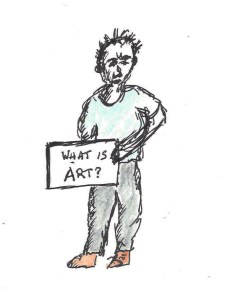
- What unseen forces are at work? I am a copywriter who also believes that God answers prayer. I am a copywriter who is also comfortable with artists who say the universe provides. My point is that the independent person has a better perspective when convinced there is more going on than what they can muster on their own. For example: every client I called last week said “No.” But then two new calls came in from completely unexpected sources. And these calls said “Yes.” Coincidence? Faith of one kind or another plays a role in this life—especially if a spouse/children/mortgage are part of the picture.
- Where does my ladder lean? Aiming for the approval of your boss is not bad, just limited. Bosses change—and sometimes very quickly. Better to climb toward a larger goal. In corporate life, we climb toward this position or that responsibility. In freelance, we climb toward this kind of project or that kind of project. Freelance does not have titles and offices that automatically designate how important you are. Are you ready for that? Freelance depends on intrinsic motivation—the stuff that bubbles out from inside. In fact—it turns out—that corporate life does too. The intrinsically-motivated colleagues are far and away the happiest, because they do the work out of willingness and mission. Just like freelancers.
- What do I look like, an entrepreneur? In fact you do, if you are someone who sees a need and starts to figure ways to meet that need. One textbook defines entrepreneur this way:

Entrepreneurship is the process of identifying opportunities for which marketable needs exist and assuming the risk of creating an organization to satisfy them.
–Hatten, Timothy S. Small Business Management, Entrepreneurship and Beyond (New York: Houghton Mifflin Company, 2003)
There is risk with the approach: you might fail. It might take a long, long time. This approach requires turning that intrinsic motivation into an engine that chugs along every single day. That can be exhausting, especially when met with a daily chorus of “No.”
- What’s sharing go to do with it? Today artists and writers and crafters and tribe members find each other online. Not exclusively, but frequently. Part of the independent life has to do with finding generous ways to talk about your passion. This is not shilling for work, this is giving away good stuff. Good stuff that people can use. It turns out that clients just might find you this way as well
- What if people knew how weird I was? That’s right, you are strange. Really strange. But everyone is. Freelance capitalizes on weird by you doing what you do in the way you do it. Freelance is the opposite of cookie-cutter. It is niche-building with much of your weirdness intact (not all, people will run from you).
That’s the book I want to use as a text. Some books I’ve read come close.
What questions shape your work life? Tell me if you’ve read this book.
###
Image and dumb sketch credit: Kirk Livingston
Go Find Yourself
Are you hiding in plain sight?
“Are you already doing who you are?”
That question barely makes sense.
Still, I like it because it combines process with self-identity and hints at motivation. To answer that question all you have to do is look at how you spend your day—and with whom—to begin to sort your priorities.
Matthew Crawford’s book The World Beyond Your Head: On becoming an individual in an age of distraction (NY: Farrar, Straus and Giroux, 2015) is not a quick read. But it is a satisfying text because he pulls back the draperies hiding some daily mysteries we live without thinking.
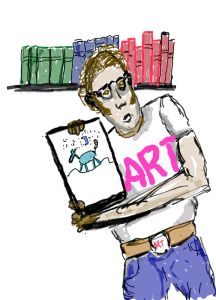
For instance, I found out I am an artist. Of sorts.
Like work.
Mr. Crawford, the philosopher/motorcycle mechanic dismantles the notion of work and rebuilds it around the cylinders of service and ability and passion. (Wait—only three cylinders? What sort of wimpy metaphor is that? Don’t blame Mr. Crawford—that’s just my take on it and I’m only ¾ of the way through the book.)
Mr. Crawford notes that we must submit to a discipline—this is important—to become useful and adept at that discipline. Sort of like knowing the rules well so that you can break them well:
- Mechanics must know the fundamentals of engines to work on them.
- Writers must know how to speel, and the must know a grammar, to right. Otherwise, misunderstood. Are they?
Mr. Crawford’s take on authority is powerfully counterintuitive: we submit to the authority of a discipline so we can work within the logic and expectations and outcomes of that discipline. Along the way, after practicing that discipline for a time, it turns out we come to understand life through the tools and foci that discipline affords.
This notion of authority is counterintuitive because we Americans like to speak ill of authority every chance we get. I may be chief among the ill-speakers. That needs to change (though, of course, speak truth to power, and so on).
Here’s the point: looking back over the disciplines we’ve come to use every day is a key to how we understand the world and how we process life. Some people understand life through their writing. Some people process life through their woodworking. Some through watercolor or costume design or clipping topiaries.
There is a link between who we are and what we do.
###
Dumb sketch: Kirk Livingston
Make mistakes as fast as possible
And get yourself a steadfast interlocutor
![As the crane slowly lowered the casket-laden truck into the hole, the widow leaned over and whispered “He loved that ’58 Chevy Suburban more than anything or anyone.” And then, quietly, “That should hold him.” [Excerpt from a short story in progress.]](https://conversationisanengine.space/wp-content/uploads/2015/07/widowsaid-2-07022015.jpg)
As the crane slowly lowered the casket-laden truck into the hole, the widow leaned over and whispered “He loved that ’58 Chevy Suburban more than anything or anyone.” And then, quietly, “That should hold him.” [Excerpt from a short story in progress.]
I am learning to make mistakes in more media. Yesterday I commented on some quick sketches by an artist in Quebec, how simple they were and how definitive.
“It’s easy,” she said. “Just sketch the people you see on TV.”
“Not so easy,” I replied. “I do that as well, but my sketches turn out fussy and juvenile. And ugly. And sometimes I despair at how bad they remain.”
“Well, I do 12 sketches before I get the one I really like.”
I found that encouraging because she is quite accomplished. And of course we all know this is true. One need only think on Philip Glass or Hemingway to gain a bit of perspective.
The more time we commit to the thing, the more mistakes we make, the more we progress. But mistakes are part of the process. As far as I can tell, making mistakes in pursuit of our passion is the only way forward.
###
Dumb Sketch: Kirk Livingston
“Dude looks like a lady.”
Is gender fluid?
Over at my public confessional (Dumb Sketch Daily) I did a drawing so bad that all my sketchy companions are ganging up. Well, OK, that’s an overstatement—they are uniformly kind and encouraging.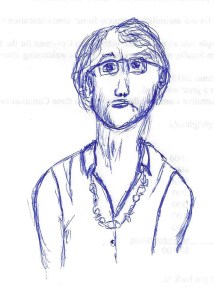
It was a quick sketch of a delightful woman sitting across from me at an evening meeting. But the sketch went haywire. In attempting shadow I accomplished a beard. She did not have a beard. She does not have a beard. Even at the time I recognized I had gone too far. So I made sure to sketch her necklace. But the critique of one artist still rings true:
Dude looks like a lady.
I agree with another sketchy commenter, that my unrealistic drawing is perhaps a “sign of the times.” Indeed, not a day goes by without a photo of the current Caitlyn Jenner/former Bruce Jenner and a story in the StarTribune or on MPR about another facet of transgender life.
Gender as something rather fluid is a relatively new thought for me, just as it is for a whole bunch of people. It’s an observation that creates an opportunity to go back and reread ancient texts and ask how I understand them. It’s also an opportunity for a whole series of (sorta uncomfortable) conversations. And the circle of topics included in those conversations gets wider and wider, taking in more ground. For starters: volumes of assumptions about gender, a reviewing of the binary nature of gender I had assumed for so long, questions about identity and self. It actually sounds like a fascinating discussion, if it weren’t all so awkward.
But this is another conversation we’re moving toward.
So gird your loins. Or not.
###
Dumb sketch: Kirk Livingston
Find Work Where You Can Draw Your Own Lines (Shop Talk #10)
Color inside your own lines
I’ve had several conversations lately with people looking for ways to bring writing into the rest of their lives. Some want to make a living as writers. Others want to flesh out a particular passion that been dormant behind the demands of their day job.

In each case I suggest drawing their own lines.
What I mean is to look for opportunities where you can define the problem yourself (or in collaboration with a few). When you define a problem yourself, you set the focus and you begin to take ownership. Then your brainpan starts spinning in a fresh orbit that lets you locate resources to help solve that problem. Defining the problem is a way of looking at the topic of your passion and finding what about it that excites you and where that might be a problem/solution for others. Inevitably you want to send your topic out so others can begin to care as well—or perhaps you send it out to find those other few who care.
Writing something is a way of drawing your own lines.
I know this from (literally) drawing lines of definition: over at Dumb Sketch Daily (currently at dumb sketch #152) I’ve been trying to learn to draw. I’ve found that an ink pen does a kind of definition work that my eye longs for. Sometimes I wonder if ink is a crutch: outlining before filling in detail with color or graphite. Do I really need those lines? But then I think
I don’t care.
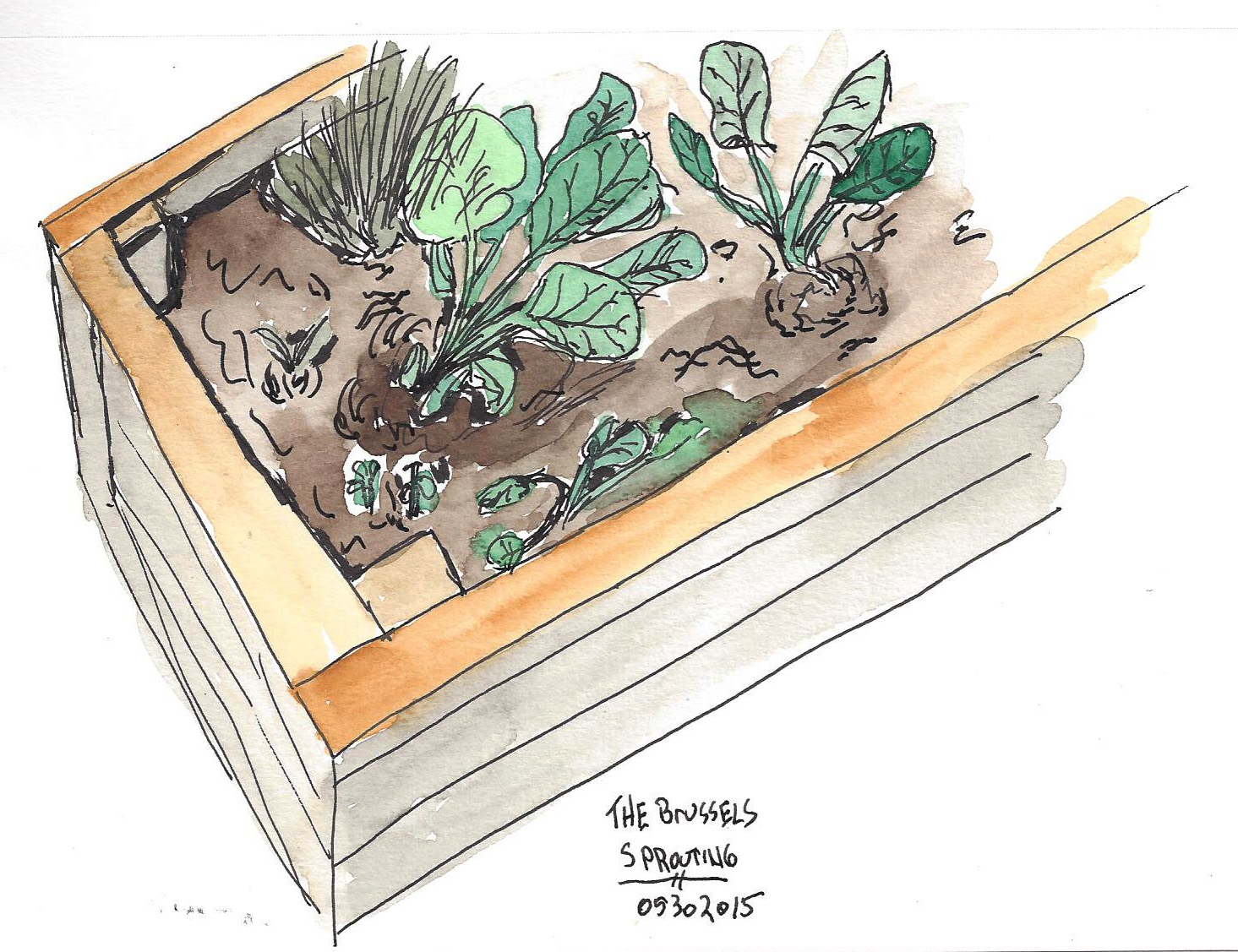
I’ve got your precious Brussels Sprouts right here.
Because there is something about the crisp line that yields a bit of loony joy. Yes, it is true, that line does not exist on the edge of my Brussels Sprouts. Not really.
Still.
Seeing something clearly feels worth that particular fiction.
What definition work will you do today?
Where will you draw lines?
###
Image credit: Kirk Livingston
Dumb sketch: Kirk Livingston
See also: “Can 78 bad sketches change your life?”
So. We all agree.
What does collaboration look like to you?
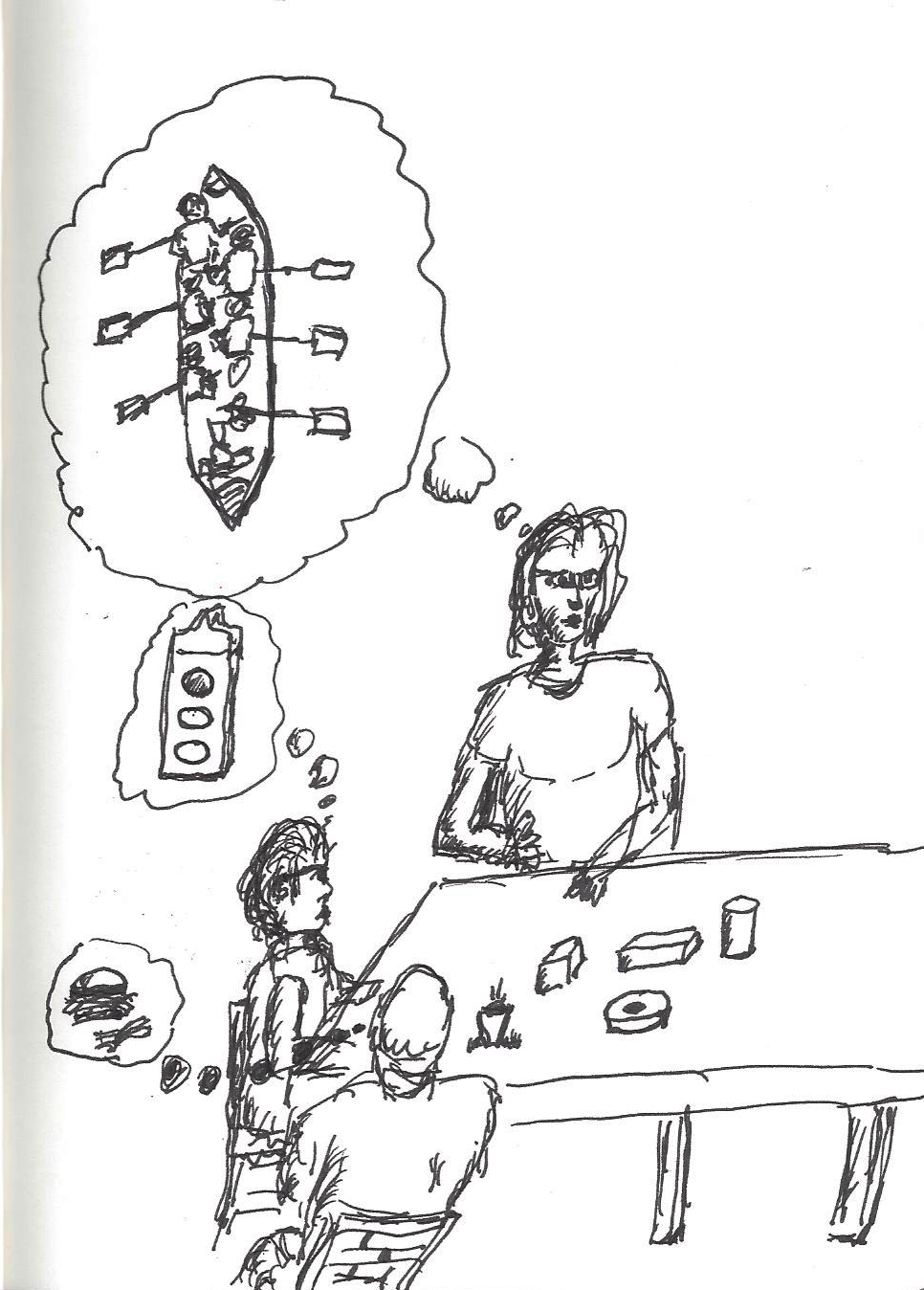
We’re having the same thought, yes?
###
Dumb Sketch: Kirk Livingston

 conversation is an engine